
州远程医疗政策对新诊断癌症患者远程医疗使用的影响。
Impact of state telehealth policies on telehealth use among patients with newly diagnosed cancer.
机构信息
Department of Surgery, Division of Surgical Oncology, Medical College of Wisconsin, Milwaukee, WI, USA.
Department of Health Services Research, The University of Texas MD Anderson Cancer Center, Houston, TX, USA.
出版信息
JNCI Cancer Spectr. 2023 Aug 31;7(5). doi: 10.1093/jncics/pkad072.
BACKGROUND
Telehealth restrictions were relaxed under the COVID-19 public health emergency. We examined telehealth use before and during the pandemic among patients with newly diagnosed cancers and the association between state policies and telehealth use.
METHODS
The study cohort was constructed from Optum's deidentified Clinformatics Data Mart and included patients with lymphoma, female breast cancer, colorectal cancer, prostate cancer, and lung cancer diagnosed between March 1, 2019, and March 31, 2021. We performed an interrupted time series analysis to examine the trend of cancer-related telehealth use within 1 month of diagnosis relative to the timing of the COVID-19 public health emergency and multivariable logistic regressions to examine factors-specifically, state parity laws and regulations on cross-state practice-associated with telehealth.
RESULTS
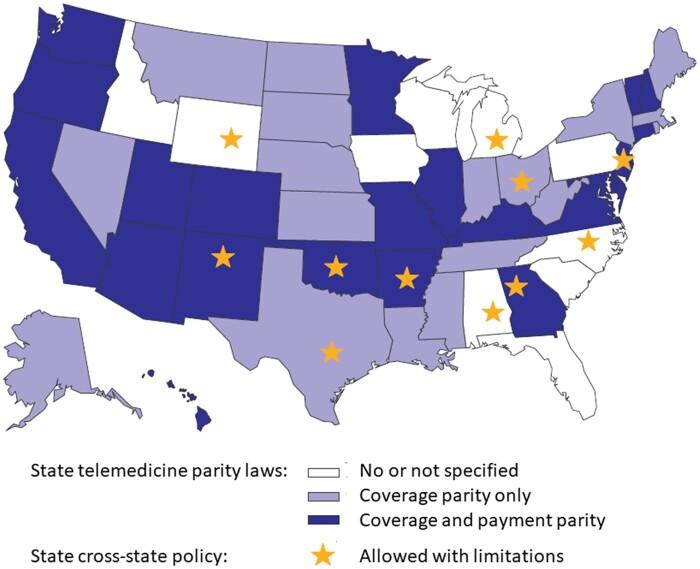
Of 110 461 patients, the rate of telehealth use peaked at 33.4% in April 2020, then decreased to 12% to 15% between September 2020 and March 2021. Among the 53 982 patients diagnosed since March 2020, telehealth use was statistically significantly lower for privately insured patients residing in states with coverage-only parity or no or unspecified parity than those in states with coverage and payment parity (adjusted rate = 20.2%, 19.1%, and 23.3%, respectively). The adjusted rate was lower for patients in states with cross-state telehealth policy limitations than for those in states without restrictions (14.9% vs 17.8%).
CONCLUSIONS
Telehealth use by patients diagnosed with cancer during the pandemic was higher among those living in states with more generous parity and less restrictive rules for cross-state practice. Policy makers contemplating whether to permanently relax certain telehealth policies must consider the impact on vulnerable patient populations who can benefit from telehealth.
背景
在 COVID-19 公共卫生紧急情况下,放宽了远程医疗限制。我们研究了大流行期间和之前新诊断癌症患者的远程医疗使用情况,以及州政策与远程医疗使用之间的关系。
方法
该研究队列来自 Optum 的匿名 Clinformatics Data Mart,包括 2019 年 3 月 1 日至 2021 年 3 月 31 日期间被诊断患有淋巴瘤、女性乳腺癌、结直肠癌、前列腺癌和肺癌的患者。我们进行了一项中断时间序列分析,以检查相对于 COVID-19 公共卫生紧急情况的时间,以及多变量逻辑回归来检查癌症相关远程医疗使用的趋势在诊断后 1 个月内与特定因素的关系,特别是州对等法规和跨州实践相关的远程医疗。
结果
在 110461 名患者中,远程医疗使用率在 2020 年 4 月达到 33.4%的峰值,然后在 2020 年 9 月至 2021 年 3 月之间降至 12%至 15%。在 2020 年 3 月以来被诊断出患有癌症的 53982 名患者中,私人保险患者居住在覆盖范围对等或无或未指定对等的州的远程医疗使用率明显低于居住在覆盖范围和支付对等的州的患者(调整后的比率分别为 20.2%、19.1%和 23.3%)。在有跨州远程医疗政策限制的州的患者的调整后的比率低于没有限制的州的患者(14.9%比 17.8%)。
结论
在大流行期间被诊断患有癌症的患者中,居住在对跨州实践更宽松的州的患者中远程医疗使用率更高。考虑是否永久放宽某些远程医疗政策的政策制定者必须考虑对可能受益于远程医疗的弱势患者群体的影响。


 Zotero 插件