
伏隔核连接在脑深部刺激中区分了行为失控与生理性行为状态。
Accumbens connectivity during deep-brain stimulation differentiates loss of control from physiologic behavioral states.
机构信息
Department of Neurosurgery, Perelman School of Medicine, University of Pennsylvania, Pennsylvania Hospital, Spruce Building 3rd Floor, 801 Spruce Street, Philadelphia, PA 19107, USA; Department of Surgery, Corporal Michael J. Crescenz Veterans Affairs Medical Center, 3900 Woodland Ave, Philadelphia, PA, USA; Department of Psychiatry and Behavioral Sciences, Stanford University School of Medicine, Stanford, CA 94304, USA.
Department of Neurosurgery, Perelman School of Medicine, University of Pennsylvania, Pennsylvania Hospital, Spruce Building 3rd Floor, 801 Spruce Street, Philadelphia, PA 19107, USA; Department of Surgery, Corporal Michael J. Crescenz Veterans Affairs Medical Center, 3900 Woodland Ave, Philadelphia, PA, USA; Department of Neurosurgery, Massachusetts General Hospital and Harvard Medical School, 55 Fruit St, Boston, MA 02114, USA.
出版信息
Brain Stimul. 2023 Sep-Oct;16(5):1384-1391. doi: 10.1016/j.brs.2023.09.010. Epub 2023 Sep 19.
BACKGROUND
Loss of control (LOC) eating, the subjective sense that one cannot control what or how much one eats, characterizes binge-eating behaviors pervasive in obesity and related eating disorders. Closed-loop deep-brain stimulation (DBS) for binge eating should predict LOC and trigger an appropriately timed intervention.
OBJECTIVE/HYPOTHESIS: This study aimed to identify a sensitive and specific biomarker to detect LOC onset for DBS. We hypothesized that changes in phase-locking value (PLV) predict the onset of LOC-associated cravings and distinguish them from potential confounding states.
METHODS
Using DBS data recorded from the nucleus accumbens (NAc) of two patients with binge eating disorder (BED) and severe obesity, we compared PLV between inter- and intra-hemispheric NAc subregions for three behavioral conditions: craving (associated with LOC eating), hunger (not associated with LOC), and sleep.
RESULTS
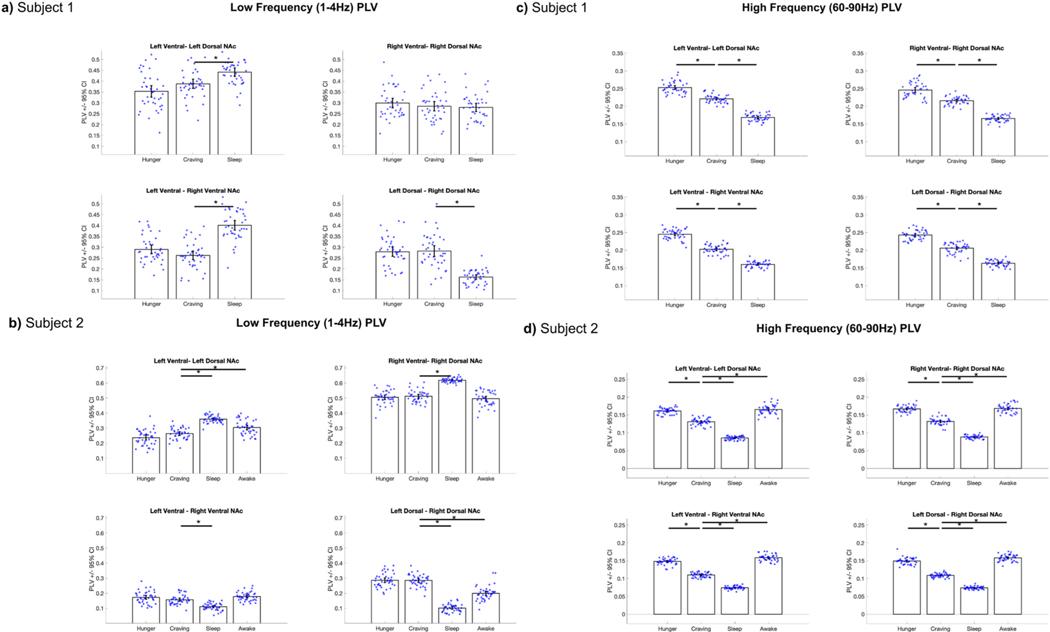
In both patients, PLV in the high gamma frequency band was significantly higher for craving compared to sleep and significantly higher for hunger compared to craving. Maximum likelihood classifiers achieved accuracies above 88% when differentiating between the three conditions.
CONCLUSIONS
High-frequency inter- and intra-hemispheric PLV in the NAc is a promising biomarker for closed-loop DBS that differentiates LOC-associated cravings from physiologic states such as hunger and sleep. Future trials should assess PLV as a LOC biomarker across a larger cohort and a wider patient population transdiagnostically.
背景
失控(LOC)进食是一种主观感觉,即无法控制自己吃什么或吃多少,这种感觉普遍存在于肥胖和相关饮食障碍中。针对暴食行为的闭环深部脑刺激(DBS)应该可以预测 LOC 并触发及时的干预。
目的/假设:本研究旨在确定一种敏感和特异的生物标志物,以检测 DBS 中的 LOC 发作。我们假设相位锁定值(PLV)的变化可以预测 LOC 相关渴望的发作,并将其与潜在的混杂状态区分开来。
方法
使用来自两名暴食障碍(BED)和严重肥胖患者的核仁_accumbens(NAc)的 DBS 数据,我们比较了三个行为条件(渴望(与 LOC 进食相关)、饥饿(与 LOC 无关)和睡眠)之间的半球间和半球内 NAc 亚区的 PLV。
结果
在两名患者中,与睡眠相比,渴望时的高伽马频带 PLV 显著升高,与渴望相比,饥饿时的 PLV 显著升高。当将三种情况区分开时,最大似然分类器的准确率超过 88%。
结论
NAc 中的高频半球间和半球内 PLV 是一种有前途的闭环 DBS 生物标志物,可将与 LOC 相关的渴望与饥饿和睡眠等生理状态区分开来。未来的试验应在更大的队列和更广泛的跨诊断患者人群中评估 PLV 作为 LOC 生物标志物。


 Zotero 插件