
代际支持在中国老年人口腔保健寻求行为中的作用。
The role of intergenerational support in shaping oral healthcare-seeking behavior among older adults in China.
机构信息
Department of Oral Implantology, The Affiliated Stomatological Hospital of Southwest Medical University, Luzhou, Sichuan, China.
Department of VIP Dental Service, The Affiliated Stomatological Hospital of Southwest Medical University, Luzhou, Sichuan, China.
出版信息
Front Public Health. 2023 Sep 4;11:1234539. doi: 10.3389/fpubh.2023.1234539. eCollection 2023.
BACKGROUND
This study aimed to explore how intergenerational support affects the oral healthcare or treatment-seeking behaviors of older Chinese adults and provide evidence for improving the oral health of the older adults in an aging society.
METHODS
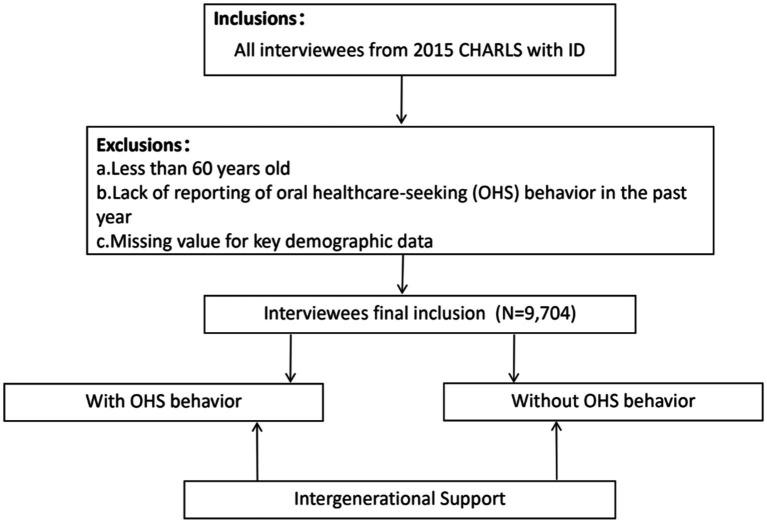
Data from a cross-sectional survey, the 2015 China Health and Retirement Longitudinal Study, were used to explore the relationship between oral healthcare-seeking behavior in older adults and various independent variables, such as marital status, number of children, offspring's education duration, parent-offspring interaction frequency, and financial/material support provided by children. The chi-square test and binary logistic regression were used.
RESULTS
According to the results of data analysis, age, sex, marital status, cohabitation status, number of children, children's education level, and financial support from children affected older adults' oral healthcare-seeking behavior. Interviewees living with a partner and those who had 1-2 or 3-4 children showed different likelihoods of seeking oral healthcare. Moreover, interviewees whose children had higher education duration and those who received more financial/material support from their children were more likely to seek dental treatment.
CONCLUSION
Regarding the study's outcome, financial and emotional support, as well as practical assistance from family members can significantly promote oral health-seeking behavior among older adult people. Intergenerational support can serve as a crucial mechanism for promoting oral health behaviors among the older adults or act as a valuable complement to social medical assistance, warranting increased attention.
背景
本研究旨在探讨代际支持如何影响中国老年成年人的口腔保健或就医行为,为改善老龄化社会中老年人的口腔健康提供依据。
方法
本研究使用 2015 年中国健康与退休纵向研究的横断面调查数据,探讨了老年成年人口腔保健就医行为与婚姻状况、子女数量、子女受教育程度、代际互动频率、子女提供的经济/物质支持等各种自变量之间的关系。采用卡方检验和二元逻辑回归进行分析。
结果
数据分析结果显示,年龄、性别、婚姻状况、居住状况、子女数量、子女受教育程度和子女的经济支持均影响老年人的口腔保健就医行为。与不与伴侣居住或子女数量为 1-2 或 3-4 个的受访者相比,受访者与伴侣居住或子女数量为 1-2 个的受访者更有可能寻求口腔保健。此外,子女受教育程度较高或从子女处获得更多经济/物质支持的受访者更有可能寻求牙科治疗。
结论
根据研究结果,经济和情感支持以及家庭成员的实际帮助可以显著促进老年成年人的口腔健康就医行为。代际支持可以作为促进老年成年人口腔健康行为的重要机制,也可以作为社会医疗援助的有益补充,值得进一步关注。

 Zotero 插件