
维奈托克联合低甲基化药物治疗新诊断的急性髓系白血病:来自真实世界研究生存数据的系统评价和荟萃分析
Venetoclax with Hypomethylating Agents in Newly Diagnosed Acute Myeloid Leukemia: A Systematic Review and Meta-Analysis of Survival Data from Real-World Studies.
作者信息
Ucciero Andrealuna, Pagnoni Federico, Scotti Lorenza, Pisterna Alessia, Barone-Adesi Francesco, Gaidano Gianluca, Patriarca Andrea, Lunghi Monia
机构信息
Hospital Pharmacy AOU Maggiore della Carità, 28100 Novara, Italy.
Department of Translational Medicine, Università del Piemonte Orientale, 28100 Novara, Italy.
出版信息
Cancers (Basel). 2023 Sep 18;15(18):4618. doi: 10.3390/cancers15184618.
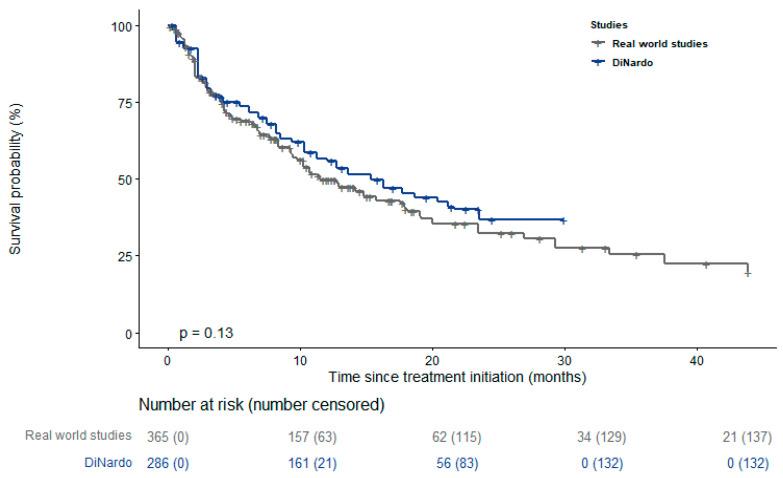
In recent years, the association of venetoclax (VEN) with hypomethylating agents (HMAs) significantly improved the outcome of patients with newly diagnosed acute myeloid leukemia (AML) who were unfit for intensive chemotherapy and became the standard of care after the publication of the pivotal RCT VIALE-A. However, it is still not clear to what extent the results observed in the VIALE-A apply to a real-world setting. For this reason, we carried out a systematic review and meta-analysis of real-world studies on newly diagnosed patients with AML, ineligible for intensive induction chemotherapy, receiving first-line VEN+HMA. We then compared their results in term of survival with those from the VIALE-A. Kaplan-Meier curves were extracted from all included studies and individual survival data was reconstructed. We then estimated a pooled survival curve and compared it with the results of the VIALE-A using the log-rank test. We also conducted a secondary analysis including only studies considering VEN plus azacytidine (AZA) as treatment, as this was the schedule originally used in the VIALE-A. Nineteen real-world studies met the inclusion criteria and were included in the systematic review. Most of them reported a worse survival than the VIALE-A. The pooled survival curve was similar to that reported in the VIALE-A during the first three months of treatment but diverged thereafter (-value = 0.0001). The pooled median survival among the real-world studies was 9.37 months (95%CI 8.81-10.5), substantially lower than that reported in the VIALE-A (14.7 months; 95%CI 11.9-18.7). Results slightly increased when the analysis was restricted to the studies using VEN+AZA as treatment (median survival: 11.5 months; 95%CI 10.2-14.8). Survival of newly diagnosed AML patients treated with VEN+HMAs in a real-world setting seems to be lower than previously reported in the VIALE-A, while the effect of VEN+AZA is more in line with expected results. Future studies are needed to evaluate whether this apparent discrepancy is due to the different characteristics of enrolled patients or to a non-optimal adherence to therapy, and whether alternative regimens can provide better results in terms of safety and effectiveness.
近年来,维奈克拉(VEN)与低甲基化药物(HMAs)联合使用显著改善了新诊断的、不适合强化化疗的急性髓系白血病(AML)患者的治疗结局,并且在关键随机对照试验(RCT)VIALE - A发表后成为了标准治疗方案。然而,VIALE - A中观察到的结果在多大程度上适用于现实世界仍不清楚。因此,我们对新诊断的、不适合强化诱导化疗且接受一线VEN + HMA治疗的AML患者的真实世界研究进行了系统评价和荟萃分析。然后,我们将他们的生存结果与VIALE - A的结果进行比较。从所有纳入研究中提取Kaplan - Meier曲线,并重建个体生存数据。然后,我们估计了一条汇总生存曲线,并使用对数秩检验将其与VIALE - A的结果进行比较。我们还进行了一项二次分析,仅纳入将VEN加阿扎胞苷(AZA)作为治疗方案的研究,因为这是VIALE - A最初使用的方案。19项真实世界研究符合纳入标准并被纳入系统评价。其中大多数研究报告的生存率低于VIALE - A。汇总生存曲线在治疗的前三个月与VIALE - A报告的曲线相似,但此后出现分歧(P值 = 0.0001)。真实世界研究中的汇总中位生存期为9.37个月(95%CI 8.81 - 10.5),显著低于VIALE - A报告的生存期(14.7个月;95%CI 11.9 - 18.7)。当分析仅限于使用VEN + AZA作为治疗方案的研究时,结果略有改善(中位生存期:11.5个月;95%CI 10.2 - 14.8)。在现实世界中,接受VEN + HMAs治疗的新诊断AML患者的生存率似乎低于VIALE - A先前报告的结果,而VEN + AZA的效果更符合预期结果。未来需要进行研究,以评估这种明显差异是由于入组患者的不同特征还是治疗依从性不佳所致,以及替代方案在安全性和有效性方面是否能提供更好的结果。


 Zotero 插件