
使用2bRAD-M技术鉴定单侧结石形成者肾盂泌尿微生物群中的两个簇。
Identification of Two Clusters in Renal Pelvis Urobiome of Unilateral Stone Formers Using 2bRAD-M.
作者信息
Hong Sen-Yuan, Miao Lin-Tao, Zhang Jia-Qiao, Wang Shao-Gang
机构信息
Department of Urology, Tongji Hospital, Tongji Medical College, Huazhong University of Science and Technology, Wuhan 430030, China.
出版信息
Microorganisms. 2023 Sep 10;11(9):2276. doi: 10.3390/microorganisms11092276.
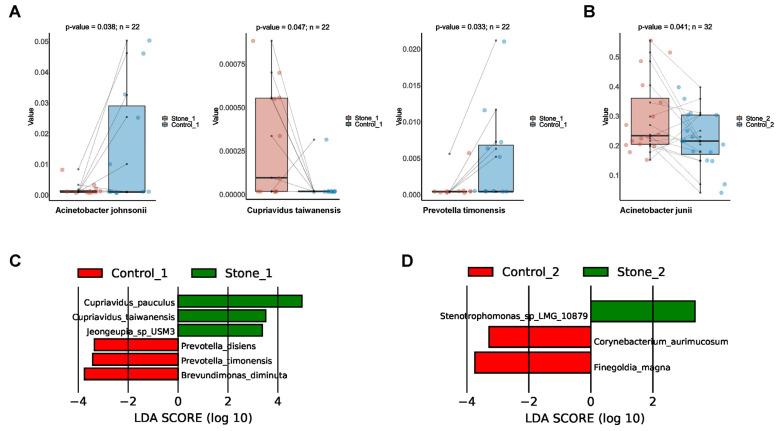
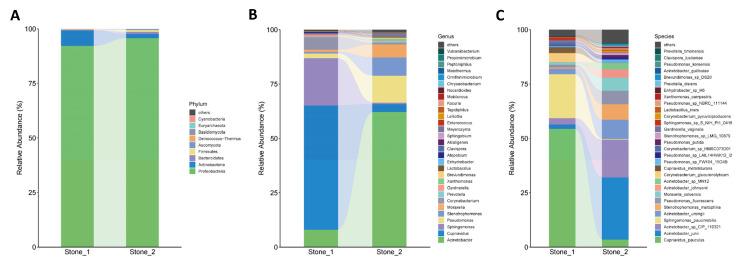
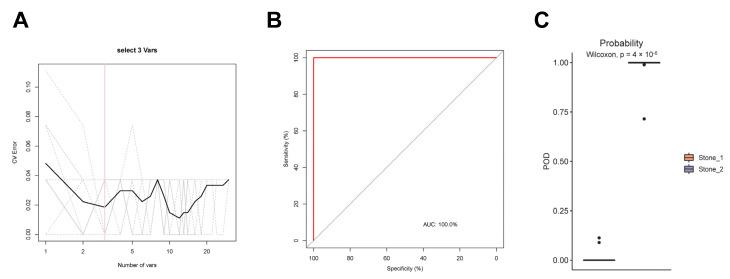
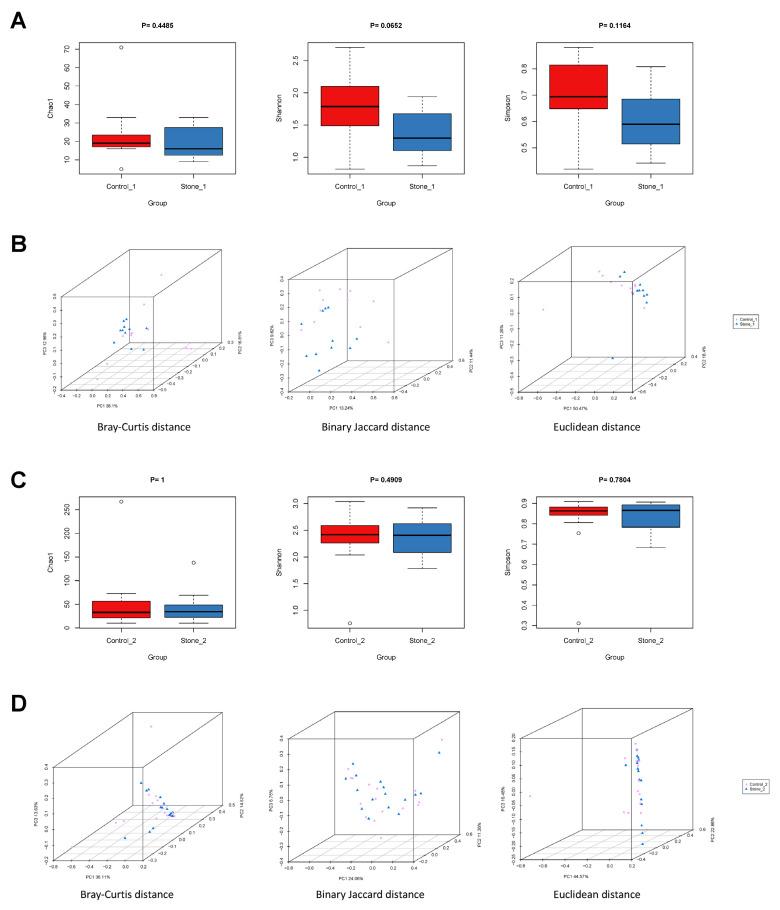
Urolithiasis is a common urological disease with increasing incidence and a high recurrence rate, whose etiology is not fully understood. The application of sequencing and culturomics has revealed that urolithiasis is closely related to the urinary microbiome (urobiome), shedding new light on the pathogenesis of stone formation. In this study, we recruited 30 patients with unilateral stones and collected their renal pelvis urine from both sides. Then, we performed 2bRAD-M, a novel sequencing technique that provides precise microbial identification at the species level, to characterize the renal pelvis urobiome of unilateral stone formers in the both sides. We first found that the urobiome in the stone side could be divided into two clusters (Stone1 and Stone2) based on distance algorithms. Stone2 harbored higher microbial richness and diversity compared to Stone1. The genera and were overrepresented in Stone1, whereas and were overrepresented in Stone2. Meanwhile, differential species were identified between Stone1 and Stone2. We further constructed a random forest model to discriminate two clusters which achieved a powerful diagnostic potential. Moreover, the urobiome of the non-stone side (Control1/2) was compared with that of the stone side (Stone1/2). Stone1 and Control1 showed different microbial community distributions, while Stone2 was similar to Control2 based on diversity analysis. We also identified differentially abundant species among all groups. We assumed that there might be different mechanisms of how microbiota contribute to stone formation in two clusters. Our findings might assist in the selection of suitable medical treatments for urolithiasis.
尿路结石是一种常见的泌尿系统疾病,发病率不断上升且复发率高,其病因尚未完全明确。测序和 culturomics 的应用表明,尿路结石与泌尿微生物群(urobiome)密切相关,为结石形成的发病机制提供了新的线索。在本研究中,我们招募了 30 名单侧结石患者,并从两侧收集他们的肾盂尿液。然后,我们进行了 2bRAD-M,这是一种新的测序技术,可在物种水平上提供精确的微生物鉴定,以表征两侧单侧结石形成者的肾盂 urobiome。我们首先发现,基于距离算法,结石侧的 urobiome 可分为两个簇(Stone1 和 Stone2)。与 Stone1 相比,Stone2 具有更高的微生物丰富度和多样性。Stone1 中 属和 属的含量过高,而 Stone2 中 属和 属的含量过高。同时,在 Stone1 和 Stone2 之间鉴定出了差异物种。我们进一步构建了一个随机森林模型来区分两个簇,该模型具有强大的诊断潜力。此外,将非结石侧(Control1/2)的 urobiome 与结石侧(Stone1/2)的进行了比较。基于多样性分析,Stone1 和 Control1 显示出不同的微生物群落分布,而 Stone2 与 Control2 相似。我们还在所有组中鉴定出了差异丰富的物种。我们假设在两个簇中微生物群促进结石形成的机制可能不同。我们的发现可能有助于为尿路结石选择合适的治疗方法。


 Zotero 插件