
职业差异对长新冠患病率和严重程度的影响:冠状病毒(COVID-19)感染调查分析。
Occupational differences in the prevalence and severity of long-COVID: analysis of the Coronavirus (COVID-19) Infection Survey.
机构信息
MRC/CSO Social and Public Health Sciences Unit, School of Health and Wellbeing, University of Glasgow, Glasgow, UK
MRC/CSO Social and Public Health Sciences Unit, School of Health and Wellbeing, University of Glasgow, Glasgow, UK.
出版信息
Occup Environ Med. 2023 Oct;80(10):545-552. doi: 10.1136/oemed-2023-108930. Epub 2023 Sep 28.
OBJECTIVES
To establish whether prevalence and severity of long-COVID symptoms vary by industry and occupation.
METHODS
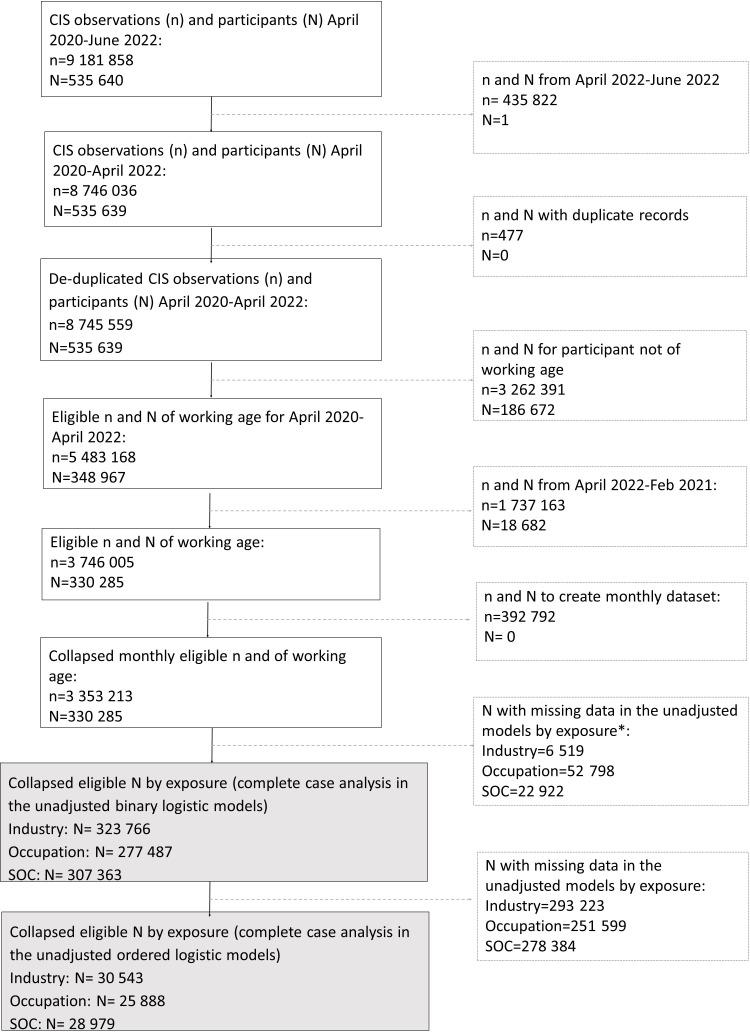
We used Office for National Statistics COVID-19 Infection Survey (CIS) data (February 2021-April 2022) of working-age participants (16-65 years). Exposures were industry, occupation and major Standard Occupational Classification (SOC) group. Outcomes were self-reported: (1) long-COVID symptoms and (2) reduced function due to long-COVID. Binary (outcome 1) and ordered (outcome 2) logistic regression were used to estimate odds ratios (OR)and prevalence (marginal means).
RESULTS
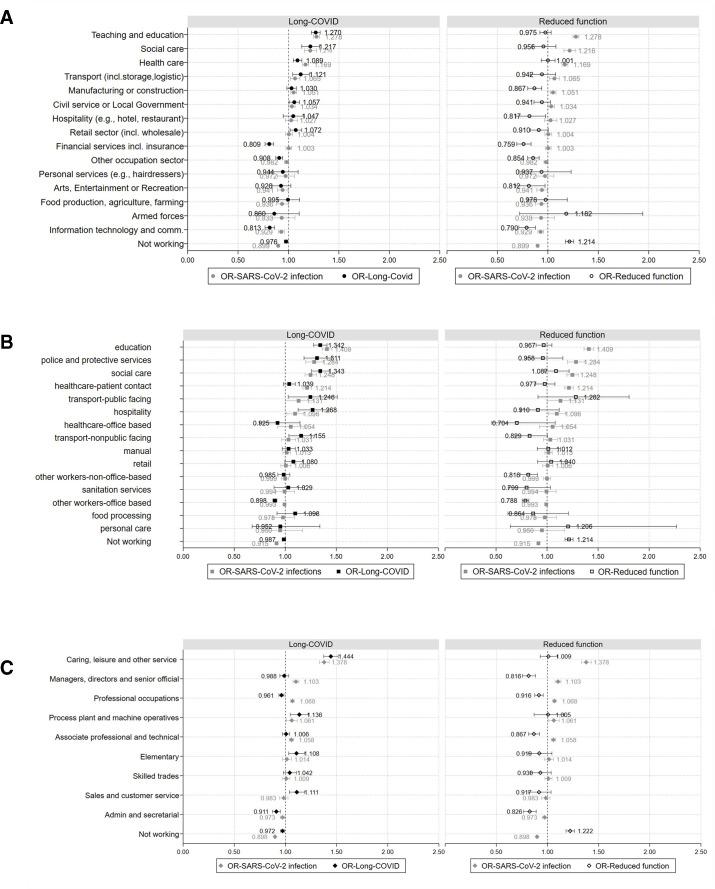
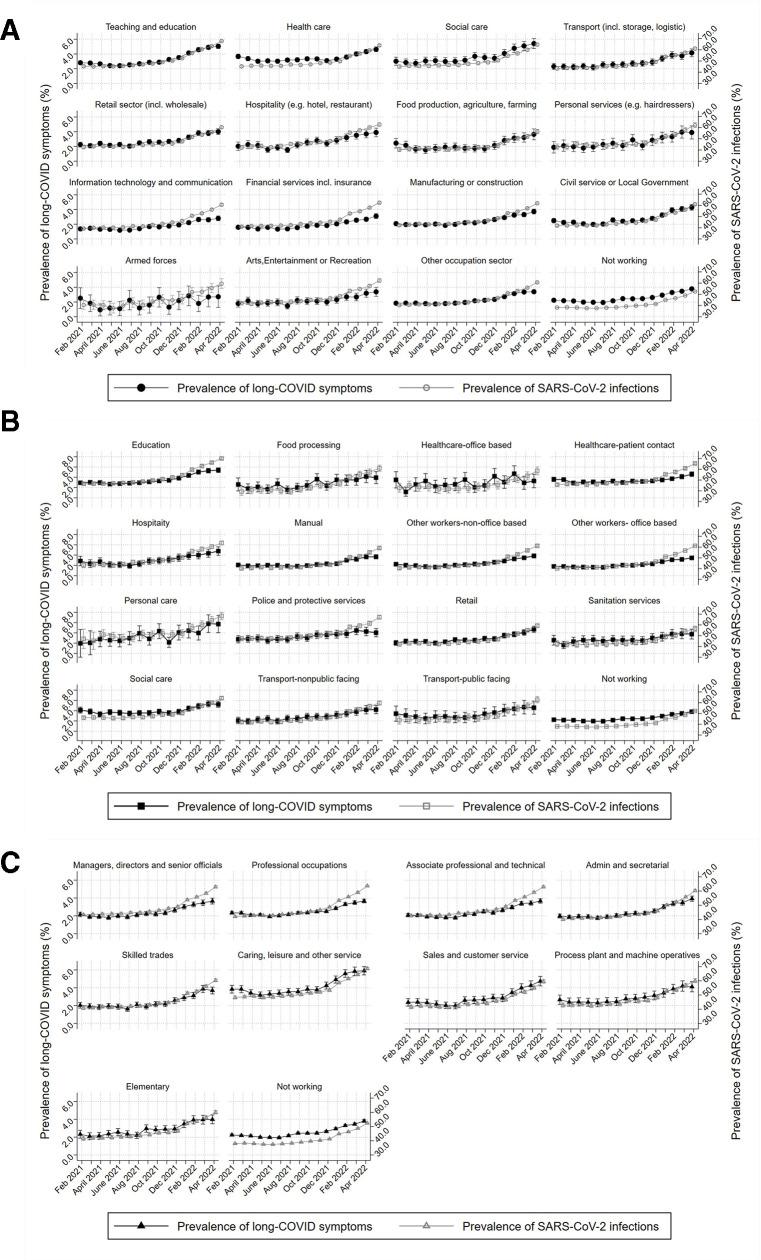
Public facing industries, including teaching and education, social care, healthcare, civil service, retail and transport industries and occupations, had the highest likelihood of long-COVID. By major SOC group, those in caring, leisure and other services (OR 1.44, 95% CIs 1.38 to 1.52) had substantially elevated odds than average. For almost all exposures, the pattern of ORs for long-COVID symptoms followed SARS-CoV-2 infections, except for professional occupations (eg, some healthcare, education, scientific occupations) (infection: OR<1 ; long-COVID: OR>1). The probability of reporting long-COVID for industry ranged from 7.7% (financial services) to 11.6% (teaching and education); whereas the prevalence of reduced function by 'a lot' ranged from 17.1% (arts, entertainment and recreation) to 22%-23% (teaching and education and armed forces) and to 27% (not working).
CONCLUSIONS
The risk and prevalence of long-COVID differs across industries and occupations. Generally, it appears that likelihood of developing long-COVID symptoms follows likelihood of SARS-CoV-2 infection, except for professional occupations. These findings highlight sectors and occupations where further research is needed to understand the occupational factors resulting in long-COVID.
目的
确定长新冠症状的流行程度和严重程度是否因行业和职业而异。
方法
我们使用了英国国家统计局(ONS)的新冠病毒感染调查(CIS)数据(2021 年 2 月至 2022 年 4 月),调查对象为劳动年龄人群(16-65 岁)。暴露因素为行业、职业和主要标准职业分类(SOC)组。结果是自我报告的:(1)长新冠症状,(2)长新冠导致的功能下降。使用二项(结果 1)和有序(结果 2)逻辑回归来估计比值比(OR)和患病率(边际均值)。
结果
面向公众的行业,包括教学、社会关怀、医疗保健、公务员、零售和交通行业及职业,患长新冠的可能性最高。按主要 SOC 组划分,从事护理、休闲和其他服务的人群(OR 1.44,95%置信区间 1.38-1.52)的患病几率明显高于平均水平。对于几乎所有的暴露因素,长新冠症状的 OR 模式都与 SARS-CoV-2 感染相符,除了一些专业职业(例如,一些医疗保健、教育、科学职业)(感染:OR<1;长新冠:OR>1)。报告长新冠的行业概率从金融服务业的 7.7%到教学与教育的 11.6%;而功能严重下降的比例从艺术、娱乐和休闲业的 17.1%到教学与教育业和军队的 22%-23%,再到非工作状态的 27%。
结论
长新冠的风险和流行程度因行业和职业而异。一般来说,长新冠症状的出现似乎与 SARS-CoV-2 感染的出现相关,除了专业职业。这些发现突出了需要进一步研究的部门和职业,以了解导致长新冠的职业因素。
 Zotero 插件