
植物性饮食模式与 2 型糖尿病、心血管疾病、癌症和死亡率风险之间的关联 - 系统评价和荟萃分析。
Associations between plant-based dietary patterns and risks of type 2 diabetes, cardiovascular disease, cancer, and mortality - a systematic review and meta-analysis.
机构信息
Department of Nutrition, Harvard T.H. Chan School of Public Health, 677 Huntington Avenue, Boston, MA, 02115, USA.
CAS Key Laboratory of Nutrition, Metabolism and Food Safety, Shanghai Institute of Nutrition and Health, University of Chinese Academy of Sciences, Chinese Academy of Sciences, Shanghai, China.
出版信息
Nutr J. 2023 Oct 4;22(1):46. doi: 10.1186/s12937-023-00877-2.
BACKGROUND
Plant-based dietary patterns are gaining more attention due to their potential in reducing the risk of developing major chronic diseases, including type 2 diabetes (T2D), cardiovascular disease (CVD), cancer, and mortality, while an up-to-date comprehensive quantitative review is lacking. This study aimed to summarize the existing prospective observational evidence on associations between adherence to plant-based dietary patterns and chronic disease outcomes.
METHODS
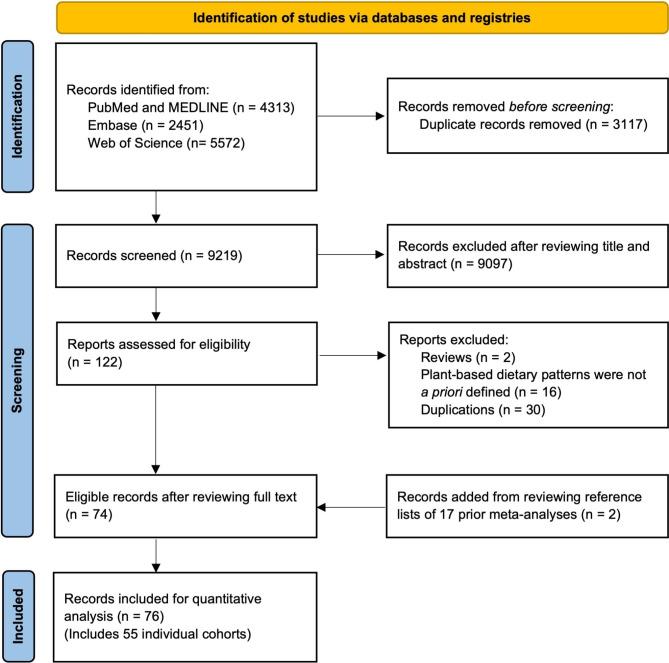
We conducted a systematic review and meta-analysis of evidence across prospective observational studies. The data sources used were PubMed and MEDLINE, Embase, Web of Science, and screening of references. We included all prospective observational studies that evaluated the association between adherence to plant-based dietary patterns and incidence of T2D, CVD, cancer, and mortality among adults (≥ 18 years).
RESULTS
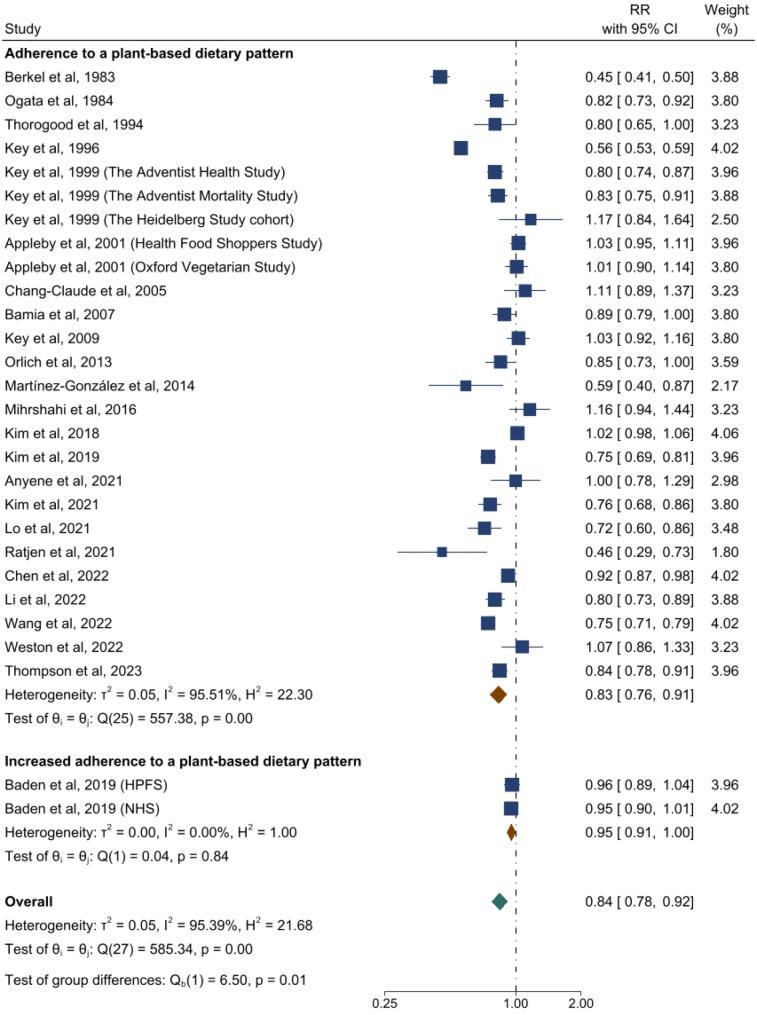
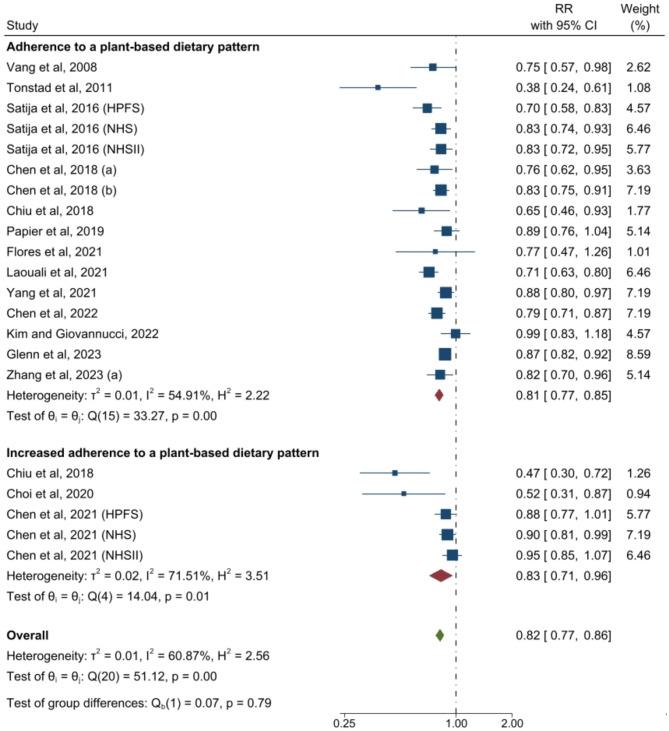
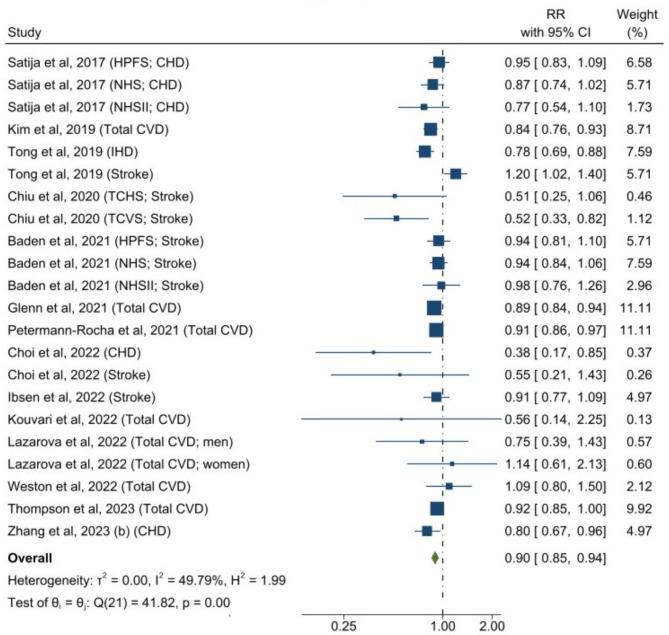
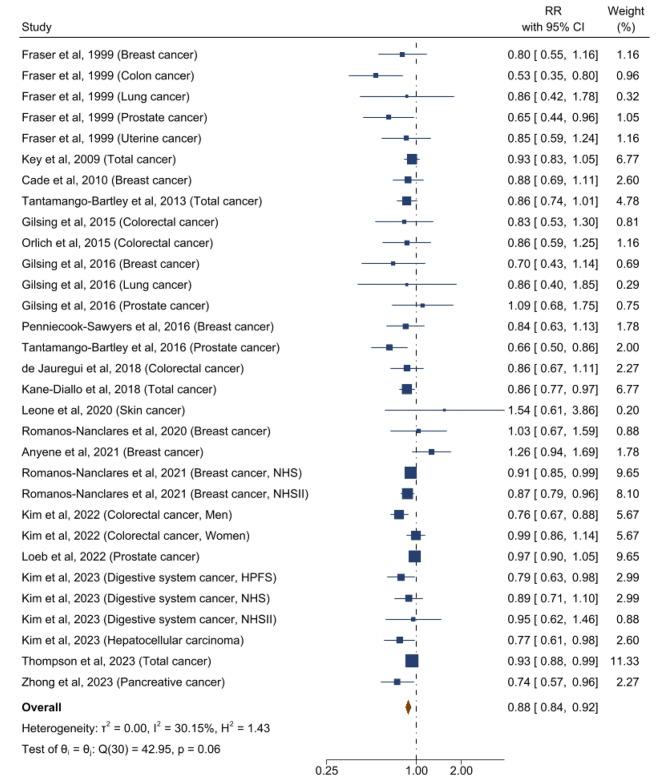
A total of 76 publications were identified, including 2,230,443 participants with 60,718 cases of incident T2D, 157,335 CVD cases, 57,759 cancer cases, and 174,435 deaths. An inverse association was observed between higher adherence to a plant-based dietary pattern and risks of T2D (RR, 0.82 [95% CI: 0.77-0.86]), CVD (0.90 [0.85-0.94]), cancer (0.91 [0.87-0.96]), and all-cause mortality (0.84 [0.78-0.92]) with moderate to high heterogeneity across studies (I ranged: 47.8-95.4%). The inverse associations with T2D, CVD and cancer were strengthened when healthy plant-based foods, such as vegetables, fruits, whole grains, and legumes, were emphasized in the definition of plant-based dietary patterns (T2D: 0.79 [0.72-0.87]; CVD: 0.85 [0.80-0.92]; cancer: 0.86 [0.80-0.92]; I ranged: 53.1-84.1%). Association for mortality was largely similar when the analyses were restricted to healthy plant-based diets (0.86 [0.80-0.92], I = 91.9%). In contrast, unhealthy plant-based diets were positively associated with these disease outcomes. Among four studies that examined changes in dietary patterns, increased adherence to plant-based dietary patterns was associated with a significantly reduced risk of T2D (0.83 [0.71-0.96]; I = 71.5%) and a marginally lower risk of mortality (0.95 [0.91-1.00]; I = 0%).
CONCLUSIONS
Better adherence to plant-based dietary patterns, especially those emphasizing healthy plant-based foods, is beneficial for lowering the risks of major chronic conditions, including T2D, CVD, cancer, as well as premature deaths.
REGISTRATION OF REVIEW PROTOCOL
This review was registered at the PROSPERO International Prospective Register of Systematic Reviews ( https://www.crd.york.ac.uk/PROSPERO/ ) with the registration number CRD42022290202.
背景
由于植物性饮食模式在降低 2 型糖尿病 (T2D)、心血管疾病 (CVD)、癌症和死亡率等主要慢性疾病风险方面的潜力,这种饮食模式越来越受到关注,但是目前缺乏全面的定量综述。本研究旨在总结现有关于植物性饮食模式与慢性疾病结局之间关系的前瞻性观察证据。
方法
我们对前瞻性观察性研究进行了系统评价和荟萃分析。使用的数据源是 PubMed 和 MEDLINE、Embase、Web of Science 和参考文献筛选。我们纳入了所有评估成人(≥18 岁)中植物性饮食模式与 T2D、CVD、癌症和死亡率发生之间关联的前瞻性观察性研究。
结果
共确定了 76 篇文献,包括 2230443 名参与者,其中有 60718 例 T2D 病例、157335 例 CVD 病例、57759 例癌症病例和 174435 例死亡病例。较高的植物性饮食模式依从性与 T2D(RR,0.82 [95%CI:0.77-0.86])、CVD(0.90 [0.85-0.94])、癌症(0.91 [0.87-0.96])和全因死亡率(0.84 [0.78-0.92])的风险降低呈负相关,研究间存在中度至高度异质性(I 范围:47.8-95.4%)。当强调植物性饮食模式中健康的植物性食物(如蔬菜、水果、全谷物和豆类)时,与 T2D、CVD 和癌症的负相关关系会加强(T2D:0.79 [0.72-0.87];CVD:0.85 [0.80-0.92];癌症:0.86 [0.80-0.92];I 范围:53.1-84.1%)。当分析仅限于健康的植物性饮食时,死亡率的相关性大致相似(0.86 [0.80-0.92],I=91.9%)。相反,不健康的植物性饮食与这些疾病结局呈正相关。在四项研究中,观察到饮食模式的变化,增加对植物性饮食模式的依从性与 T2D 风险显著降低(0.83 [0.71-0.96];I=71.5%)和死亡率降低(0.95 [0.91-1.00];I=0.0%)有关。
结论
更好地遵循植物性饮食模式,尤其是强调健康植物性食物的饮食模式,有利于降低 T2D、CVD、癌症等主要慢性疾病以及过早死亡的风险。
注册
本综述在 PROSPERO 国际前瞻性系统评价登记册(https://www.crd.york.ac.uk/PROSPERO/)进行了登记,注册编号为 CRD42022290202。
 Zotero 插件