
解析新冠后综合征中的脑雾:主观认知主诉与认知功能、疲劳及神经精神症状之间的关系
Unraveling brain fog in post-COVID syndrome: Relationship between subjective cognitive complaints and cognitive function, fatigue, and neuropsychiatric symptoms.
作者信息
Delgado-Alonso Cristina, Díez-Cirarda María, Pagán Josué, Pérez-Izquierdo Carlos, Oliver-Mas Silvia, Fernández-Romero Lucía, Martínez-Petit Álvaro, Valles-Salgado María, Gil-Moreno María José, Yus Miguel, Matías-Guiu Jorge, Ayala José Luis, Matias-Guiu Jordi A
机构信息
Department of Neurology, Hospital Clínico San Carlos, Health Research Institute "San Carlos" (IdISCC), Universidad Complutense de Madrid, Madrid, Spain.
Department of Electronic Engineering, Universidad Politécnica de Madrid, Madrid, Spain.
出版信息
Eur J Neurol. 2025 Jan;32(1):e16084. doi: 10.1111/ene.16084. Epub 2023 Oct 5.
BACKGROUND AND PURPOSE
"Brain fog" is a frequent and disabling symptom that can occur after SARS-CoV-2 infection. However, its clinical characteristics and the relationships among brain fog and objective cognitive function, fatigue, and neuropsychiatric symptoms (depression, anxiety) are still unclear. In this study, we aimed to examine the characteristics of brain fog and to understand how fatigue, cognitive performance, and neuropsychiatric symptoms and the mutual relationships among these variables influence subjective cognitive complaints.
METHODS
A total of 170 patients with cognitive complaints in the context of post-COVID syndrome were evaluated using a comprehensive neuropsychological protocol. The FLEI scale was used to characterize subjective cognitive complaints. Correlation analysis, regression machine-learning algorithms, and mediation analysis were calculated.
RESULTS
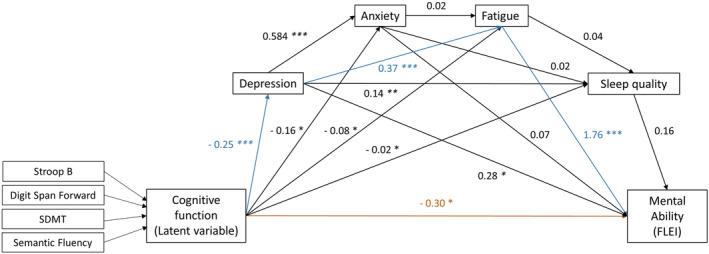
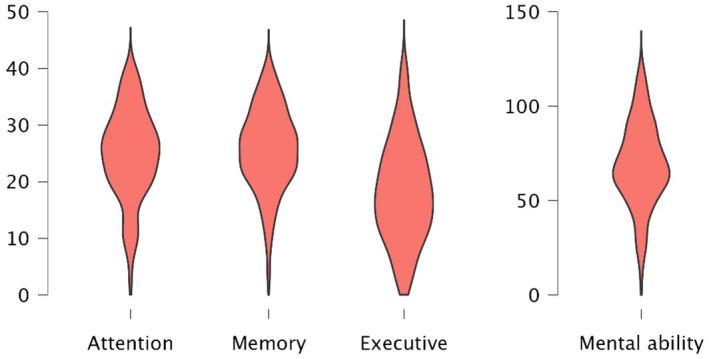
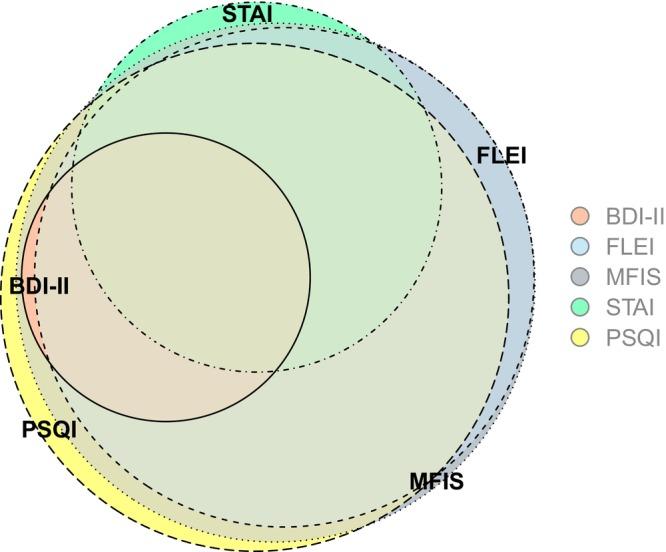
Cognitive complaints were mainly attention and episodic memory symptoms, while executive functions (planning) issues were less often reported. The FLEI scale, a mental ability questionnaire, showed high correlations with a fatigue scale and moderate correlations with the Stroop test, and anxiety and depressive symptoms. Random forest algorithms showed an R value of 0.409 for the prediction of FLEI score, with several cognitive tests, fatigue and depression being the best variables used in the prediction. Mediation analysis showed that fatigue was the main mediator between objective and subjective cognition, while the effect of depression was indirect and mediated through fatigue.
CONCLUSIONS
Brain fog associated with COVID-19 is mainly characterized by attention and episodic memory, and fatigue, which is the main mediator between objective and subjective cognition. Our findings contribute to understanding the pathophysiology of brain fog and emphasize the need to unravel the main mechanisms underlying brain fog, considering several aspects.
背景与目的
“脑雾”是新型冠状病毒感染后常见且使人丧失能力的症状。然而,其临床特征以及脑雾与客观认知功能、疲劳和神经精神症状(抑郁、焦虑)之间的关系仍不明确。在本研究中,我们旨在研究脑雾的特征,并了解疲劳、认知表现、神经精神症状以及这些变量之间的相互关系如何影响主观认知主诉。
方法
使用全面的神经心理学方案对总共170名患有新冠后综合征并伴有认知主诉的患者进行评估。使用FLEI量表来描述主观认知主诉。进行相关分析、回归机器学习算法和中介分析。
结果
认知主诉主要为注意力和情景记忆症状,而执行功能(计划)问题的报告较少。FLEI量表作为一种心理能力问卷,与疲劳量表高度相关,与斯特鲁普测试、焦虑和抑郁症状中度相关。随机森林算法对FLEI得分预测的R值为0.409,几种认知测试、疲劳和抑郁是预测中使用的最佳变量。中介分析表明,疲劳是客观与主观认知之间的主要中介因素,而抑郁的影响是间接的,通过疲劳介导。
结论
与新冠相关的脑雾主要表现为注意力和情景记忆,以及疲劳,疲劳是客观与主观认知之间的主要中介因素。我们的研究结果有助于理解脑雾的病理生理学,并强调需要从多个方面阐明脑雾背后的主要机制。

 Zotero 插件