
维生素 D 缺乏及其与 2 型糖尿病患者相关因素的系统评价和荟萃分析。
Vitamin D deficiency and its associated factors among patients with type 2 diabetes mellitus: a systematic review and meta-analysis.
机构信息
Department of Biomedical Sciences, College of Medicine and Health Sciences, Wolkite University, Wolkite, Ethiopia
Department of Biomedical Sciences, College of Medicine and Health Sciences, Wolkite University, Wolkite, Ethiopia.
出版信息
BMJ Open. 2023 Oct 5;13(10):e075607. doi: 10.1136/bmjopen-2023-075607.
OBJECTIVE
The study intended to assess the pooled prevalence of vitamin D deficiency (VDD) and its associated factors among patients with type 2 diabetes mellitus (T2DM).
DESIGN
The Preferred Reporting Items for Systematic Reviews and Meta-Analyses guidelines were employed to plan and conduct this systematic review and meta-analysis.
DATA SOURCES
PubMed, Medline, Google Scholar, Web of Science, Science Direct and the Worldwide Science database were searched from their inception to 31 January 2023.
METHODS
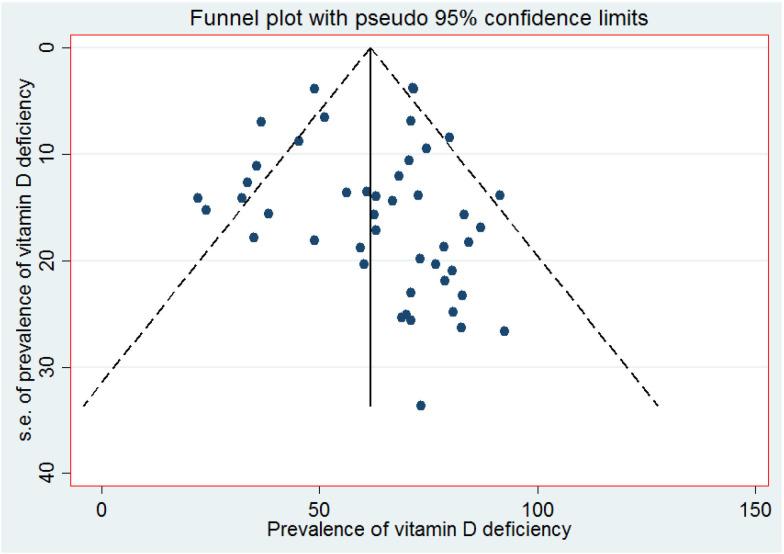
Data were extracted using a standardised data extraction format prepared in Microsoft Excel. The inverse variance (I) test was used to evaluate the presence of heterogeneity across the included studies. To identify the possible source of heterogeneity, subgroup analysis was carried out. Funnel plot symmetry, Begg's and Egger's tests were used to evaluate the existence of publication bias. In addition, factors associated with VDD among patients with T2DM were examined. All statistical analyses were carried out with STATA V.14 software.
RESULTS
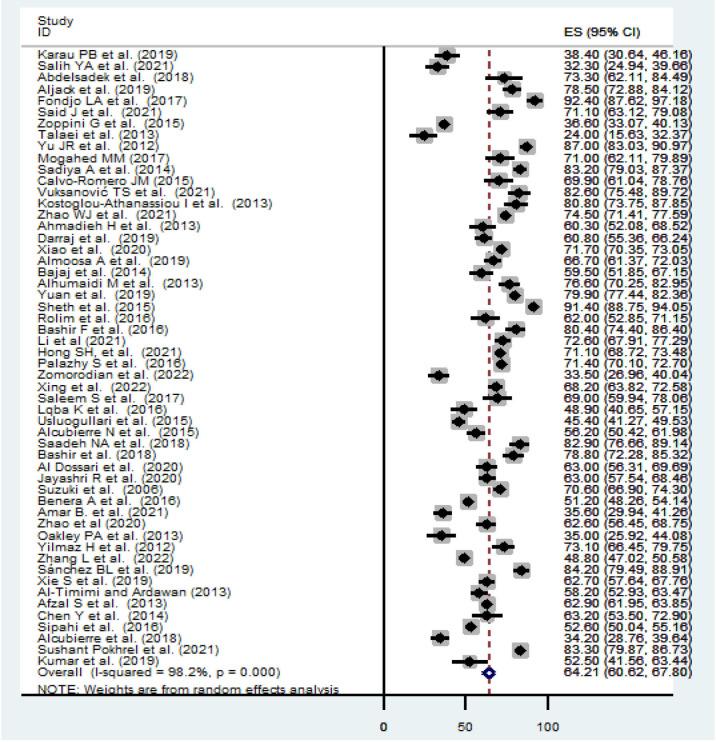
A total of 54 studies with 38 016 study participants were included in the study. The pooled prevalence of VDD among patients with T2DM was found to be 64.2% (95% CI 60.6% to 67.8%) with a substantial level of heterogeneity (I=98.2%; p<0.001). Results of the subgroup analysis indicated that the pooled prevalence of VDD among patients with T2DM was highest (70.9%) in African nations and lowest (57.1%) in Middle East countries. Being female (pooled OR (POR) 1.60, 95% CI 1.29 to 1.97), having poor glycaemic control (POR 2.50; 95% CI 1.74 to 3.59), hypertension (POR 1.21; 95% CI 1.08 to 1.36), obesity (body mass index ≥25) (POR 1.68; 95% CI 1.16 to 2.44), dyslipidaemia (POR 2.54, 95% CI 1.37 to 4.73), albuminuria (POR 2.22, 95% CI 1.71 to 2.95), nephropathy (POR 1.58; 95% CI 1.08 to 2.31) and retinopathy (POR 1.48: 95% CI 1.17 to 1.89) were predictors of VDD among patients with T2DM.
CONCLUSIONS
More than half of patients with T2DM were suffering from VDD. Being female, having poor glycaemic control, hypertension, obesity, dyslipidaemia, albuminuria, nephropathy and retinopathy were the predictors of VDD among patients with T2DM.
目的
本研究旨在评估 2 型糖尿病(T2DM)患者维生素 D 缺乏(VDD)的总体患病率及其相关因素。
设计
本系统评价和荟萃分析按照系统评价和荟萃分析的首选报告项目(Preferred Reporting Items for Systematic Reviews and Meta-Analyses)指南进行规划和实施。
数据来源
从建库至 2023 年 1 月 31 日,检索了 PubMed、Medline、Google Scholar、Web of Science、Science Direct 和 WorldWideScience 数据库。
方法
使用 Microsoft Excel 中准备的标准化数据提取格式提取数据。采用方差倒数(Inverse variance,I)检验评估纳入研究间的异质性。为了确定可能的异质性来源,进行了亚组分析。采用漏斗图对称性、贝格(Begg)检验和埃格(Egger)检验评估发表偏倚的存在。此外,还分析了 T2DM 患者发生 VDD 的相关因素。所有的统计分析均使用 STATA V.14 软件进行。
结果
共有 54 项研究,涉及 38016 名研究参与者纳入本研究。T2DM 患者 VDD 的总体患病率为 64.2%(95%置信区间:60.6%67.8%),存在高度异质性(I=98.2%;p<0.001)。亚组分析结果表明,T2DM 患者 VDD 的总体患病率在非洲国家最高(70.9%),在中东国家最低(57.1%)。女性(汇总比值比[pooled odds ratio,POR] 1.60,95%置信区间:1.291.97)、血糖控制不佳(POR 2.50;95%置信区间:1.743.59)、高血压(POR 1.21;95%置信区间:1.081.36)、肥胖(体重指数≥25)(POR 1.68;95%置信区间:1.162.44)、血脂异常(POR 2.54,95%置信区间:1.374.73)、白蛋白尿(POR 2.22,95%置信区间:1.712.95)、肾病(POR 1.58;95%置信区间:1.082.31)和视网膜病变(POR 1.48:95%置信区间:1.17~1.89)是 T2DM 患者 VDD 的预测因素。
结论
超过一半的 T2DM 患者患有 VDD。女性、血糖控制不佳、高血压、肥胖、血脂异常、白蛋白尿、肾病和视网膜病变是 T2DM 患者 VDD 的预测因素。

 Zotero 插件