
Nrf2信号通路:在人类癌症中的现状及潜在的可靶向治疗作用
Nrf2 signaling pathway: current status and potential therapeutic targetable role in human cancers.
作者信息
Lin Li, Wu Qing, Lu Feifei, Lei Jiaming, Zhou Yanhong, Liu Yifei, Zhu Ni, Yu You, Ning Zhifeng, She Tonghui, Hu Meichun
机构信息
Key Laboratory of Environmental Related Diseases and One Health, School of Basic Medical Sciences, Xianning Medical College, Hubei University of Science and Technology, Xianning, China.
Department of Medical School of Facial Features, Xianning Medical College, Hubei University of Science and Technology, Xianning, China.
出版信息
Front Oncol. 2023 Sep 22;13:1184079. doi: 10.3389/fonc.2023.1184079. eCollection 2023.
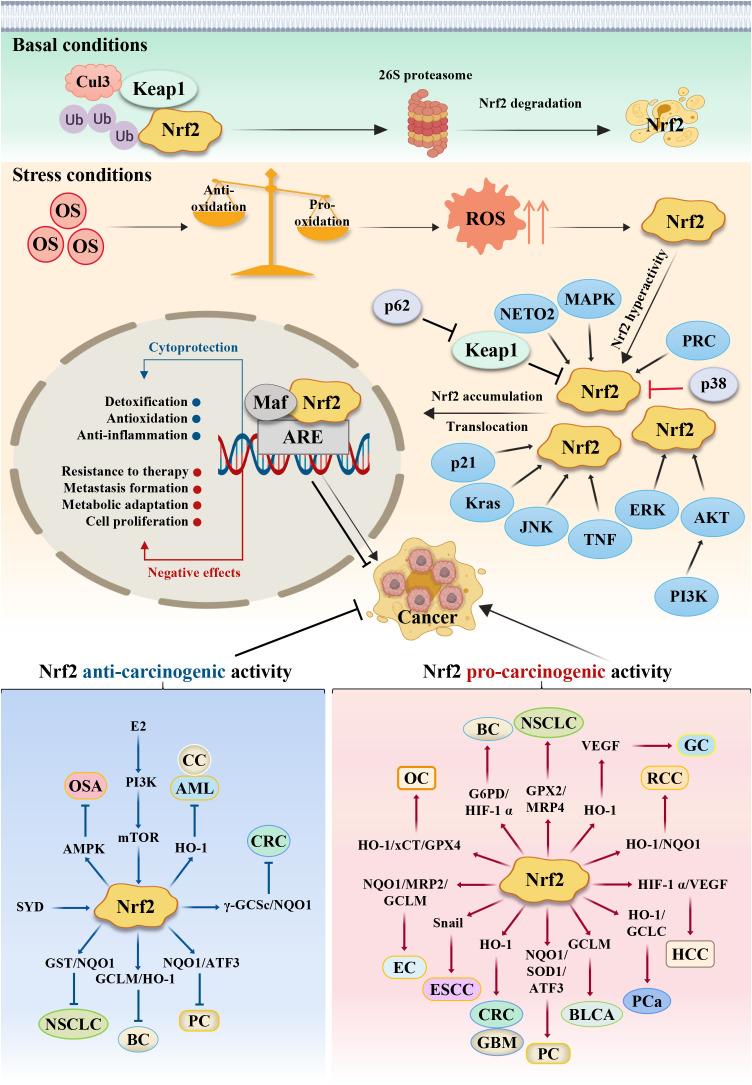
Cancer is a borderless global health challenge that continues to threaten human health. Studies have found that oxidative stress (OS) is often associated with the etiology of many diseases, especially the aging process and cancer. Involved in the OS reaction as a key transcription factor, Nrf2 is a pivotal regulator of cellular redox state and detoxification. Nrf2 can prevent oxidative damage by regulating gene expression with antioxidant response elements (ARE) to promote the antioxidant response process. OS is generated with an imbalance in the redox state and promotes the accumulation of mutations and genome instability, thus associated with the establishment and development of different cancers. Nrf2 activation regulates a plethora of processes inducing cellular proliferation, differentiation and death, and is strongly associated with OS-mediated cancer. What's more, Nrf2 activation is also involved in anti-inflammatory effects and metabolic disorders, neurodegenerative diseases, and multidrug resistance. Nrf2 is highly expressed in multiple human body parts of digestive system, respiratory system, reproductive system and nervous system. In oncology research, Nrf2 has emerged as a promising therapeutic target. Therefore, certain natural compounds and drugs can exert anti-cancer effects through the Nrf2 signaling pathway, and blocking the Nrf2 signaling pathway can reduce some types of tumor recurrence rates and increase sensitivity to chemotherapy. However, Nrf2's dual role and controversial impact in cancer are inevitable consideration factors when treating Nrf2 as a therapeutic target. In this review, we summarized the current state of biological characteristics of Nrf2 and its dual role and development mechanism in different tumor cells, discussed Keap1/Nrf2/ARE signaling pathway and its downstream genes, elaborated the expression of related signaling pathways such as AMPK/mTOR and NF-κB. Besides, the main mechanism of Nrf2 as a cancer therapeutic target and the therapeutic strategies using Nrf2 inhibitors or activators, as well as the possible positive and negative effects of Nrf2 activation were also reviewed. It can be concluded that Nrf2 is related to OS and serves as an important factor in cancer formation and development, thus provides a basis for targeted therapy in human cancers.
癌症是一项无国界的全球健康挑战,持续威胁着人类健康。研究发现,氧化应激(OS)常与许多疾病的病因相关,尤其是衰老过程和癌症。作为关键转录因子参与OS反应,Nrf2是细胞氧化还原状态和解毒的关键调节因子。Nrf2可通过用抗氧化反应元件(ARE)调节基因表达来预防氧化损伤,从而促进抗氧化反应过程。OS是由氧化还原状态失衡产生的,并促进突变积累和基因组不稳定,因此与不同癌症的发生和发展相关。Nrf2激活调节大量诱导细胞增殖、分化和死亡的过程,并与OS介导的癌症密切相关。此外,Nrf2激活还涉及抗炎作用、代谢紊乱、神经退行性疾病和多药耐药性。Nrf2在消化系统、呼吸系统、生殖系统和神经系统的多个人体部位中高表达。在肿瘤学研究中,Nrf2已成为一个有前景的治疗靶点。因此,某些天然化合物和药物可通过Nrf2信号通路发挥抗癌作用,阻断Nrf2信号通路可降低某些类型肿瘤的复发率并增加对化疗的敏感性。然而,在将Nrf2作为治疗靶点时,Nrf2在癌症中的双重作用和有争议的影响是不可避免的考虑因素。在本综述中,我们总结了Nrf2的生物学特性现状及其在不同肿瘤细胞中的双重作用和发展机制,讨论了Keap1/Nrf2/ARE信号通路及其下游基因,阐述了AMPK/mTOR和NF-κB等相关信号通路的表达。此外,还综述了Nrf2作为癌症治疗靶点的主要机制以及使用Nrf2抑制剂或激活剂的治疗策略,以及Nrf2激活可能产生的正负效应。可以得出结论,Nrf2与OS相关,是癌症形成和发展的重要因素,从而为人类癌症的靶向治疗提供了依据。
 Zotero 插件