
血糖控制与糖尿病患者高血压的关联:基于人群的纵向研究。
Association of glycemic control with hypertension in patients with diabetes: a population-based longitudinal study.
机构信息
Department of Health Policy and Management, School of Public Health, Sun Yat-sen University, 74, Zhongshan 2nd Road, Guangzhou, 510030, Guangdong, P. R. China.
出版信息
BMC Cardiovasc Disord. 2023 Oct 10;23(1):501. doi: 10.1186/s12872-023-03478-3.
BACKGROUND
Diabetes increases the risk of hypertension morbidity, but whether this association is varied with glycemic control remains unknown. We aimed to examine the association of glycemic control with hypertension among individuals with diabetes.
METHODS
Data was from the China Health and Retirement Longitudinal Study (CHARLS) between 2011 and 2018. Participants were categorized as having adequate glycemic control (HbA1c < 7%) and inadequate glycemic uncontrol (HbA1c ≥ 7%) by combining blood glucose tests and physician's diagnoses in 2011. Incident hypertension was ascertained through self-reported physician diagnoses from 2011 to 2018. Cox proportional hazards regression models were used to examine the effect of glycemic control on hypertension.
RESULTS
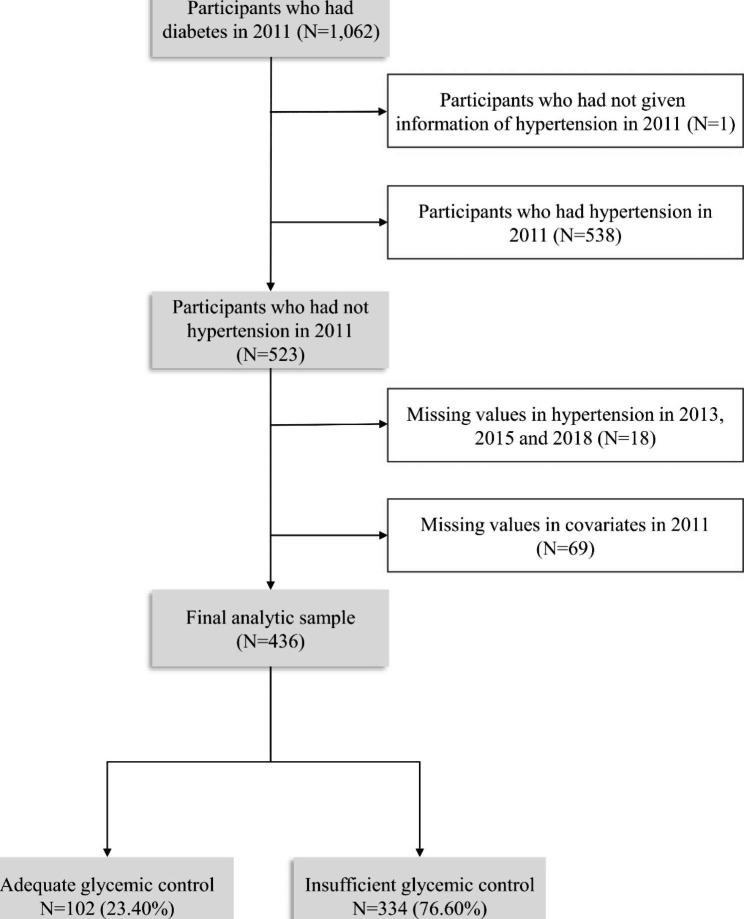
Among 436 participants with diabetes in this study, 102 met the glycemic control standard, and 334 were insufficient glycemic control. During 7 years of follow-up, 141 individuals developed hypertension. Compared with adequate glycemic control, the hazard ratio of inadequate glycemic control on hypertension was 1.54 (95% CI, 1.07-2.21) in the multivariate model. Additionally, the influence of glycemic control on hypertension varied based on educational attainment and the presence of depressive symptoms (P for interaction < 0.05).
CONCLUSIONS
Insufficient glycemic control was associated with a higher risk of hypertension among individuals with diabetes. Notably, the effect of glycemic control on hypertension was more pronounced among those with lower educational attainment and those exhibiting depressive symptoms. These findings underscore the significance of vigilant glycemic monitoring, educational background considerations, and mental health assessments in managing diabetic individuals.
背景
糖尿病会增加高血压发病的风险,但这种关联是否因血糖控制情况而有所不同尚不清楚。我们旨在研究血糖控制与糖尿病患者高血压之间的关系。
方法
数据来自 2011 年至 2018 年的中国健康与养老追踪调查(CHARLS)。2011 年结合血糖检测和医生诊断将参与者分为血糖控制良好(HbA1c<7%)和血糖控制不佳(HbA1c≥7%)两组。通过 2011 年至 2018 年的自我报告医生诊断来确定高血压的发生情况。使用 Cox 比例风险回归模型来检验血糖控制对高血压的影响。
结果
在这项研究的 436 名糖尿病患者中,有 102 名符合血糖控制标准,334 名患者血糖控制不佳。在 7 年的随访期间,有 141 人患上了高血压。与血糖控制良好相比,在多变量模型中血糖控制不佳发生高血压的风险比为 1.54(95%CI,1.07-2.21)。此外,血糖控制对高血压的影响因受教育程度和抑郁症状的存在而异(交互作用 P 值<0.05)。
结论
血糖控制不佳与糖尿病患者高血压风险增加相关。值得注意的是,血糖控制对高血压的影响在受教育程度较低和存在抑郁症状的人群中更为显著。这些发现强调了在管理糖尿病患者时,需要密切监测血糖、考虑教育背景以及评估心理健康的重要性。

 Zotero 插件