
血液系统恶性肿瘤中的细胞外囊泡:重塑肿瘤微环境的细胞外囊泡证据
Extracellular vesicles in hematological malignancies: EV-dence for reshaping the tumoral microenvironment.
作者信息
Van Morckhoven David, Dubois Nathan, Bron Dominique, Meuleman Nathalie, Lagneaux Laurence, Stamatopoulos Basile
机构信息
Laboratory of Clinical Cell Therapy, Jules Bordet Institute, Université Libre de Bruxelles (ULB), Brussels, Belgium.
Departement of Hematology, Jules Bordet Institute, Brussels, Belgium.
出版信息
Front Immunol. 2023 Sep 26;14:1265969. doi: 10.3389/fimmu.2023.1265969. eCollection 2023.
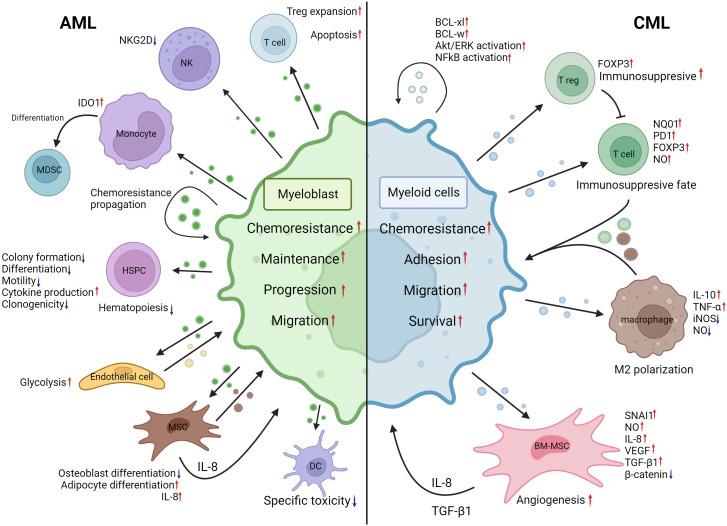
Following their discovery at the end of the 20th century, extracellular vesicles (EVs) ranging from 50-1,000 nm have proven to be paramount in the progression of many cancers, including hematological malignancies. EVs are a heterogeneous group of cell-derived membranous structures that include small EVs (commonly called exosomes) and large EVs (microparticles). They have been demonstrated to participate in multiple physiological and pathological processes by allowing exchange of biological material (including among others proteins, DNA and RNA) between cells. They are therefore a crucial way of intercellular communication. In this context, malignant cells can release these extracellular vesicles that can influence their microenvironment, induce the formation of a tumorigenic niche, and prepare and establish distant niches facilitating metastasis by significantly impacting the phenotypes of surrounding cells and turning them toward supportive roles. In addition, EVs are also able to manipulate the immune response and to establish an immunosuppressive microenvironment. This in turn allows for ideal conditions for heightened chemoresistance and increased disease burden. Here, we review the latest findings and reports studying the effects and therapeutic potential of extracellular vesicles in various hematological malignancies. The study of extracellular vesicles remains in its infancy; however, rapid advances in the analysis of these vesicles in the context of disease allow us to envision prospects to improve the detection and treatment of hematological malignancies.
在20世纪末被发现后,直径在50至1000纳米之间的细胞外囊泡(EVs)已被证明在包括血液系统恶性肿瘤在内的许多癌症进展中至关重要。EVs是一组异质性的细胞来源膜性结构,包括小EVs(通常称为外泌体)和大EVs(微颗粒)。它们已被证明通过允许细胞间交换生物物质(包括蛋白质、DNA和RNA等)参与多种生理和病理过程。因此,它们是细胞间通讯的一种关键方式。在这种情况下,恶性细胞可以释放这些细胞外囊泡,这些囊泡可以影响其微环境,诱导致瘤微环境的形成,并通过显著影响周围细胞的表型并使其发挥支持作用,来准备和建立促进转移的远处微环境。此外,EVs还能够操纵免疫反应并建立免疫抑制微环境。这反过来又为增强化疗耐药性和增加疾病负担创造了理想条件。在这里,我们综述了研究细胞外囊泡在各种血液系统恶性肿瘤中的作用和治疗潜力的最新发现和报告。细胞外囊泡的研究仍处于起步阶段;然而,在疾病背景下对这些囊泡分析的快速进展使我们能够展望改善血液系统恶性肿瘤检测和治疗的前景。




 Zotero 插件