
血管紧张素 II 致高血压大鼠肾小管:对钠钾耦联转运的预测影响
Angiotensin II hypertension along the female rat tubule: predicted impact on coupled transport of Na and K.
机构信息
Department of Biomedical Engineering, Boston University, Boston, Massachusetts, United States.
Department of Physiology and Neuroscience, Keck School of Medicine, University of Southern California, Los Angeles, California, United States.
出版信息
Am J Physiol Renal Physiol. 2023 Dec 1;325(6):F733-F749. doi: 10.1152/ajprenal.00232.2023. Epub 2023 Oct 12.
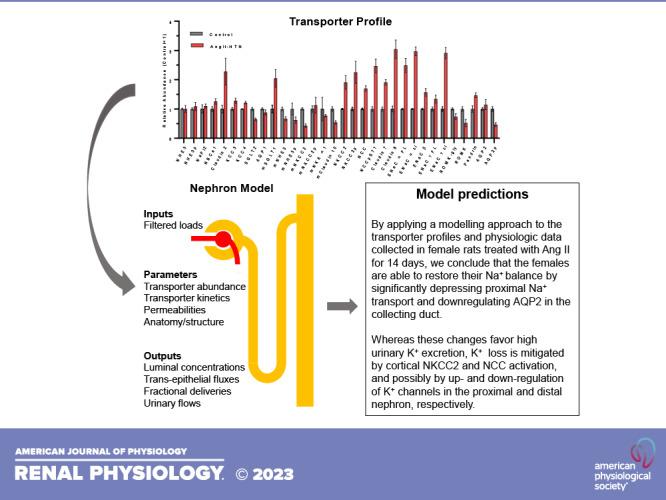
Chronic infusion of subpressor level of angiotensin II (ANG II) increases the abundance of Na transporters along the distal nephron, balanced by suppression of Na transporters along the proximal tubule and medullary thick ascending limb (defined as "proximal nephron"), which impacts K handling along the entire renal tubule. The objective of this study was to quantitatively assess the impact of chronic ANG II on the renal handling of Na and K in female rats, using a computational model of the female rat renal tubule. Our results indicate that the downregulation of proximal nephron Na reabsorption (T), which occurs in response to ANG II-triggered hypertension, involves changes in both transporter abundance and trafficking. Our model suggests that substantial (∼30%) downregulation of active NHE3 in proximal tubule (PT) microvilli is needed to reestablish the Na balance at 2 wk of ANG II infusion. The 35% decrease in SGLT2, a known NHE3 regulator, may contribute to this downregulation. Both depression of proximal nephron T and stimulation of distal ENaC raise urinary K excretion in ANG II-treated females, while K loss is slightly mitigated by cortical NKCC2 and NCC upregulation. Our model predicts that K excretion may be more significantly limited during ANG II infusion by ROMK inhibition in the distal nephron and/or KCC3 upregulation in the PT, which remain open questions for experimental validation. In summary, our analysis indicates that ANG II hypertension triggers a series of events from distal T stimulation followed by compensatory reduction in proximal nephron T and accompanying adjustments to limit excessive K secretion. We used a computational model of the renal tubule to assess the impact of 2-wk angiotensin II (ANG II) infusion on the handling of Na and K in female rats. ANG II strongly stimulates distal Na reabsorption and K secretion. Simulations indicate that substantial downregulation of proximal tubule NHE3 is needed to reestablish Na balance at 2 wk. Proximal adaptations challenge K homeostasis, and regulation of distal NCC and specific K channels likely limit urinary K losses.
慢性输注亚加压素水平的血管紧张素 II(ANG II)会增加远曲小管中钠转运体的丰度,同时抑制近曲小管和髓质升支粗段(定义为“近曲小管”)中的钠转运体,从而影响整个肾小管中的钾处理。本研究的目的是使用雌性大鼠肾小管的计算模型,定量评估慢性 ANG II 对雌性大鼠肾钠和钾处理的影响。我们的结果表明,ANG II 引发的高血压导致近曲小管钠重吸收(T)下调,这涉及转运体丰度和运输的变化。我们的模型表明,需要近曲小管(PT)微绒毛中主动 NHE3 大量(约 30%)下调,才能在 ANG II 输注 2 周时重新建立钠平衡。SGLT2 的下调(已知是 NHE3 的调节剂)可能导致这种下调。近曲小管 T 下调和远端 ENaC 刺激均会增加 ANG II 处理雌性大鼠的尿钾排泄,而皮质 NKCC2 和 NCC 的上调则略微减轻钾丢失。我们的模型预测,在 ANG II 输注期间,远曲小管 ROMK 抑制和/或 PT 中 KCC3 的上调可能会更显著地限制钾排泄,这仍然是实验验证的开放性问题。总之,我们的分析表明,ANG II 高血压引发了一系列事件,从远端 T 刺激开始,随后补偿性地减少近曲小管 T,同时进行相应调整以限制过度的钾分泌。我们使用肾小管的计算模型来评估 2 周血管紧张素 II(ANG II)输注对雌性大鼠钠和钾处理的影响。ANG II 强烈刺激远端钠重吸收和钾分泌。模拟表明,需要近曲小管 NHE3 大量下调才能在 2 周时重新建立钠平衡。近端适应性挑战钾的动态平衡,而远端 NCC 和特定钾通道的调节可能限制尿钾丢失。
 Zotero 插件