
基于金纳米粒子的比色传感器:用于重金属和生物分子检测的特性及应用。
Gold Nanoparticle-Based Colorimetric Sensors: Properties and Application in Detection of Heavy Metals and Biological Molecules.
机构信息
Department of Pharmaceutical Biology, Faculty of Pharmacy, Universitas Padjadjaran, Jalan Raya Bandung-Sumedang KM 21 Jatinangor, Bandung 45363, Indonesia.
Department of Pharmaceutical Analysis and Medicinal Chemistry, Faculty of Pharmacy, Universitas Padjadjaran, Jalan Raya Bandung-Sumedang KM 21 Jatinangor, Bandung 45363, Indonesia.
出版信息
Sensors (Basel). 2023 Sep 29;23(19):8172. doi: 10.3390/s23198172.
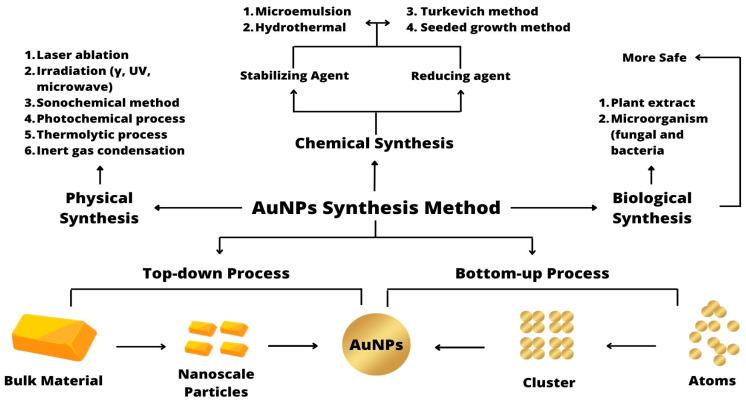
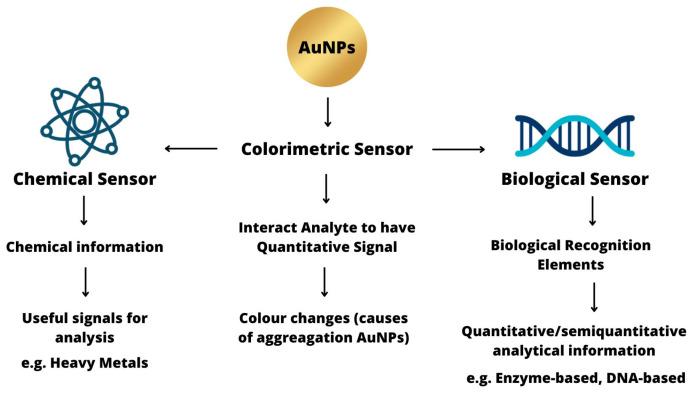
During the last decade, advances have been made in nanotechnology using nanomaterials, leading to improvements in their performance. Gold nanoparticles (AuNPs) have been widely used in the field of sensor analysis and are also combined with certain materials to obtain the desired characteristics. AuNPs are commonly used as colorimetric sensors in detection methods. In developing an ideal sensor, there are certain characteristics that must be met such as selectivity, sensitivity, accuracy, precision, and linearity, among others. Various methods for the synthesis of AuNPs and conjugation with other components have been carried out in order to obtain good characteristics for their application. AuNPs can be applied in the detection of both heavy metals and biological molecules. This review aimed at observing the role of AuNPs in its application. The synthesis of AuNPs for sensors will also be revealed, along with their characteristics suitable for this role. In the application method, the size and shape of the particles must be considered. AuNPs used in heavy metal detection have a particle size of around 15-50 nm; in the detection of biological molecules, the particle size of AuNPs used is 6-35 nm whereas in pharmaceutical compounds for cancer treatment and the detection of other drugs, the particle size used is 12-30 nm. The particle sizes did not correlate with the type of molecules regardless of whether it was a heavy metal, biological molecule, or pharmaceutical compound but depended on the properties of the molecule itself. In general, the best morphology for application in the detection process is a spherical shape to obtain good sensitivity and selectivity based on previous studies. Functionalization of AuNPs with conjugates/receptors can be carried out to increase the stability, sensitivity, selectivity, solubility, and plays a role in detecting biological compounds through conjugating AuNPs with biological molecules.
在过去的十年中,纳米技术在纳米材料的应用方面取得了进展,从而提高了它们的性能。金纳米粒子(AuNPs)已广泛应用于传感器分析领域,并与某些材料结合以获得所需的特性。AuNPs 通常用作比色传感器在检测方法中。在开发理想的传感器时,必须满足某些特性,例如选择性、灵敏度、准确性、精密度和线性度等。为了获得良好的特性以进行应用,已经进行了各种合成 AuNPs 并与其他组件结合的方法。AuNPs 可应用于重金属和生物分子的检测。本综述旨在观察 AuNPs 在其应用中的作用。还将揭示用于传感器的 AuNPs 的合成及其适合该角色的特性。在应用方法中,必须考虑颗粒的尺寸和形状。用于重金属检测的 AuNPs 的粒径约为 15-50nm;用于生物分子检测的 AuNPs 的粒径为 6-35nm,而用于癌症治疗和其他药物检测的药物化合物的粒径为 12-30nm。颗粒尺寸与分子类型无关,无论分子是重金属、生物分子还是药物化合物,而是取决于分子本身的性质。一般来说,根据以往的研究,应用于检测过程的最佳形态是球形,以获得良好的灵敏度和选择性。可以对 AuNPs 进行官能化以与配体/受体结合,以提高稳定性、灵敏度、选择性、溶解度,并通过将 AuNPs 与生物分子结合来发挥检测生物化合物的作用。
 Zotero 插件