
长期暴露于工作场所环境臭氧与高血压和血压的发生呈正相关且非线性关系:来自京津冀体检队列的纵向证据。
Long-term exposure to ambient ozone at workplace is positively and non-linearly associated with incident hypertension and blood pressure: longitudinal evidence from the Beijing-Tianjin-Hebei medical examination cohort.
机构信息
School of Statistics and Data Science, Nankai University, Tianjin, China.
Big Data Center for Children's Medical Care, Children's Hospital of Chongqing Medical University, National Clinical Research Center for Child Health and Disorders, Ministry of Education Key Laboratory of Child Development and Disorders, Chongqing, China.
出版信息
BMC Public Health. 2023 Oct 16;23(1):2011. doi: 10.1186/s12889-023-16932-w.
BACKGROUND
There is limited longitudinal evidence on the hypertensive effects of long-term exposure to ambient O. We investigated the association between long-term O exposure at workplace and incident hypertension, diastolic blood pressure (DBP), systolic blood pressure (SBP), pulse pressure (PP), and mean arterial pressure (MAP) in general working adults.
METHODS
We conducted a cohort study by recruiting over 30,000 medical examination attendees through multistage stratified cluster sampling. Participants completed a standard questionnaire and comprehensive medical examination. Three-year ambient O concentrations at each employed participant's workplace were estimated using a two-stage machine learning model. Mixed-effects Cox proportional hazards models and linear mixed-effects models were used to examine the effect of O concentrations on incident hypertension and blood pressure parameters, respectively. Generalized additive mixed models were used to explore non-linear concentration-response relationships.
RESULTS
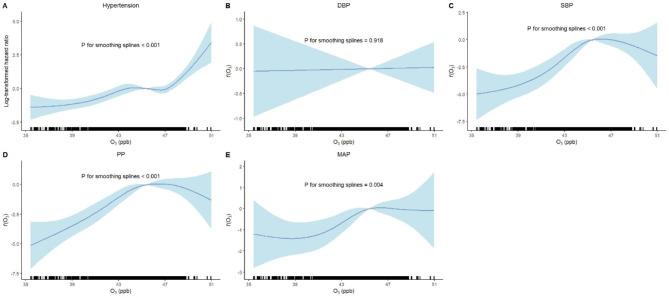
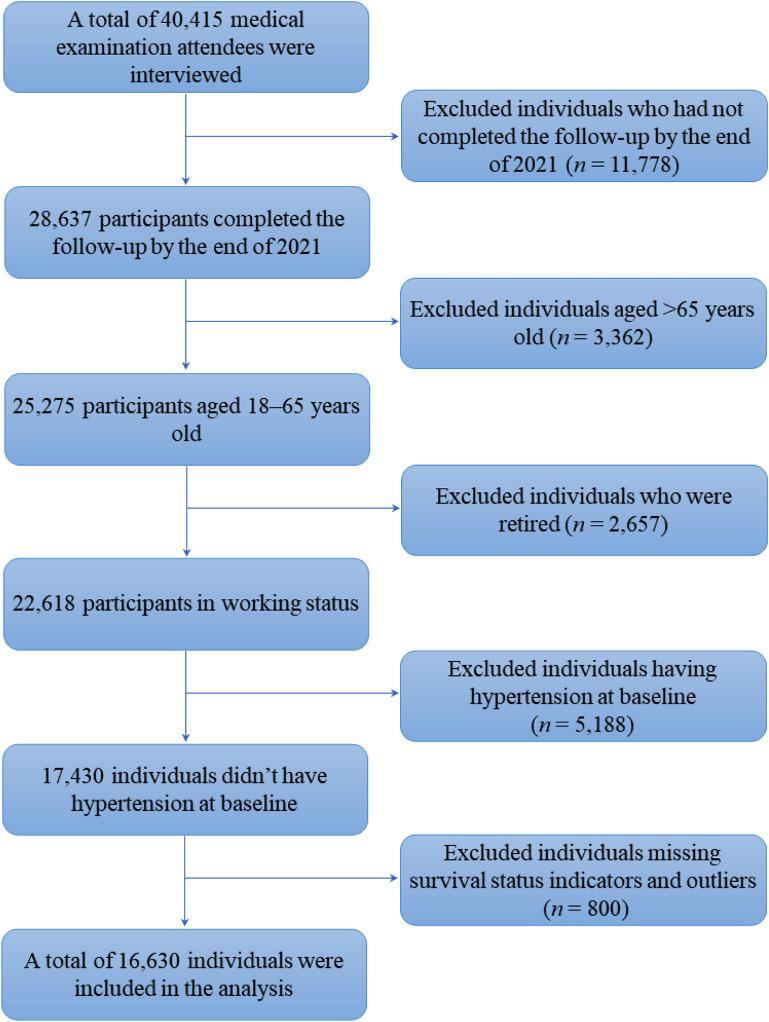
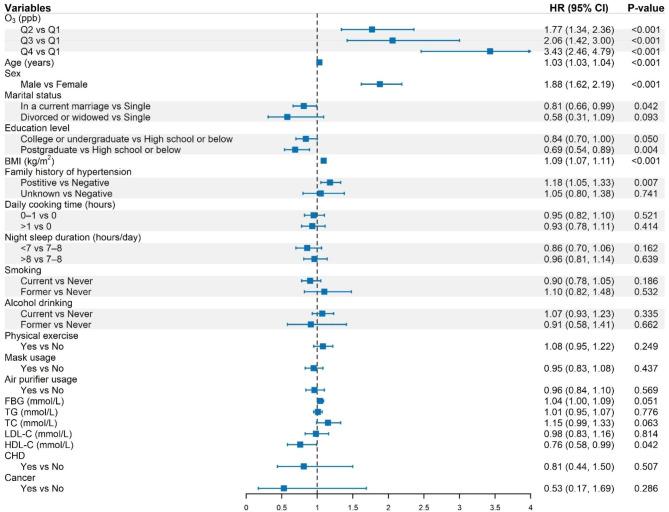
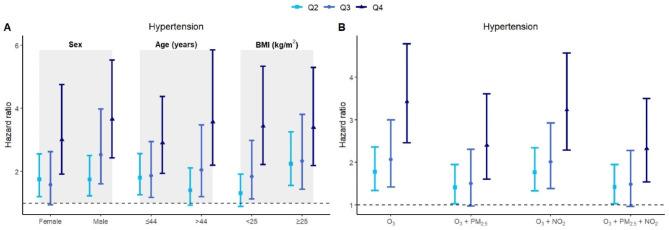
A total of 16,630 hypertension-free working participants at baseline finished the follow-up. The mean (SD) O exposure was 45.26 (2.70) ppb. The cumulative incidence of hypertension was 7.11 (95% CI: 6.76, 7.47) per 100 person-years. Long-term O exposure was independently, positively and non-linearly associated with incident hypertension (Hazard ratios (95% CI) for Q2, Q3, and Q4 were 1.77 (1.34, 2.36), 2.06 (1.42, 3.00) and 3.43 (2.46, 4.79), respectively, as compared with the first quartile (Q1)), DBP (β (95% CI) was 0.65 (0.01, 1.30) for Q2, as compared to Q1), SBP (β (95% CI) was 2.88 (2.00, 3.77), 2.49 (1.36, 3.61) and 2.61 (1.64, 3.58) for Q2, Q3, and Q4, respectively), PP (β (95% CI) was 2.12 (1.36, 2.87), 2.03 (1.18, 2.87) and 2.14 (1.38, 2.90) for Q2, Q3, and Q4, respectively), and MAP (β (95% CI) was 1.39 (0.76, 2.02), 1.04 (0.24, 1.84) and 1.12 (0.43, 1.82) for Q2, Q3, and Q4, respectively). The associations were robust across sex, age, BMI, and when considering PM and NO.
CONCLUSIONS
To our knowledge, this is the first cohort study in the general population that demonstrates the non-linear hypertensive effects of long-term O exposure. The findings are particularly relevant for policymakers and researchers involved in ambient pollution and public health, supporting the integration of reduction of ambient O into public health interventions.
背景
目前关于长期暴露于环境臭氧(O3)对高血压的影响,仅有少量的纵向证据。本研究旨在探讨一般职业成年人长期工作场所 O3 暴露与新发高血压、舒张压(DBP)、收缩压(SBP)、脉压(PP)和平均动脉压(MAP)之间的关联。
方法
我们通过多阶段分层聚类抽样,对超过 30000 名体检参与者进行了队列研究。参与者完成了标准问卷和全面体检。使用两阶段机器学习模型估算每个在职参与者工作场所的三年环境 O3 浓度。使用混合效应 Cox 比例风险模型和线性混合效应模型分别检验 O3 浓度对新发高血压和血压参数的影响。使用广义加性混合模型来探索非线性浓度-反应关系。
结果
共有 16630 名基线时无高血压的工作参与者完成了随访。O3 暴露的平均(SD)值为 45.26(2.70)ppb。高血压的累积发病率为每 100 人年 7.11(95%CI:6.76,7.47)。长期 O3 暴露与新发高血压呈独立、正相关和非线性关系(Q2、Q3 和 Q4 的风险比(95%CI)分别为 1.77(1.34,2.36)、2.06(1.42,3.00)和 3.43(2.46,4.79),与第一四分位数(Q1)相比),DBP(Q2 与 Q1 相比,β(95%CI)为 0.65(0.01,1.30))、SBP(β(95%CI)为 2.88(2.00,3.77)、2.49(1.36,3.61)和 2.61(1.64,3.58),Q2、Q3 和 Q4 分别),PP(β(95%CI)为 2.12(1.36,2.87)、2.03(1.18,2.87)和 2.14(1.38,2.90),Q2、Q3 和 Q4 分别)和 MAP(β(95%CI)为 1.39(0.76,2.02)、1.04(0.24,1.84)和 1.12(0.43,1.82),Q2、Q3 和 Q4 分别)。这些关联在性别、年龄、BMI 以及考虑 PM 和 NO 时都是稳健的。
结论
据我们所知,这是在一般人群中进行的第一项关于长期 O3 暴露对高血压的非线性影响的队列研究。研究结果对于参与大气污染和公共卫生的政策制定者和研究人员特别相关,支持将减少大气 O3 纳入公共卫生干预措施。

 Zotero 插件