
欧洲人群中2019冠状病毒病的易感性、严重程度及精神障碍风险:一项孟德尔随机化研究
Susceptibility and severity of COVID-19 and risk of psychiatric disorders in European populations: a Mendelian randomization study.
作者信息
Xue Hua, Zeng Li, Liu Shuangjuan
机构信息
Department of Neurology, Sichuan Taikang Hospital, Chengdu, China.
Department of Respiratory, Affiliated Hospital of Youjiang Medical University for Nationalities, Baise, China.
出版信息
Front Psychiatry. 2023 Oct 5;14:1253051. doi: 10.3389/fpsyt.2023.1253051. eCollection 2023.
BACKGROUND
Observational studies have suggested that COVID-19 increases the prevalence of psychiatric disorders, but the results of such studies are inconsistent. This study aims to investigate the association between COVID-19 and the risk of psychiatric disorders using Mendelian randomization (MR) analysis.
METHODS
We used summary statistics from COVID-19 Host Genetics Initiative genome-wide association study (GWAS) of COVID-19 involving 2,586,691 participants from European ancestry. Genetic variations of five psychiatric disorders including autism spectrum disorder (ASD) ( = 46,351), bipolar disorder (BID) ( = 51,710), major depressive disorder (MDD) ( = 480,359), anxiety disorder ( = 83,566), and schizophrenia (SCZ) ( = 77,096) were extracted from several GWAS of European ancestry. The inverse-variance weighted (IVW) method as the main MR analysis conducted. We further performed sensitivity analyzes and heterogeneity analyzes as validation of primary MR results.
RESULTS
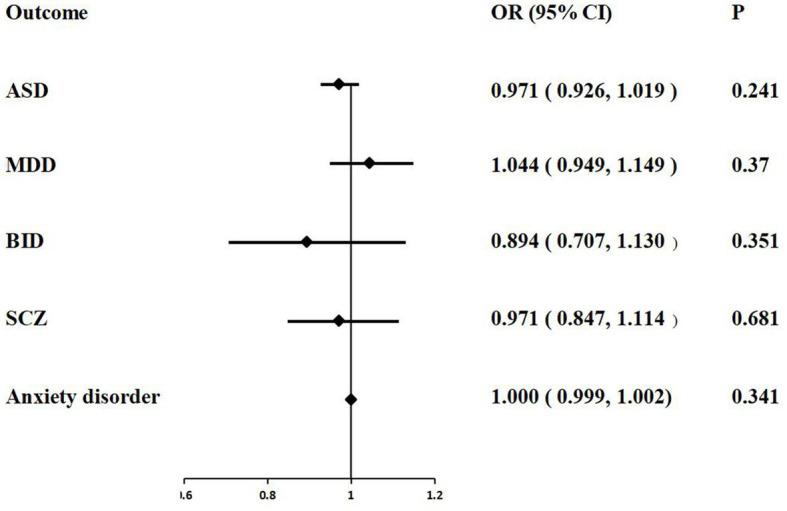
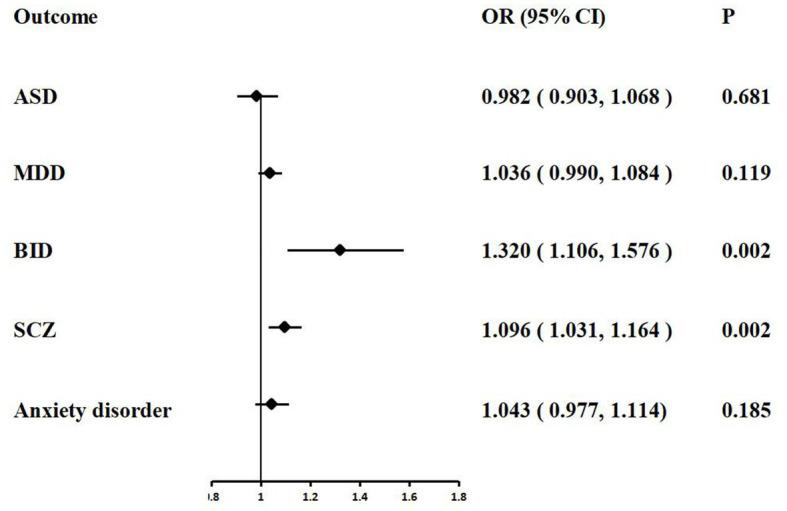
The IVW analysis found that COVID-19 hospitalization phenotype was the risk factor for BID (OR = 1.320, 95% CI = 1.106-1.576, = 0.002) and SCZ (OR = 1.096, 95% CI = 1.031-1.164, = 0.002). Moreover, we detected a significant positive genetic correlation between COVID-19 severity and two psychiatric traits, BID (OR = 1.139, 95% CI = 1.033-1.256, = 0.008) and SCZ (OR = 1.043, 95% CI = 1.005-1.082, = 0.024). There was no evidence supporting the causal relationship between COVID-19 susceptibility and psychiatric disorders.
CONCLUSION
Our results found that the COVID-19 hospitalization phenotype and COVID-19 severity phenotype might be the potential risks of BID and SCZ in European populations. Therefore, patients infected with SARS-CoV-2 should have enhanced monitoring of their mental status.
背景
观察性研究表明,新型冠状病毒肺炎(COVID-19)会增加精神障碍的患病率,但此类研究结果并不一致。本研究旨在利用孟德尔随机化(MR)分析调查COVID-19与精神障碍风险之间的关联。
方法
我们使用了COVID-19宿主遗传学倡议全基因组关联研究(GWAS)的汇总统计数据,该研究涉及2586691名欧洲血统参与者。从几项欧洲血统的GWAS中提取了包括自闭症谱系障碍(ASD)(n = 46351)、双相情感障碍(BID)(n = 51710)、重度抑郁症(MDD)(n = 480359)、焦虑症(n = 83566)和精神分裂症(SCZ)(n = 77096)在内的五种精神障碍的基因变异。采用逆方差加权(IVW)法作为主要的MR分析方法。我们进一步进行了敏感性分析和异质性分析,以验证主要MR结果。
结果
IVW分析发现,COVID-19住院表型是BID(比值比[OR]=1.320,95%置信区间[CI]=1.106-1.576,P = 0.002)和SCZ(OR = 1.096,95%CI = 1.031-1.164,P = 0.002)的危险因素。此外,我们检测到COVID-19严重程度与两种精神特质BID(OR = 1.139,95%CI = 1.033-1.256,P = 0.008)和SCZ(OR = 1.043,95%CI = 1.005-1.082,P = 0.024)之间存在显著的正遗传相关性。没有证据支持COVID-19易感性与精神障碍之间存在因果关系。
结论
我们的研究结果发现,COVID-19住院表型和COVID-19严重程度表型可能是欧洲人群中BID和SCZ的潜在风险因素。因此,感染严重急性呼吸综合征冠状病毒2(SARS-CoV-2)的患者应加强对其精神状态的监测。


 Zotero 插件