
给予抗S100A4抗体可减轻哮喘小鼠的支气管上皮-间质转化。
Anti-S100A4 antibody administration alleviates bronchial epithelial-mesenchymal transition in asthmatic mice.
作者信息
Liu Shuang, Liu Min, Zhong Jinnan, Chen Shi, Wang Ziming, Gao Xiaoyan, Li Fajiu
机构信息
Department of Respiratory and Critical Care Medicine, Affiliated Hospital of Jianghan University, Wuhan 430000, Hubei, China.
Department of Respiratory and Critical Care Medicine, Affiliated Hospital of Jianghan University, No. 168, Hong Kong Road, Jiang'an District, Wuhan 430000, Hubei, China.
出版信息
Open Med (Wars). 2023 Oct 17;18(1):20220622. doi: 10.1515/med-2022-0622. eCollection 2023.
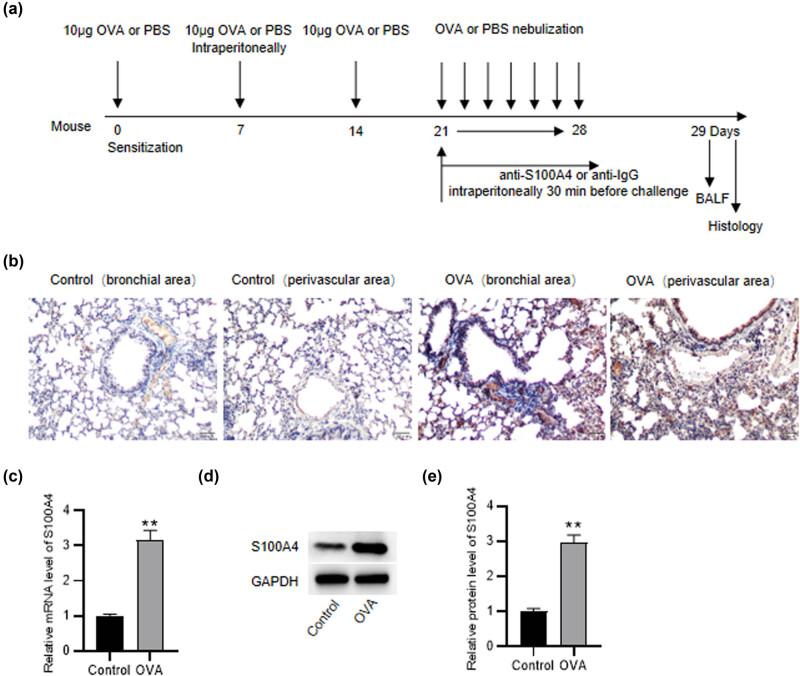
We elucidated the effect of S100A4 on airway remodeling by regulating airway inflammation and epithelial-mesenchymal transition (EMT) in mouse models of asthma. Asthmatic mouse models were established by sensitization and challenged with ovalbumin (OVA). Anti-S100A4 antibody or control IgG antibody was administered daily before the OVA challenge. After the last challenge, airway inflammation and airway hyperresponsiveness were measured; lung tissues and bronchoalveolar lavage fluid (BALF) were harvested. Lung tissue sections were stained and evaluated for pathological changes. Levels of inflammatory cytokines were measured using ELISA. Levels of S100A4 and EMT markers were determined via western blotting analysis. Human bronchial epithelial cells were stimulated with 100 mg/mL house dust mites (HDMs) to evaluate the effect of S100A4 downregulation on EMT . S100A4 was increased in lung tissues and BALF from asthmatic mice. The asthmatic mice presented airway hyperresponsiveness, airway inflammation, and airway remodeling. After anti-S100A4 antibody administration, pathophysiological signs, including airway hyperresponsiveness and increased infiltration of inflammatory cells, were attenuated. Additionally, anti-S100A4 administration downregulated vimentin and α-SMA expression and upregulated E-cadherin expression in OVA-challenged mice. S100A4 downregulation also inhibited EMT process in HDM-stimulated 16HBE cells. Anti-S100A4 antibody administration alters airway remodeling by preventing EMT in mouse models of asthma.
我们通过调节哮喘小鼠模型中的气道炎症和上皮-间质转化(EMT),阐明了S100A4对气道重塑的影响。通过致敏和用卵清蛋白(OVA)激发建立哮喘小鼠模型。在OVA激发前每天给予抗S100A4抗体或对照IgG抗体。最后一次激发后,测量气道炎症和气道高反应性;收集肺组织和支气管肺泡灌洗液(BALF)。对肺组织切片进行染色并评估病理变化。使用酶联免疫吸附测定(ELISA)测量炎性细胞因子水平。通过蛋白质印迹分析确定S100A4和EMT标志物的水平。用100μg/mL屋尘螨(HDM)刺激人支气管上皮细胞,以评估S100A4下调对EMT的影响。哮喘小鼠的肺组织和BALF中S100A4增加。哮喘小鼠出现气道高反应性、气道炎症和气道重塑。给予抗S100A4抗体后,包括气道高反应性和炎性细胞浸润增加在内的病理生理体征得到减轻。此外,给予抗S100A4可下调OVA激发小鼠中波形蛋白和α-平滑肌肌动蛋白(α-SMA)的表达,并上调E-钙黏蛋白的表达。S100A4下调还抑制了HDM刺激的16HBE细胞中的EMT过程。给予抗S100A4抗体通过在哮喘小鼠模型中阻止EMT来改变气道重塑。



 Zotero 插件