
乐伐替尼通过抑制晚期肝细胞癌肿瘤微环境中的免疫抑制浸润来激活抗肿瘤免疫。
Lenvatinib activates anti-tumor immunity by suppressing immunoinhibitory infiltrates in the tumor microenvironment of advanced hepatocellular carcinoma.
作者信息
Yamauchi Masami, Ono Atsushi, Amioka Kei, Fujii Yasutoshi, Nakahara Hikaru, Teraoka Yuji, Uchikawa Shinsuke, Fujino Hatsue, Nakahara Takashi, Murakami Eisuke, Okamoto Wataru, Miki Daiki, Kawaoka Tomokazu, Tsuge Masataka, Imamura Michio, Hayes C Nelson, Ohishi Waka, Kishi Takeshi, Kimura Mizuki, Suzuki Natsumi, Arihiro Koji, Aikata Hiroshi, Chayama Kazuaki, Oka Shiro
机构信息
Department of Gastroenterology, Graduate School of Biomedical and Health Sciences, Hiroshima University, Hiroshima, Japan.
Department of Clinical and Molecular Genetics, Hiroshima University, Hiroshima, Japan.
出版信息
Commun Med (Lond). 2023 Oct 25;3(1):152. doi: 10.1038/s43856-023-00390-x.
BACKGROUND
Lenvatinib, a multiple receptor tyrosine kinase inhibitor, might exert antitumor effects via tumor immune modulation. However, changes in the tumor immune microenvironment induced by lenvatinib are poorly understood. We investigated the effect of lenvatinib on immune features in clinical samples from patients with hepatocellular carcinoma.
METHODS
Fifty-one patients with advanced hepatocellular carcinoma who received lenvatinib monotherapy as first-line treatment were enrolled. We collected blood sample (n = 51) and tumor tissue (n, baseline/four weeks after treatment initiation/post-progression = 50/8/12). DNA, RNA, and proteins extracted from the tissues were subjected to multi-omics analysis, and patients were classified into two groups according to baseline immune status. Each group was investigated in terms of the dynamics of tumor signaling. We also longitudinally analyzed circulating immune proteins and chemokines in peripheral blood.
RESULTS
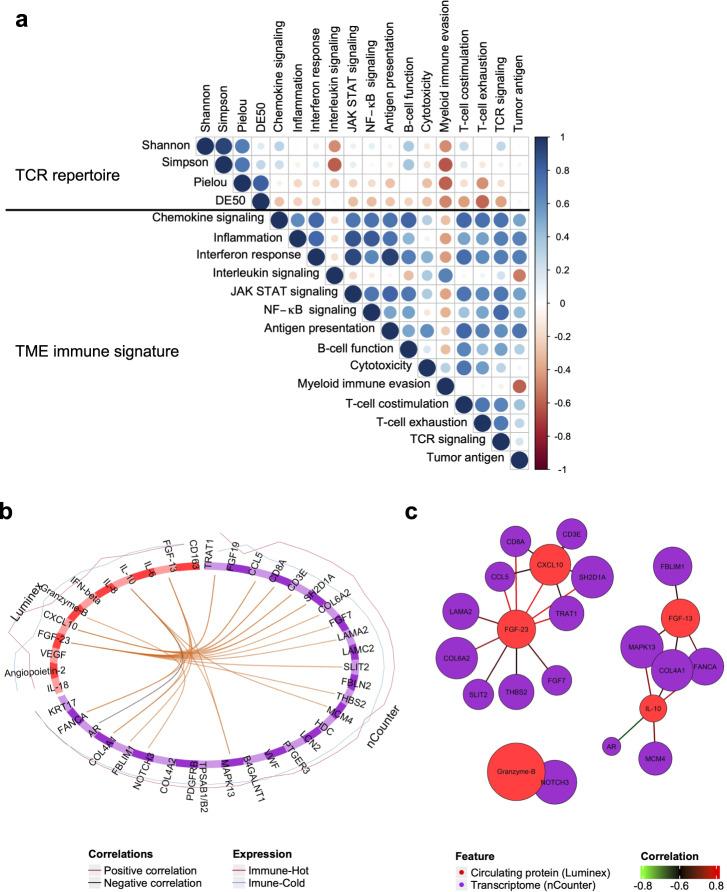
Here we show that lenvatinib has similar anti-tumor efficacy with objective response rate and progression-free survival in both Immune-Hot and Immune-Cold subtypes. Immune signatures associated with T-cell functions and interferon responses are enriched in the early phase of treatment, while signatures associated with immunoinhibitory cells are downregulated along with efficient vascular endothelial growth factor receptor and fibroblast growth factor receptor blockades. These findings are supported by imaging mass cytometry, T-cell receptor repertoire analysis and kinetics of circulating proteins. We also identify interleukin-8 and angiopoietin-2 as possible targets of intervention to overcome resistance to existing immunotherapies.
CONCLUSIONS
Our findings show the ability of lenvatinib to modulate tumor immunity in clinical samples of hepatocellular carcinoma.
背景
仑伐替尼是一种多受体酪氨酸激酶抑制剂,可能通过肿瘤免疫调节发挥抗肿瘤作用。然而,对于仑伐替尼诱导的肿瘤免疫微环境变化知之甚少。我们研究了仑伐替尼对肝细胞癌患者临床样本中免疫特征的影响。
方法
纳入51例接受仑伐替尼单药一线治疗的晚期肝细胞癌患者。我们采集了血液样本(n = 51)和肿瘤组织(n,基线/治疗开始后四周/疾病进展后 = 50/8/12)。从组织中提取的DNA、RNA和蛋白质进行多组学分析,并根据基线免疫状态将患者分为两组。对每组的肿瘤信号动态进行研究。我们还纵向分析了外周血中循环免疫蛋白和趋化因子。
结果
我们发现,仑伐替尼在免疫热和免疫冷亚型中具有相似的抗肿瘤疗效,客观缓解率和无进展生存期相近。与T细胞功能和干扰素反应相关的免疫特征在治疗早期富集,而与免疫抑制细胞相关的特征随着有效的血管内皮生长因子受体和成纤维细胞生长因子受体阻断而下调。这些发现得到了成像质谱流式细胞术、T细胞受体库分析和循环蛋白动力学的支持。我们还确定白细胞介素-8和血管生成素-2是克服对现有免疫疗法耐药性的可能干预靶点。
结论
我们的研究结果显示了仑伐替尼在肝细胞癌临床样本中调节肿瘤免疫的能力。


 Zotero 插件