
Sox2和βIII-微管蛋白作为低分化鼻窦癌耐药性的生物标志物
Sox2 and βIII-Tubulin as Biomarkers of Drug Resistance in Poorly Differentiated Sinonasal Carcinomas.
作者信息
López Luis, Fernández-Vañes Laura, Cabal Virginia N, García-Marín Rocío, Suárez-Fernández Laura, Codina-Martínez Helena, Lorenzo-Guerra Sara L, Vivanco Blanca, Blanco-Lorenzo Verónica, Llorente José L, López Fernando, Hermsen Mario A
机构信息
Department of Otolaryngology, Hospital Universitario Central de Asturias, 33011 Oviedo, Spain.
Department of Head and Neck Cancer, Instituto de Investigación Sanitaria del Principado de Asturias (ISPA), 33011 Oviedo, Spain.
出版信息
J Pers Med. 2023 Oct 18;13(10):1504. doi: 10.3390/jpm13101504.
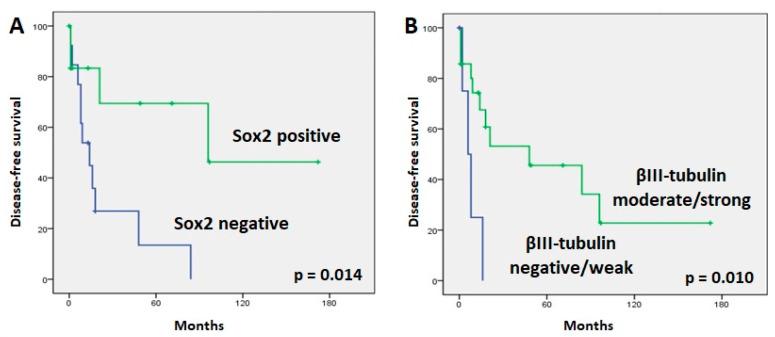
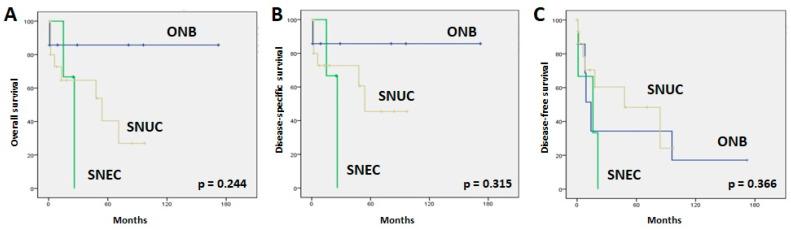
Poorly differentiated sinonasal carcinomas (PDCs) are tumors that have a poor prognosis despite advances in classical treatment. Predictive and prognostic markers and new personalized treatments could improve the oncological outcomes of patients. In this study, we analyzed SOX2 and βIII-tubulin as biomarkers that could have prognostic and therapeutic impacts on these tumors. The cohort included 57 cases of PDCs: 36 sinonasal undifferentiated carcinoma (SNUC) cases, 13 olfactory neuroblastoma (ONB) cases, and 8 sinonasal neuroendocrine carcinoma (SNEC) cases. Clinical follow-up data were available for 26 of these cases. Sox2 expression was detected using immunohistochemistry in 6 (75%) SNEC cases, 19 (53%) SNUC cases, and 6 (46%) ONB cases. The absence of Sox2 staining correlated with a higher rate of recurrence ( = 0.015), especially distant recurrence. The majority of cases showed βIII-tubulin expression, with strong positivity in 85%, 75%, and 64% of SNEC, ONB, and SNUC cases, respectively. Tumors with stronger βIII-tubulin expression demonstrated longer disease-free survival than those with no expression or low expression ( = 0.049). Sox2 and βIII-tubulin expression is common in poorly differentiated sinonasal tumors and has prognostic and therapeutic utility.
低分化鼻窦癌(PDCs)是一类尽管经典治疗方法有所进步但预后仍较差的肿瘤。预测性和预后性标志物以及新的个性化治疗方法可能会改善患者的肿瘤学结局。在本研究中,我们分析了SOX2和βIII微管蛋白作为可能对这些肿瘤具有预后和治疗影响的生物标志物。该队列包括57例PDCs病例:36例鼻窦未分化癌(SNUC)病例、13例嗅神经母细胞瘤(ONB)病例和8例鼻窦神经内分泌癌(SNEC)病例。其中26例有临床随访数据。采用免疫组织化学法检测发现,6例(75%)SNEC病例、19例(53%)SNUC病例和6例(46%)ONB病例中存在Sox2表达。Sox2染色缺失与较高的复发率相关(=0.015),尤其是远处复发。大多数病例显示βIII微管蛋白表达,分别在85%、75%和64%的SNEC、ONB和SNUC病例中呈强阳性。βIII微管蛋白表达较强的肿瘤比无表达或低表达的肿瘤显示出更长的无病生存期(=0.049)。Sox2和βIII微管蛋白表达在低分化鼻窦肿瘤中常见,具有预后和治疗价值。

 Zotero 插件