
海洋菌 Rhodococcus pyridinivorans P23 膜锚定 PET 酯酶对 PET 的生物降解。
Biodegradation of PET by the membrane-anchored PET esterase from the marine bacterium Rhodococcus pyridinivorans P23.
机构信息
Key Laboratory of Marine Biogenetic Resources, Third Institute of Oceanography, Ministry of Natural Resources, 361005, Xiamen, Fujian, China.
College of Environment and Ecology, Xiamen University, 361005, Xiamen, Fujian, China.
出版信息
Commun Biol. 2023 Oct 27;6(1):1090. doi: 10.1038/s42003-023-05470-1.
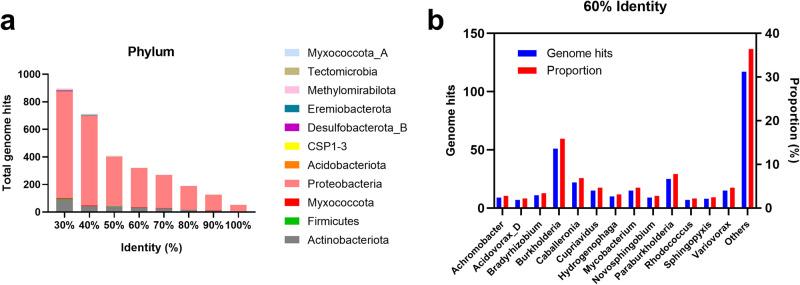
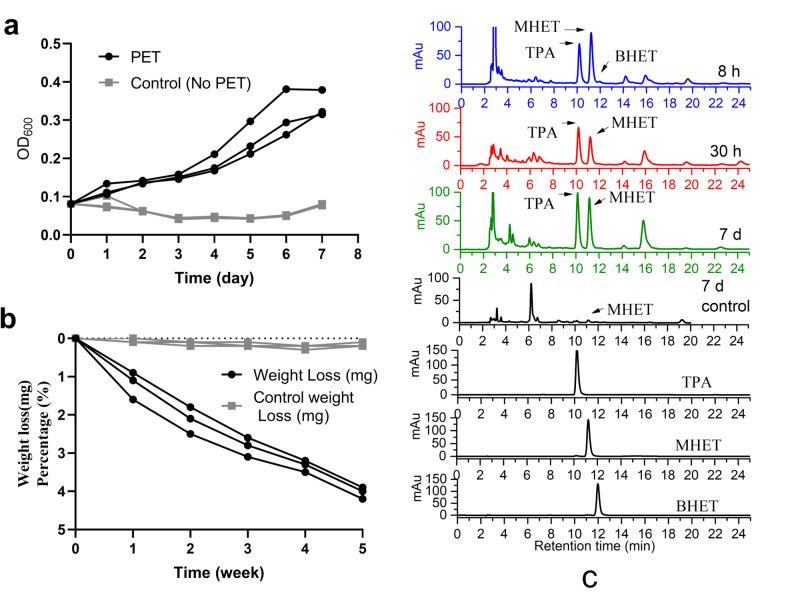
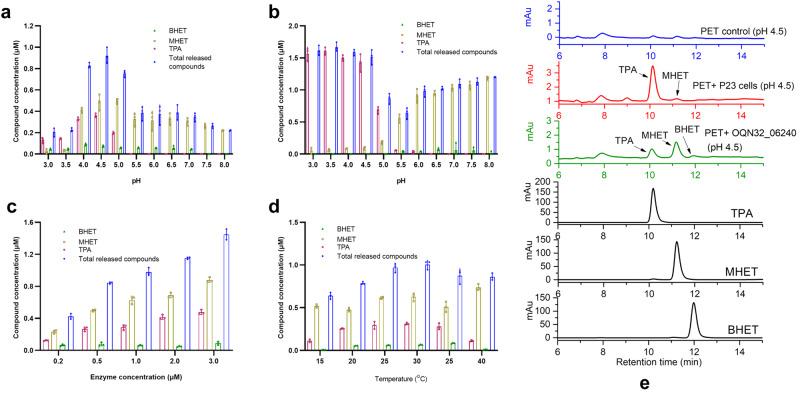
Evidence for microbial biodegradation of polyethylene terephthalate (PET) has been reported, but little is known about the PET biodegradation process and molecular mechanism by marine microorganisms. Here, we show the biodegradation of PET by the membrane-anchored PET esterase from the marine bacterium Rhodococcus pyridinivorans P23, elucidate the properties of this enzyme, and propose the PET biodegradation by this strain in biofilm. We identify the PET-degrading enzyme dubbed PET esterase through activity tracking. In addition to depolymerizing PET, it hydrolyzes MHET into TPA under acid conditions. We prove that it is a low and constitutively transcribed, membrane-anchored protein displayed on the cell surface. Furthermore, we also investigate the microbial groups possessing PET esterase coupled with the TPA degradation pathway, mainly in the phyla Proteobacteria and Actinobacteriota. Clarification of the microbial PET biodegradation in the marine environment will contribute to the understanding of bioremediation of marine PET pollution.
已经有报道称微生物可以生物降解聚对苯二甲酸乙二醇酯(PET),但人们对海洋微生物的 PET 生物降解过程和分子机制知之甚少。在这里,我们展示了海洋细菌 Rhodococcus pyridinivorans P23 中膜锚定的 PET 酯酶对 PET 的生物降解作用,阐明了该酶的性质,并提出了该菌株在生物膜中进行 PET 生物降解的假设。我们通过活性追踪鉴定了这种被称为 PET 酯酶的 PET 降解酶。除了降解 PET 外,它还能在酸性条件下将 MHET 水解成 TPA。我们证明它是一种低表达且组成型转录的、膜锚定的蛋白,呈现在细胞表面。此外,我们还研究了具有 PET 酯酶和 TPA 降解途径的微生物群,主要分布在变形菌门和放线菌门中。阐明海洋环境中微生物对 PET 的生物降解将有助于了解海洋中 PET 污染的生物修复。




 Zotero 插件