
基于数据的饮食模式与肺癌风险的相关性:系统综述和剂量反应荟萃分析。
Adherence to Data-Driven Dietary Patterns and Lung Cancer Risk: A Systematic Review and Dose-Response Meta-Analysis.
机构信息
Department of Chemistry, Biology and Biotechnology, University of Perugia, 06123 Perugia, Italy.
Department of Biomedical Sciences and Public Health, Section of Hygiene, Preventive Medicine and Public Health, Polytechnic University of the Marche Region, 60126 Ancona, Italy.
出版信息
Nutrients. 2023 Oct 17;15(20):4406. doi: 10.3390/nu15204406.
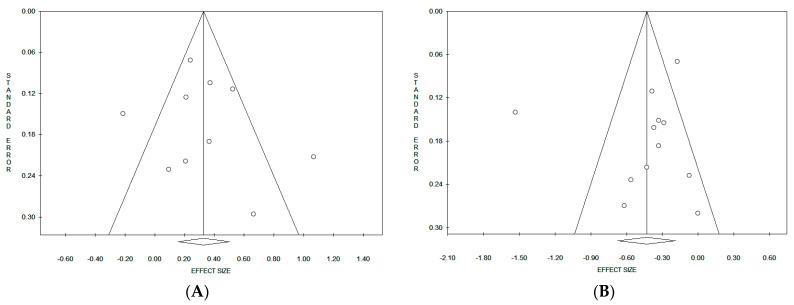
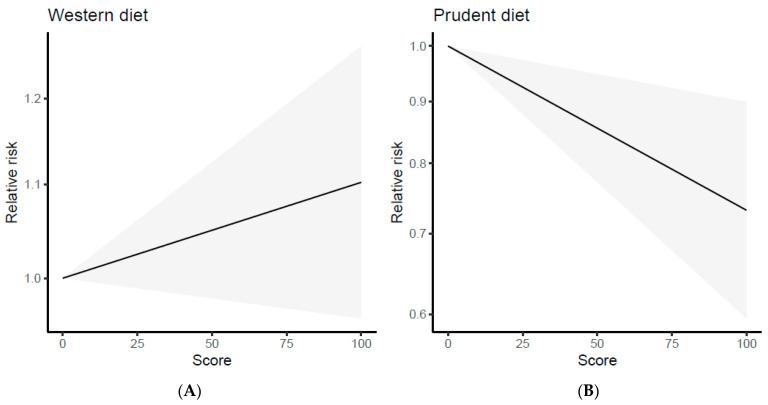
The effect of dietary patterns on lung cancer risk is currently debated. In this study, we evaluated the association between different "a posteriori" dietary patterns and lung cancer risk. The search was carried out (February 2023) through Scopus, Web of Science, and PubMed databases. Meta-analysis was performed by a random-effects model using risk values (RR and OR) extracted from the 12 selected studies. Two main dietary patterns were identified and named "Western/meat" and "Healthy/prudent". The highest adherence to the "Western/meat" dietary pattern significantly increased the lung cancer risk (OR = 1.39; 95% CI: 1.17-1.65; = 0.0002) while the highest adherence to the "Healthy/prudent" pattern reduced it (OR = 0.65; 95% CI: 0.51-0.83; = 0.001). A linear trend between both dietary patterns and lung cancer risk was observed. However, a statistically significant inverse dose-response trend was found only for the "Healthy/prudent" dietary pattern (regression coefficient = -0.0031, = 0.003). Subgroup analyses showed that the "Western/meat" pattern significantly increased the lung cancer risk in former ( = 4) (OR = 1.93, 95% CI: 1.11-3.36) and current smokers ( = 7) (OR = 1.35, 95% CI: 1.06-1.71). Similarly, the "Healthy/prudent" pattern exerts a protective effect on former ( = 4) (OR = 0.61, 95% CI: 0.44-0.85) and current smokers ( = 8) (OR = 0.64, 95% CI: 0.46-0.88). For both dietary patterns, no significant effect was observed on never-smokers.
饮食模式对肺癌风险的影响目前存在争议。本研究评估了不同“后天”饮食模式与肺癌风险之间的关系。检索(2023 年 2 月)通过 Scopus、Web of Science 和 PubMed 数据库进行。通过从 12 项选定研究中提取的风险值(RR 和 OR),使用随机效应模型进行荟萃分析。确定并命名了两种主要的饮食模式,分别为“西方/肉类”和“健康/谨慎”。对“西方/肉类”饮食模式的最高依从性显著增加了肺癌风险(OR = 1.39;95%CI:1.17-1.65; = 0.0002),而对“健康/谨慎”模式的最高依从性降低了肺癌风险(OR = 0.65;95%CI:0.51-0.83; = 0.001)。观察到两种饮食模式与肺癌风险之间存在线性趋势。然而,仅对“健康/谨慎”饮食模式发现了统计学上显著的反向剂量-反应趋势(回归系数= -0.0031, = 0.003)。亚组分析表明,“西方/肉类”模式在前吸烟者( = 4)(OR = 1.93,95%CI:1.11-3.36)和现吸烟者( = 7)(OR = 1.35,95%CI:1.06-1.71)中显著增加肺癌风险。同样,“健康/谨慎”模式对前吸烟者( = 4)(OR = 0.61,95%CI:0.44-0.85)和现吸烟者( = 8)(OR = 0.64,95%CI:0.46-0.88)有保护作用。对于这两种饮食模式,在从不吸烟者中均未观察到显著影响。


 Zotero 插件