
脊髓5-羟色胺能系统参与[6]-姜辣素对小鼠奥沙利铂诱导的神经性疼痛的镇痛作用
Involvement of the Spinal Serotonergic System in the Analgesic Effect of [6]-Shogaol in Oxaliplatin-Induced Neuropathic Pain in Mice.
作者信息
Gang Juan, Park Keun-Tae, Kim Suyong, Kim Woojin
机构信息
Department of East-West Medicine, Graduate School, Kyung Hee University, Seoul 02447, Republic of Korea.
Department of Physiology, College of Korean Medicine, Kyung Hee University, Seoul 02453, Republic of Korea.
出版信息
Pharmaceuticals (Basel). 2023 Oct 15;16(10):1465. doi: 10.3390/ph16101465.
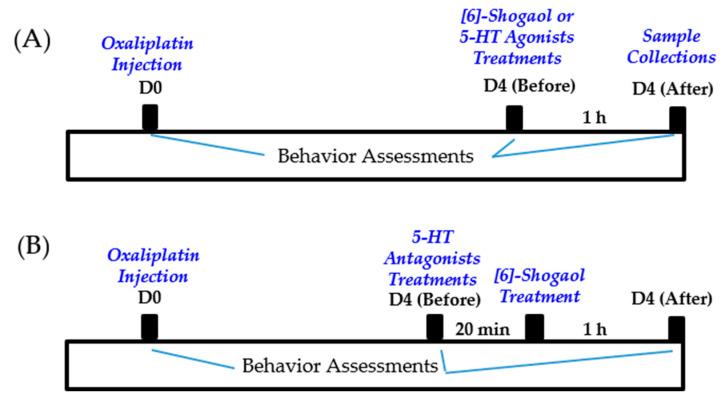
Oxaliplatin is a chemotherapy drug that can induce severe acute neuropathy in patients within hours of treatment. In our previous study, 10 mg/kg [6]-shogaol (i.p.) significantly alleviated cold and mechanical allodynia induced by a 6 mg/kg oxaliplatin injection (i.p.); however, the precise serotonin-modulatory effect has not been investigated. In this study, we showed that intrathecal injections of NAN-190 (5-HT receptor antagonist, 1 µg) and MDL-72222 (5-HT receptor antagonist, 15 µg), but not ketanserin (5-HT receptor antagonist, 1 µg), significantly blocked the analgesic effect of [6]-shogaol (10 mg/kg, i.p.). Furthermore, the gene expression of the serotonin-synthesizing enzyme tryptophan hydroxylase 2 (TPH2) and serotonin levels in the spinal cord and serum were significantly downregulated ( < 0.0001 and = 0.0002) and upregulated ( = 0.0298 and = 0.0099) after oxaliplatin and [6]-shogaol administration, respectively. Moreover, both the gene and protein expression of the spinal serotonin receptors 5-HT and 5-HT significantly increased after [6]-shogaol injections ( < 0.0001). Finally, intrathecal injections of both receptor agonists (8-OH-DPAT; 5-HT receptor agonist, 10 µg and m-CPBG; 5-HT receptor agonist, 15 µg) mimicked the effects of [6]-shogaol in oxaliplatin-injected mice. Taken together, these results demonstrate that [6]-shogaol attenuates oxaliplatin-induced neuropathic pain by modulating the spinal serotoninergic system.
奥沙利铂是一种化疗药物,可在治疗数小时内使患者诱发严重的急性神经病变。在我们之前的研究中,10毫克/千克的[6]-姜辣素(腹腔注射)可显著减轻6毫克/千克奥沙利铂注射(腹腔注射)诱发的冷和机械性异常性疼痛;然而,其确切的血清素调节作用尚未得到研究。在本研究中,我们发现鞘内注射NAN-190(5-羟色胺受体拮抗剂,1微克)和MDL-72222(5-羟色胺受体拮抗剂,15微克),而非酮色林(5-羟色胺受体拮抗剂,1微克),可显著阻断[6]-姜辣素(10毫克/千克,腹腔注射)的镇痛作用。此外,分别给予奥沙利铂和[6]-姜辣素后,脊髓和血清中血清素合成酶色氨酸羟化酶2(TPH2)的基因表达以及血清素水平显著下调(<0.0001和=0.0002)和上调(=0.0298和=0.0099)。此外,注射[6]-姜辣素后,脊髓血清素受体5-HT和5-HT的基因和蛋白表达均显著增加(<0.0001)。最后,鞘内注射两种受体激动剂(8-OH-DPAT;5-羟色胺受体激动剂,10微克和m-CPBG;5-羟色胺受体激动剂,15微克)可模拟[6]-姜辣素对注射奥沙利铂小鼠的作用。综上所述,这些结果表明,[6]-姜辣素通过调节脊髓血清素能系统减轻奥沙利铂诱发的神经性疼痛。


 Zotero 插件