
向健康成年人安全有效地补充铁剂:一项两阶段随机双盲试验——安全铁研究
Safe and effective delivery of supplemental iron to healthy adults: a two-phase, randomized, double-blind trial - the safe iron study.
作者信息
Lewis Erin D, Ortega Edwin F, Dao Maria Carlota, Barger Kathryn, Mason Joel B, Leong John M, Osburne Marcia S, Magoun Loranne, Nepveux V Felix J, Chishti Athar H, Schwake Christopher, Quynh Anh, Gilhooly Cheryl H, Petty Gayle, Guo Weimin, Matuszek Gregory, Pereira Dora, Reddy Manju, Wang Jifan, Wu Dayong, Meydani Simin N, Combs Gerald F
机构信息
Jean Mayer USDA Human Nutrition Research Center on Aging, Tufts University, Boston, MA, United States.
Department of Molecular Biology and Microbiology, Tufts University, Boston, MA, United States.
出版信息
Front Nutr. 2023 Oct 11;10:1230061. doi: 10.3389/fnut.2023.1230061. eCollection 2023.
INTRODUCTION
The safety of novel forms of iron in healthy, iron-replete adults as might occur if used in population-based iron supplementation programs was examined. We tested the hypotheses that supplementation with nanoparticulate iron hydroxide adipate tartrate (IHAT), an iron-enriched product (ASP), or ferrous sulphate heptahydrate (FS) are safe as indicated by erythrocyte susceptibility to malarial infection, bacterial proliferation, and gut inflammation. Responses to FS administered daily or weekly, and with or without other micronutrients were compared.
METHODS
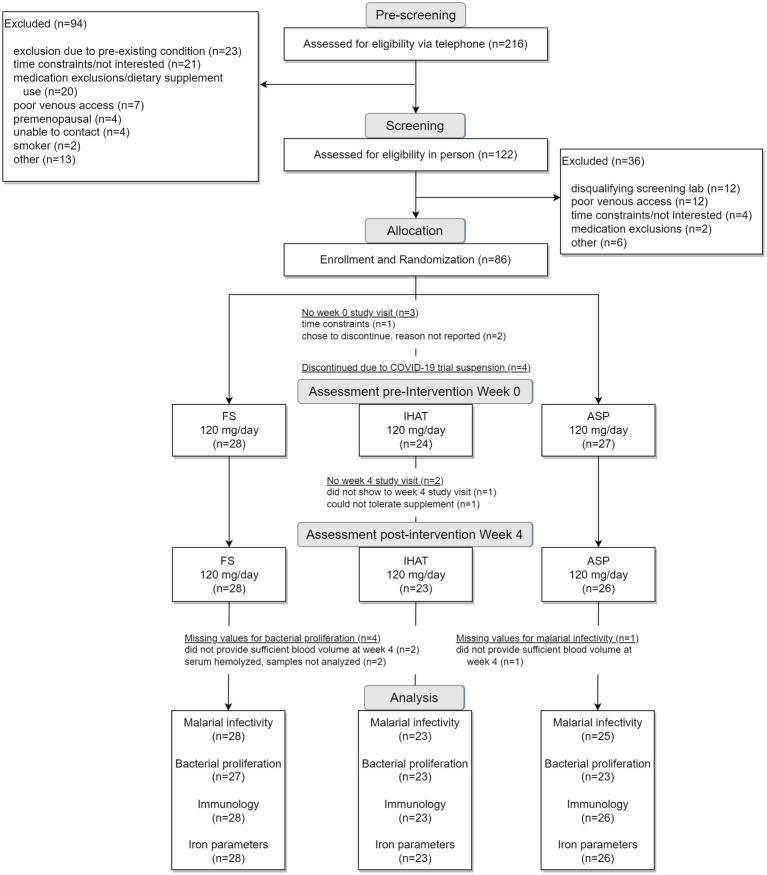
Two phases of randomized, double-blinded trials were conducted in Boston, MA. Phase I randomized 160 volunteers to six treatments: placebo, IHAT, ASP, FS, and FS plus a micronutrient powder (MNP) administrated daily at 60 mg Fe/day; and FS administered as a single weekly dose of 420 mg Fe. Phase II randomized 86 volunteers to IHAT, ASP, or FS administered at 120 mg Fe/day. Completing these phases were 151 and 77 participants, respectively. The study was powered to detect effects on primary endpoints: susceptibility of participant erythrocytes to infection by , the proliferation potential of selected pathogenic bacteria in sera, and markers of gut inflammation. Secondary endpoints for which the study was not powered included indicators of iron status and gastrointestinal symptoms.
RESULTS
Supplementation with any form of iron did not affect any primary endpoint. In Phase I, the frequency of gastrointestinal symptoms associated with FS was unaffected by dosing with MNP or weekly administration; but participants taking IHAT more frequently reported abdominal pain (27%, < 0.008) and nausea (4%, = 0.009) than those taking FS, while those taking ASP more frequently reported nausea (8%, = 0.009). Surprisingly, only 9% of participants taking IHAT at 120 mg Fe/day (Phase II) reported abdominal pain and no other group reported that symptom.
DISCUSSION
With respect to the primary endpoints, few differences were found when comparing these forms of iron, indicating that 28 days of 60 or 120 mg/day of IHAT, ASP, or FS may be safe for healthy, iron-replete adults. With respect to other endpoints, subjects receiving IHAT more frequently reported abdominal pain and nausea, suggesting the need for further study.
CLINICAL TRIAL REGISTRATION
ClinicalTrials.gov, NCT03212677; registered: 11 July 2017.
引言
研究了新型铁制剂在健康、铁储备充足的成年人中使用时(如在基于人群的铁补充计划中可能出现的情况)的安全性。我们检验了以下假设:补充纳米颗粒己二酸酒石酸氢氧化铁(IHAT)、一种富铁产品(ASP)或七水硫酸亚铁(FS),根据红细胞对疟疾感染的易感性、细菌增殖和肠道炎症情况表明是安全的。比较了每日或每周服用FS以及是否同时服用其他微量营养素的反应。
方法
在马萨诸塞州波士顿进行了两个阶段的随机双盲试验。第一阶段将160名志愿者随机分为六种治疗组:安慰剂、IHAT、ASP、FS、每日服用60毫克铁的FS加微量营养素粉(MNP);以及每周单次服用420毫克铁的FS。第二阶段将86名志愿者随机分为每日服用120毫克铁的IHAT、ASP或FS组。分别有151名和77名参与者完成了这些阶段。该研究旨在检测对主要终点的影响:参与者红细胞对感染的易感性、血清中选定病原菌的增殖潜力以及肠道炎症标志物。该研究未设定检测能力的次要终点包括铁状态指标和胃肠道症状。
结果
补充任何形式的铁均未影响任何主要终点。在第一阶段,与FS相关的胃肠道症状频率不受MNP给药或每周给药的影响;但服用IHAT的参与者比服用FS的参与者更频繁地报告腹痛(27%,P<0.008)和恶心(4%,P = 0.009),而服用ASP的参与者更频繁地报告恶心(8%,P = 0.009)。令人惊讶的是,在第二阶段每日服用120毫克铁的IHAT的参与者中,只有9%报告腹痛,其他组均未报告该症状。
讨论
关于主要终点,比较这些形式的铁时发现差异很少,表明对于健康、铁储备充足的成年人,28天每日服用60或120毫克的IHAT、ASP或FS可能是安全的。关于其他终点,接受IHAT的受试者更频繁地报告腹痛和恶心,表明需要进一步研究。
临床试验注册
ClinicalTrials.gov,NCT03212677;注册时间:2017年7月11日。


 Zotero 插件