
身体活动、久坐行为与骨关节炎:一项两样本孟德尔随机化分析
Physical Activity, Sedentary Behavior, and Osteoarthritis: A Two-Sample Mendelian Randomization Analysis.
作者信息
Wang Yanpeng, Zhang Yinzhen, Zhao Changwei, Cai Wenjun, Wang Zhengyan, Zhao Wenhai
机构信息
Department of Traditional Chinese Medicine, Changchun University of Chinese Medicine, Changchun 130117, China.
Department of Orthopedics, Affiliated Hospital of Changchun University of Chinese Medicine, Changchun 130021, China.
出版信息
Iran J Public Health. 2023 Oct;52(10):2099-2108. doi: 10.18502/ijph.v52i10.13848.
BACKGROUND
Sedentary behavior and physical activity are still ambiguous in their effects on osteoarthritis. We aimed to evaluate the effects of physical activity and sedentary behavior on osteoarthritis to provide a reference for the prevention of osteoarthritis.
METHODS
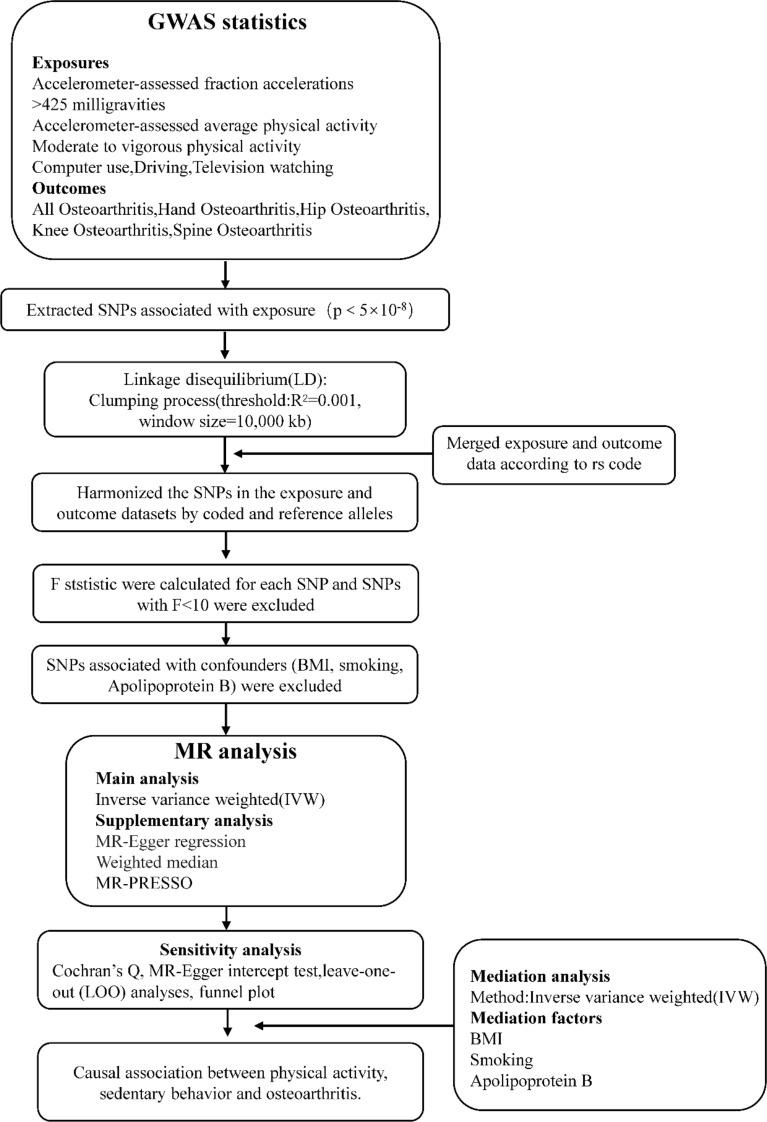
This study was conducted in Changchun, China in 2022. We used two-sample Mendelian randomization with the SNP as an instrumental variable to investigate the effect of physical activity and sedentary behavior on osteoarthritis. In addition, a two-step Mendelian randomization method was used to test whether mediating factors (BMI, smoking, Apolipoprotein B) were involved in mediating the effects of exposure factors on osteoarthritis.
RESULTS
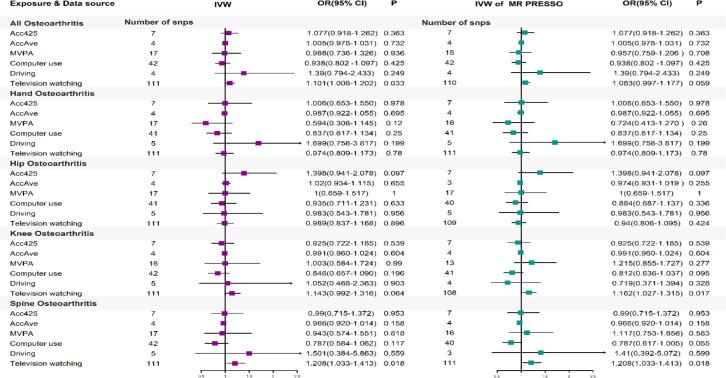
TV watching was causally related to knee osteoarthritis and spine osteoarthritis, and they were positively correlated (knee osteoarthritis: OR=1.162,95 %CI: 1.027-1.315, =0.017; spine osteoarthritis: OR=1.208,95 %CI: 1.033-1.413, =0.018). BMI played a mediating role in the process of TV watching with knee osteoarthritis and spine osteoarthritis. ((The proportion of BMI mediating effect: knee osteoarthritis: 47.1% (95% CI: 36.7%63.2%); spine osteoarthritis: 29.5% (95% CI: 19.3%40.8%)). The proportion of Smoking mediating effect in the process of TV watching with spine osteoarthritis was 16.1% (95% CI: 3.7% ~ 31.6%).
CONCLUSION
TV watching is a potential risk factor for osteoarthritis and plays a role through modifiable factors such as BMI and smoking, therefore, interventions on these factors have the potential to reduce the burden of osteoarthritis caused by longer TV watching times.
背景
久坐行为和体育活动对骨关节炎的影响仍不明确。我们旨在评估体育活动和久坐行为对骨关节炎的影响,为骨关节炎的预防提供参考。
方法
本研究于2022年在中国长春进行。我们使用以单核苷酸多态性(SNP)作为工具变量的两样本孟德尔随机化方法,研究体育活动和久坐行为对骨关节炎的影响。此外,采用两步孟德尔随机化方法,检验中介因素(体重指数、吸烟、载脂蛋白B)是否参与介导暴露因素对骨关节炎的影响。
结果
看电视与膝关节骨关节炎和脊柱骨关节炎存在因果关系,且呈正相关(膝关节骨关节炎:比值比=1.162,95%置信区间:1.027 - 1.315,P = 0.017;脊柱骨关节炎:比值比=1.208,95%置信区间:1.033 - 1.413,P = 0.018)。体重指数在看电视导致膝关节骨关节炎和脊柱骨关节炎的过程中起中介作用。(体重指数中介效应比例:膝关节骨关节炎:47.1%(95%置信区间:36.7%63.2%);脊柱骨关节炎:29.5%(95%置信区间:19.3%40.8%))。吸烟在看电视导致脊柱骨关节炎过程中的中介效应比例为16.1%(95%置信区间:3.7%~31.6%)。
结论
看电视是骨关节炎的一个潜在危险因素,并通过体重指数和吸烟等可改变因素发挥作用,因此,对这些因素进行干预有可能减轻因看电视时间过长导致的骨关节炎负担。


 Zotero 插件