
使用移植后环磷酰胺的单倍体相合干细胞移植治疗阿仑单抗诱导治疗后的T细胞幼淋巴细胞白血病:一例报告
Haploidentical Stem Cell Transplantation Using Post-Transplant Cyclophosphamide for T-Cell Prolymphocytic Leukemia after Alemtuzumab Induction Therapy: A Case Report.
作者信息
Okada Naoki, Yamamoto Ryusuke, Maruoka Hayato, Himeno Mayuko, Hiramoto Nobuhiro, Ishikawa Takayuki
机构信息
Department of Hematology, Kobe City Medical Center General Hospital, Kobe, Japan.
Department of Clinical Laboratory, Kobe City Medical Center General Hospital, Kobe, Japan.
出版信息
Case Rep Oncol. 2023 Aug 11;16(1):604-612. doi: 10.1159/000531471. eCollection 2023 Jan-Dec.
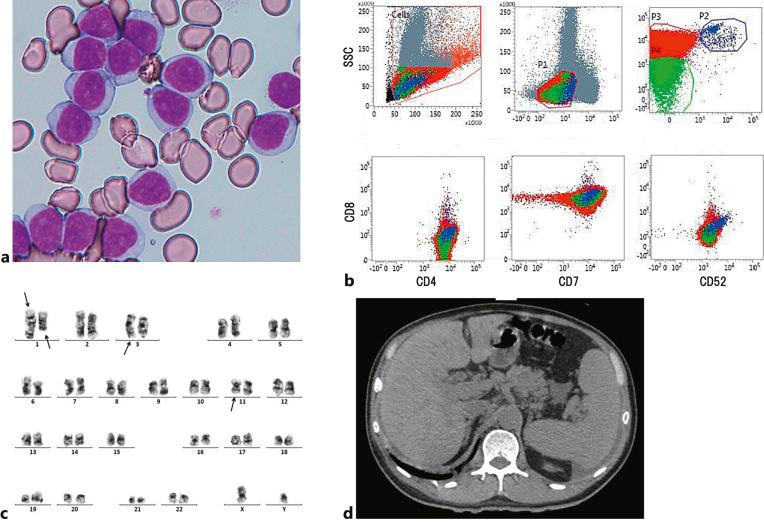
T-cell prolymphocytic leukemia (T-PLL) is a rare aggressive disease with a poor prognosis. Allogeneic stem cell transplantation (allo-SCT) followed by alemtuzumab administration is the most promising treatment for T-PLL but is associated with a high risk of infections as alemtuzumab strongly suppresses cellular immunity, leading to high transplant-related mortality and unsatisfactory survival rates. In addition, for patients without human leukocyte antigen-matched donors, haploidentical stem cell transplantation (haplo-SCT) using post-transplant cyclophosphamide (PTCy) has been used because of the ready availability of donors and achievement of results comparable to those of transplantation with human leukocyte antigen-matched donors. However, there are no reports on the efficacy and safety, including infectious complications, of haplo-SCT with PTCy after alemtuzumab therapy in patients with. Here, we describe a 66-year-old Japanese male patient with T-PLL treated successfully with haplo-SCT after induction therapy of alemtuzumab for T-PLL. Approximately 3 months after the achievement of complete remission with alemtuzumab for T-PLL, haplo-SCT with reduced-intensity conditioning and PTCy was performed. Infectious complications were improved by early therapeutic interventions, and peripheral T cell counts gradually recovered. The patient was alive for more than 16 months after allo-SCT with no signs of relapse. Thus, haplo-SCT using PTCy should be considered as an option after alemtuzumab treatment for T-PLL.
T 细胞幼淋巴细胞白血病(T-PLL)是一种罕见的侵袭性疾病,预后较差。异基因干细胞移植(allo-SCT)后给予阿仑单抗是 T-PLL 最有前景的治疗方法,但由于阿仑单抗强烈抑制细胞免疫,会导致感染风险高,进而导致高移植相关死亡率和不尽人意的生存率。此外,对于没有人类白细胞抗原匹配供体的患者,由于供体易于获得且结果与人类白细胞抗原匹配供体移植相当,已采用使用移植后环磷酰胺(PTCy)的单倍体干细胞移植(haplo-SCT)。然而,关于阿仑单抗治疗后 PTCy 单倍体干细胞移植在患者中的疗效和安全性(包括感染并发症)尚无报道。在此,我们描述了一名 66 岁的日本男性 T-PLL 患者,在接受阿仑单抗诱导治疗 T-PLL 后成功接受了单倍体干细胞移植。在用阿仑单抗使 T-PLL 达到完全缓解约 3 个月后,进行了低强度预处理和 PTCy 的单倍体干细胞移植。通过早期治疗干预改善了感染并发症,外周 T 细胞计数逐渐恢复。该患者在异基因干细胞移植后存活超过 16 个月,无复发迹象。因此,在阿仑单抗治疗 T-PLL 后,应考虑使用 PTCy 的单倍体干细胞移植作为一种选择。

 Zotero 插件