
与出血风险患者肝移植后机械通气时间超过 24 小时相关的因素。
Factors associated with mechanical ventilation longer than 24 h after liver transplantation in patients at risk for bleeding.
机构信息
Department of Anaesthesiology, University Hospital of Bellvitge, University of Barcelona Health Campus, IDIBELL, Barcelona, Spain.
Department of Anaesthesiology, Clinic Hospital, University of Barcelona Health Campus, IDIBAPS, Barcelona, Spain.
出版信息
BMC Anesthesiol. 2023 Nov 2;23(1):356. doi: 10.1186/s12871-023-02321-8.
BACKGROUND
This risk analysis aimed to explore all modifiable factors associated with prolonged mechanical ventilation (lasting > 24 h) after liver transplantation, based on prospectively collected data from a clinical trial.
METHODS
We evaluated 306 candidates. Ninety-three patients were excluded for low risk for transfusion (preoperative haemoglobin > 130 g.l), and 31 patients were excluded for anticoagulation therapy, bleeding disorders, familial polyneuropathy, or emergency status. Risk factors were initially identified with a log-binomial regression model. Relative risk was then calculated and adjusted for age, sex, and disease severity (Model for End-Stage Liver Disease [MELD] score).
RESULTS
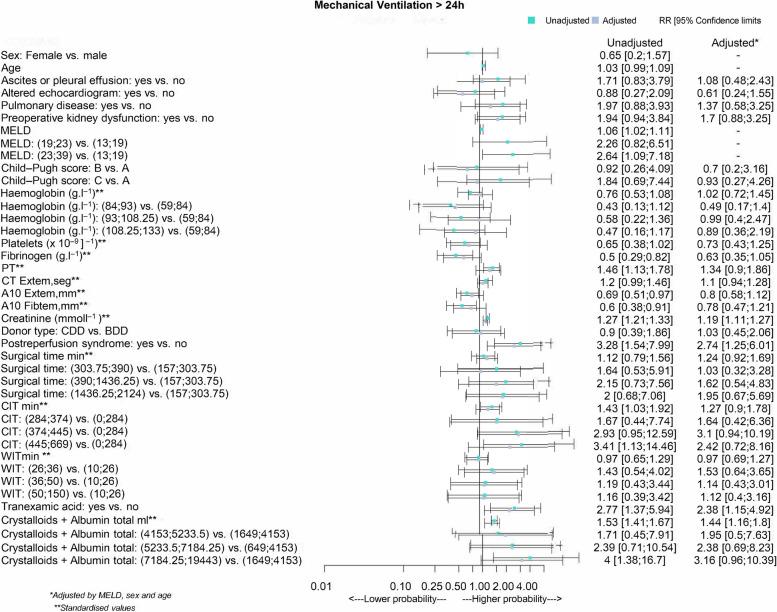
Early tracheal extubation was performed in 149 patients (84.7%), and 27 patients (15.3%) required prolonged mechanical ventilation. Reoperations were required for 6.04% of the early extubated patients and 44% of patients who underwent prolonged ventilation (p = 0.001). A MELD score > 23 was the main risk factor for prolonged ventilation. Once modifiable risk factors were adjusted for MELD score, sex, and age, three factors were significantly associated with prolonged ventilation: tranexamic acid (p = 0.007) and red blood cell (p = 0.001) infusion and the occurrence of postreperfusion syndrome (p = 0.004). The median (IQR) ICU stay was 3 (2-4) days in the early extubation group vs. 5 (3-10) days in the prolonged ventilation group (p = 0.001). The median hospital stay was also significantly shorter after early extubation, at 14 (10-24) days, vs. 25 (14-55) days in the prolonged ventilation group (p = 0.001). Eight patients in the early-extubation group (5.52%) were readmitted to the ICU, nearly all for reoperations, with no between-group differences in ICU readmissions (prolonged ventilation group, 3.7%).
CONCLUSION
We conclude that bleeding and postreperfusion syndrome are the main modifiable factors associated with prolonged mechanical ventilation and length of ICU stay, suggesting that trials should explore vasopressor support strategies and other interventions prior to graft reperfusion that might prevent potential fibrinolysis.
TRIAL REGISTRATION
European Clinical Trials Database (EudraCT 2018-002510-13,) and on ClinicalTrials.gov (NCT01539057).
背景
本风险分析旨在根据一项临床试验中前瞻性收集的数据,探讨与肝移植后机械通气时间延长(>24 小时)相关的所有可改变因素。
方法
我们评估了 306 名候选者。93 名患者因输血风险低(术前血红蛋白>130g/L)而被排除在外,31 名患者因抗凝治疗、出血性疾病、家族性多发性神经病或紧急情况而被排除在外。使用对数二项回归模型初步确定了危险因素。然后计算了相对风险,并根据年龄、性别和疾病严重程度(终末期肝病模型 [MELD] 评分)进行了调整。
结果
149 名患者(84.7%)早期拔管,27 名患者(15.3%)需要长时间机械通气。早期拔管患者中有 6.04%需要再次手术,而长时间通气患者中有 44%需要再次手术(p=0.001)。MELD 评分>23 是长时间通气的主要危险因素。一旦调整了 MELD 评分、性别和年龄的可改变危险因素,三个因素与长时间通气显著相关:氨甲环酸(p=0.007)和红细胞(p=0.001)输注和再灌注后综合征的发生(p=0.004)。早期拔管组 ICU 住院时间中位数(IQR)为 3(2-4)天,而长时间通气组为 5(3-10)天(p=0.001)。早期拔管后住院时间也显著缩短,为 14(10-24)天,而长时间通气组为 25(14-55)天(p=0.001)。早期拔管组有 8 名患者(5.52%)入住 ICU,几乎均因再次手术,两组 ICU 再入院率无差异(长时间通气组为 3.7%)。
结论
我们得出结论,出血和再灌注后综合征是与机械通气时间延长和 ICU 住院时间延长相关的主要可改变因素,这表明试验应在移植再灌注前探索血管加压支持策略和其他干预措施,以防止潜在的纤溶。
试验注册
欧洲临床试验数据库(EudraCT 2018-002510-13)和 ClinicalTrials.gov(NCT01539057)。
 Zotero 插件