
时变信息测度:信息存储的自适应估计及其在脑-心交互作用中的应用
Time-varying information measures: an adaptive estimation of information storage with application to brain-heart interactions.
作者信息
Antonacci Yuri, Barà Chiara, Zaccaro Andrea, Ferri Francesca, Pernice Riccardo, Faes Luca
机构信息
Department of Engineering, University of Palermo, Palermo, Italy.
Department of Neuroscience, Imaging and Clinical Sciences, "G. d'Annunzio" University of Chieti-Pescara, Chieti, Italy.
出版信息
Front Netw Physiol. 2023 Oct 18;3:1242505. doi: 10.3389/fnetp.2023.1242505. eCollection 2023.
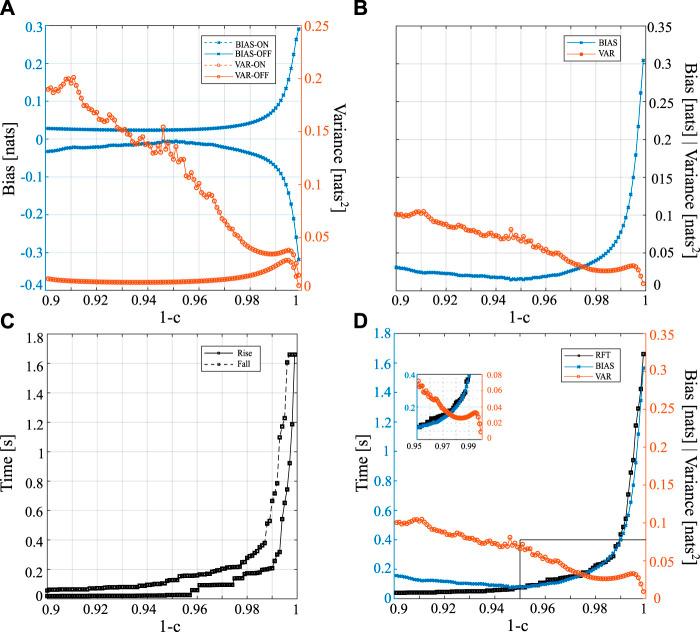
Network Physiology is a rapidly growing field of study that aims to understand how physiological systems interact to maintain health. Within the information theory framework the information storage (IS) allows to measure the regularity and predictability of a dynamic process under stationarity assumption. However, this assumption does not allow to track over time the transient pathways occurring in the dynamical activity of a physiological system. To address this limitation, we propose a time-varying approach based on the recursive least squares algorithm (RLS) for estimating IS at each time instant, in non-stationary conditions. We tested this approach in simulated time-varying dynamics and in the analysis of electroencephalographic (EEG) signals recorded from healthy volunteers and timed with the heartbeat to investigate brain-heart interactions. In simulations, we show that the proposed approach allows to track both abrupt and slow changes in the information stored in a physiological system. These changes are reflected in its evolution and variability over time. The analysis of brain-heart interactions reveals marked differences across the cardiac cycle phases of the variability of the time-varying IS. On the other hand, the average IS values exhibit a weak modulation over parieto-occiptal areas of the scalp. Our study highlights the importance of developing more advanced methods for measuring IS that account for non-stationarity in physiological systems. The proposed time-varying approach based on RLS represents a useful tool for identifying spatio-temporal dynamics within the neurocardiac system and can contribute to the understanding of brain-heart interactions.
网络生理学是一个快速发展的研究领域,旨在了解生理系统如何相互作用以维持健康。在信息论框架内,信息存储(IS)允许在平稳性假设下测量动态过程的规律性和可预测性。然而,这种假设不允许随时间跟踪生理系统动态活动中发生的瞬态路径。为了解决这一局限性,我们提出了一种基于递归最小二乘算法(RLS)的时变方法,用于在非平稳条件下估计每个时刻的IS。我们在模拟时变动力学以及对健康志愿者记录的脑电图(EEG)信号进行分析时测试了这种方法,并与心跳同步以研究脑-心相互作用。在模拟中,我们表明所提出的方法能够跟踪生理系统中存储信息的突然变化和缓慢变化。这些变化反映在其随时间的演变和变异性中。对脑-心相互作用的分析揭示了时变IS变异性在心动周期各阶段的显著差异。另一方面,平均IS值在头皮顶枕区表现出微弱的调制。我们的研究强调了开发更先进的测量IS方法的重要性,这些方法要考虑到生理系统中的非平稳性。所提出的基于RLS的时变方法是识别神经心脏系统内时空动力学的有用工具,有助于理解脑-心相互作用。




 Zotero 插件