
恶性疟原虫中PEXEL基序及其下游区域内的序列元件调节依赖PTEX的蛋白质输出。
Sequence elements within the PEXEL motif and its downstream region modulate PTEX-dependent protein export in Plasmodium falciparum.
作者信息
Gabriela Mikha, Barnes Claudia B G, Leong Dickson, Sleebs Brad E, Schneider Molly Parkyn, Littler Dene R, Crabb Brendan S, de Koning-Ward Tania F, Gilson Paul R
机构信息
Malaria Virulence and Drug Discovery Group, Burnet Institute, Melbourne, Victoria, Australia.
School of Medicine, Deakin University, Geelong, Victoria, Australia.
出版信息
Traffic. 2024 Jan;25(1):e12922. doi: 10.1111/tra.12922. Epub 2023 Nov 5.
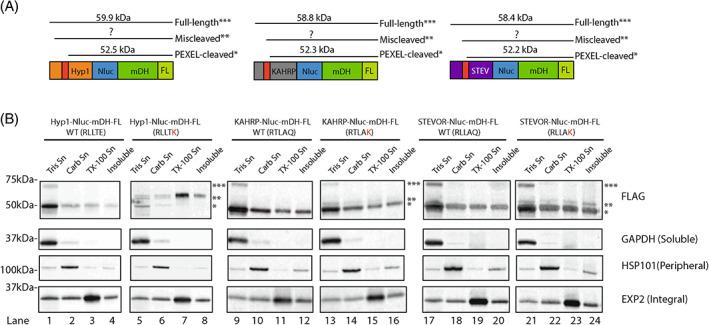
The parasite Plasmodium falciparum causes the most severe form of malaria and to invade and replicate in red blood cells (RBCs), it exports hundreds of proteins across the encasing parasitophorous vacuole membrane (PVM) into this host cell. The exported proteins help modify the RBC to support rapid parasite growth and avoidance of the human immune system. Most exported proteins possess a conserved Plasmodium export element (PEXEL) motif with the consensus RxLxE/D/Q amino acid sequence, which acts as a proteolytic cleavage recognition site within the parasite's endoplasmic reticulum (ER). Cleavage occurs after the P L residue and is thought to help release the protein from the ER so it can be putatively escorted by the HSP101 chaperone to the parasitophorous vacuole space surrounding the intraerythrocytic parasite. HSP101 and its cargo are then thought to assemble with the rest of a Plasmodium translocon for exported proteins (PTEX) complex, that then recognises the xE/D/Q capped N-terminus of the exported protein and translocates it across the vacuole membrane into the RBC compartment. Here, we present evidence that supports a dual role for the PEXEL's conserved P ' position E/Q/D residue, first, for plasmepsin V cleavage in the ER, and second, for efficient PTEX mediated export across the PVM into the RBC. We also present evidence that the downstream 'spacer' region separating the PEXEL motif from the folded functional region of the exported protein controls cargo interaction with PTEX as well. The spacer must be of a sufficient length and permissive amino acid composition to engage the HSP101 unfoldase component of PTEX to be efficiently translocated into the RBC compartment.
恶性疟原虫这种寄生虫会引发最严重形式的疟疾,为了侵入红细胞(RBC)并在其中复制,它会将数百种蛋白质穿过包裹它的寄生泡膜(PVM)输出到这个宿主细胞中。这些输出的蛋白质有助于改变红细胞,以支持疟原虫的快速生长并躲避人体免疫系统。大多数输出蛋白都具有保守的疟原虫输出元件(PEXEL)基序,其共有序列为RxLxE/D/Q氨基酸序列,该基序在疟原虫的内质网(ER)中作为蛋白水解切割识别位点。切割发生在P L残基之后,被认为有助于将蛋白质从内质网释放出来,这样它可能会被HSP101伴侣蛋白护送,进入围绕红细胞内疟原虫的寄生泡空间。然后,HSP101及其携带的蛋白被认为会与疟原虫输出蛋白转运体(PTEX)复合物的其他部分组装在一起,该复合物随后识别输出蛋白的xE/D/Q封端的N端,并将其穿过泡膜转运到红细胞区室中。在这里,我们提供的证据支持PEXEL保守的P' 位置的E/Q/D残基具有双重作用,首先,用于在内质网中进行疟原虫天冬氨酸蛋白酶V的切割,其次,用于PTEX介导的高效穿过PVM进入红细胞的输出过程。我们还提供证据表明,将PEXEL基序与输出蛋白的折叠功能区隔开的下游“间隔”区域也控制着货物与PTEX的相互作用。该间隔必须具有足够的长度和允许的氨基酸组成,以便与PTEX的HSP101解折叠酶成分结合,从而有效地转运到红细胞区室中。




 Zotero 插件