
干预措施以增加孕妇 COVID-19、流感和百日咳疫苗接种率:系统评价和荟萃分析。
Interventions to increase vaccination against COVID-19, influenza and pertussis during pregnancy: a systematic review and meta-analysis.
机构信息
Population Health Research Institute, St George's University of London, London, UK.
Primary Care Unit, University Hospitals Sussex NHS Foundation Trust, Sussex, UK.
出版信息
J Travel Med. 2023 Dec 28;30(8). doi: 10.1093/jtm/taad138.
BACKGROUND
Pregnant women and their babies face significant risks from three vaccine-preventable diseases: COVID-19, influenza and pertussis. However, despite these vaccines' proven safety and effectiveness, uptake during pregnancy remains low.
METHODS
We conducted a systematic review (PROSPERO CRD42023399488; January 2012-December 2022 following PRISMA guidelines) of interventions to increase COVID-19/influenza/pertussis vaccination in pregnancy. We searched nine databases, including grey literature. Two independent investigators extracted data; discrepancies were resolved by consensus. Meta-analyses were conducted using random-effects models to estimate pooled effect sizes. Heterogeneity was assessed using the I2 statistics.
RESULTS
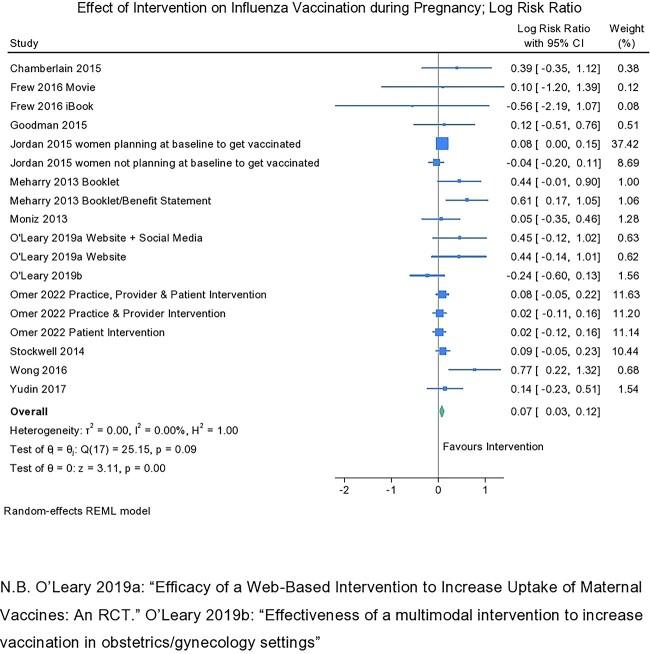
From 2681 articles, we identified 39 relevant studies (n = 168 262 participants) across nine countries. Fifteen studies (39%) were randomized controlled trials (RCTs); the remainder were observational cohort, quality-improvement or cross-sectional studies. The quality of 18% (7/39) was strong. Pooled results of interventions to increase influenza vaccine uptake (18 effect estimates from 12 RCTs) showed the interventions were effective but had a small effect (risk ratio = 1.07, 95% CI 1.03, 1.13). However, pooled results of interventions to increase pertussis vaccine uptake (10 effect estimates from six RCTs) showed no clear benefit (risk ratio = 0.98, 95% CI 0.94, 1.03). There were no relevant RCTs for COVID-19. Interventions addressed the 'three Ps': patient-, provider- and policy-level strategies. At the patient level, clear recommendations from healthcare professionals backed by text reminders/written information were strongly associated with increased vaccine uptake, especially tailored face-to-face interventions, which addressed women's concerns, dispelled myths and highlighted benefits. Provider-level interventions included educating healthcare professionals about vaccines' safety and effectiveness and reminders to offer vaccinations routinely. Policy-level interventions included financial incentives, mandatory vaccination data fields in electronic health records and ensuring easy availability of vaccinations.
CONCLUSIONS
Interventions had a small effect on increasing influenza vaccination. Training healthcare providers to promote vaccinations during pregnancy is crucial and could be enhanced by utilizing mobile health technologies.
背景
孕妇及其婴儿面临着三种可通过疫苗预防的疾病(新冠病毒、流感和百日咳)带来的重大风险。然而,尽管这些疫苗已被证明安全有效,但在怀孕期间的接种率仍然很低。
方法
我们按照 PRISMA 指南(2012 年 1 月至 2022 年 12 月)进行了一项系统评价,以评估增加孕妇接种新冠病毒/流感/百日咳疫苗的干预措施。我们检索了 9 个数据库,包括灰色文献。两名独立的调查员提取数据;意见不一致的地方通过共识解决。使用随机效应模型进行荟萃分析,以估计汇总效应大小。使用 I2 统计量评估异质性。
结果
从 2681 篇文章中,我们确定了来自 9 个国家的 39 项相关研究(n=168262 名参与者)。15 项研究(39%)为随机对照试验(RCT);其余为观察性队列研究、质量改进研究或横断面研究。39 项研究中有 18%(7/39)的质量较高。增加流感疫苗接种率的干预措施的汇总结果(来自 12 项 RCT 的 18 项效应评估)表明,这些干预措施有效,但效果较小(风险比=1.07,95%CI 1.03,1.13)。然而,增加百日咳疫苗接种率的干预措施的汇总结果(来自 6 项 RCT 的 10 项效应评估)表明没有明显的益处(风险比=0.98,95%CI 0.94,1.03)。没有关于新冠病毒的相关 RCT。干预措施针对“三个 P”:患者、提供者和政策层面的策略。在患者层面,来自医疗保健专业人员的明确建议,辅以文字提醒/书面信息,与增加疫苗接种率密切相关,特别是针对女性关注问题的定制面对面干预措施,消除了误解,强调了益处。提供者层面的干预措施包括教育医疗保健专业人员疫苗的安全性和有效性,并定期提醒接种疫苗。政策层面的干预措施包括财政激励、在电子健康记录中强制设置疫苗接种数据字段以及确保疫苗的便捷可及性。
结论
干预措施对增加流感疫苗接种率有一定效果。培训医疗保健提供者在怀孕期间推广疫苗接种至关重要,并且可以通过利用移动健康技术来增强这种效果。



 Zotero 插件