
非洲卫生系统效率的现状和主要驱动因素:系统评价和荟萃分析。
The state and significant drivers of health systems efficiency in Africa: A systematic review and meta-analysis.
机构信息
World Health Organization (WHO) Africa Regional Office, Office of the Regional Director, Brazzaville, Congo.
Centre for Health Professions Education, Faculty of Health Sciences, North-West University, Potchefstroom, South Africa.
出版信息
J Glob Health. 2023 Nov 9;13:04131. doi: 10.7189/jogh.13.04131.
BACKGROUND
Low-and-middle-income countries, especially in Africa, lack the capacity to adequately invest in health systems to attain universal health coverage (UHC). As such, countries must improve efficiency and provide more services within the available resources. This systematic review synthesised evidence on the efficiency of health systems in the African region and its drivers.
METHODS
We conducted a systematic literature review guided by the Preferred Reporting Items for Systematic Reviews and Meta-Analyses (PRISMA) 2020 statement. Related studies were grouped and meta-analysed, while others were descriptively analysed. We employed a qualitative content synthesis for synthesising the drivers of efficiency.
RESULTS
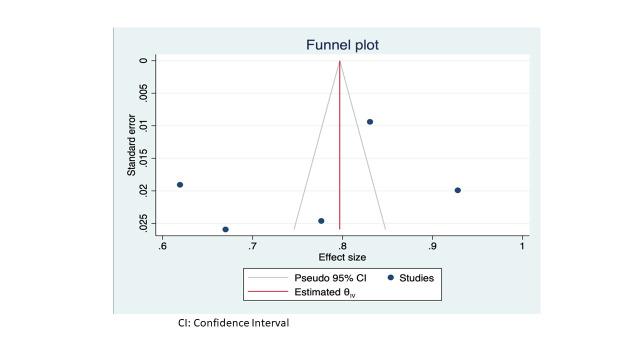
Overall, 39 studies met a predetermined inclusion criterion and were included from a possible 4 609 records retrieved through a rigorous search and selection process. Using a random effects restricted maximum likelihood method, the pooled efficiency score for the Africa region was estimated to be 0.77, implying that on the flip side, health system inefficiency across countries in the African region was approximately 23%. Across 22 studies that used data envelopment analysis to examine efficiency at the level of health facilities and sub-national entities, the efficiency level was 0.67. Facility-level studies tended to estimate low levels of efficiency compared to health system-level studies. Across the 39 studies, 21 significant drivers of inefficiency were reported, including population density of the catchment area, governance, health facility ownership, health facility staff density, national economic status, type of health facility, education index, hospital size and bed occupancy rate.
CONCLUSION
With approximately 23% of the inefficiency of health systems in Africa, improving efficiency alone will yield an average of 34% improvement in resource availability, assuming all countries are performing similarly to the frontier countries. However, with the low level of health expenditure per capita in Africa, the efficiency gains alone will be insufficient to meet the minimum funding requirement for UHC.
REGISTRATION
PROSPERO: CRD42022318122.
背景
中低收入国家,尤其是非洲国家,在卫生系统投资能力方面存在不足,难以实现全民健康覆盖。因此,这些国家必须提高效率,在现有资源内提供更多服务。本系统评价综合了非洲区域卫生系统效率及其驱动因素的证据。
方法
我们遵循《系统评价和荟萃分析的首选报告项目(PRISMA) 2020 声明》进行了系统文献综述。相关研究被分组并进行荟萃分析,而其他研究则进行描述性分析。我们采用定性内容综合法来综合分析效率的驱动因素。
结果
通过严格的搜索和选择过程,从可能的 4609 条记录中检索到 39 项符合预定纳入标准的研究。使用随机效应限制最大似然法,估计非洲区域的总体效率得分为 0.77,这意味着非洲国家的卫生系统效率低下约为 23%。在 22 项使用数据包络分析(DEA)来检查卫生设施和次国家实体层面效率的研究中,效率水平为 0.67。与卫生系统层面的研究相比,设施层面的研究往往估计效率水平较低。在 39 项研究中,报告了 21 个导致效率低下的显著驱动因素,包括服务区域的人口密度、治理、卫生设施所有权、卫生设施员工密度、国家经济状况、卫生设施类型、教育指数、医院规模和床位入住率。
结论
由于非洲卫生系统效率低下约 23%,仅提高效率,假设所有国家的表现都与前沿国家类似,平均可使资源可用性提高 34%。然而,由于非洲人均卫生支出水平较低,仅提高效率不足以满足全民健康覆盖的最低资金要求。
注册
PROSPERO:CRD42022318122。


 Zotero 插件