
探讨人口老龄化对新发呼吸道传染病传播的影响及其相关的死亡负担。
Exploring the impact of population ageing on the spread of emerging respiratory infections and the associated burden of mortality.
机构信息
Data Science Institute, Interuniversity Institute of Biostatistics and statistical Bioinformatics, Hasselt University, Hasselt, Belgium.
Center for Population, Family and Health, University of Antwerp, Antwerp, Belgium.
出版信息
BMC Infect Dis. 2023 Nov 7;23(1):767. doi: 10.1186/s12879-023-08657-3.
BACKGROUND
Increasing life expectancy and persistently low fertility levels have led to old population age structures in most high-income countries, and population ageing is expected to continue or even accelerate in the coming decades. While older adults on average have few interactions that potentially could lead to disease transmission, their morbidity and mortality due to infectious diseases, respiratory infections in particular, remain substantial. We aim to explore how population ageing affects the future transmission dynamics and mortality burden of emerging respiratory infections.
METHODS
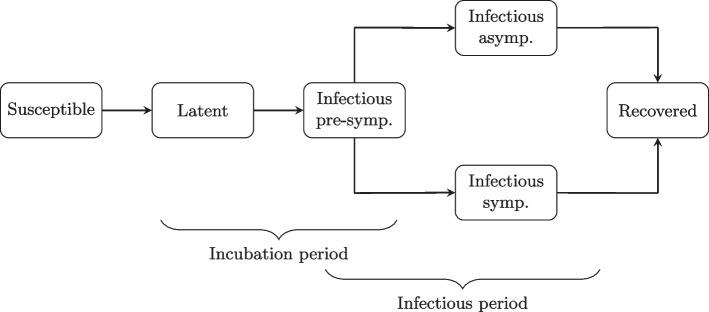
Using longitudinal individual-level data from population registers, we model the Belgian population with evolving age and household structures, and explicitly consider long-term care facilities (LTCFs). Three scenarios are presented for the future proportion of older adults living in LTCFs. For each demographic scenario, we simulate outbreaks of SARS-CoV-2 and a novel influenza A virus in 2020, 2030, 2040 and 2050 and distinguish between household and community transmission. We estimate attack rates by age and household size/type, as well as disease-related deaths and the associated quality-adjusted life-years (QALYs) lost.
RESULTS
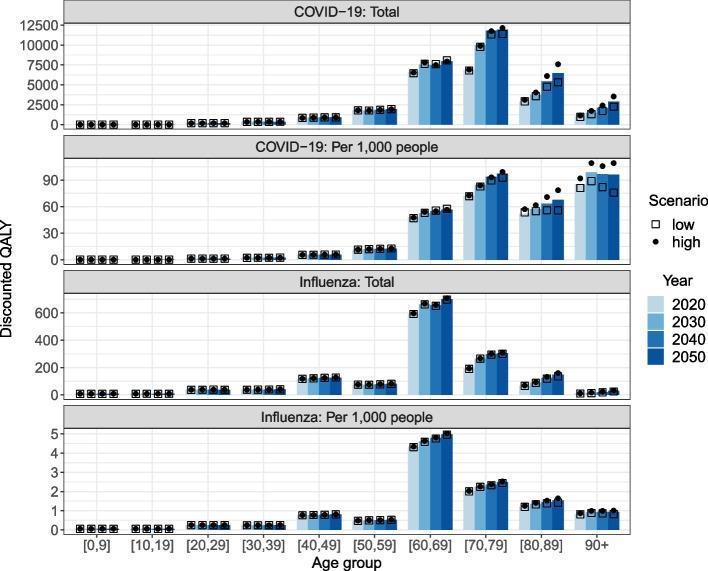
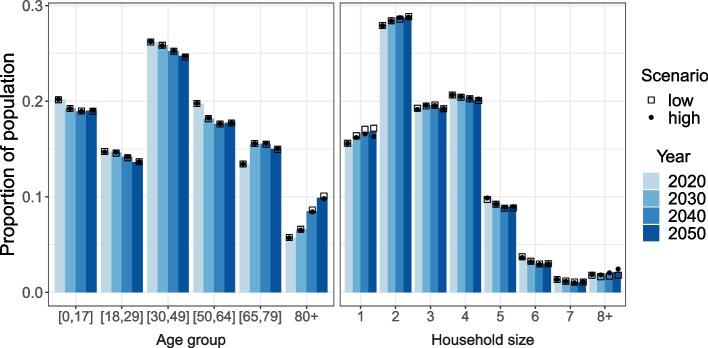
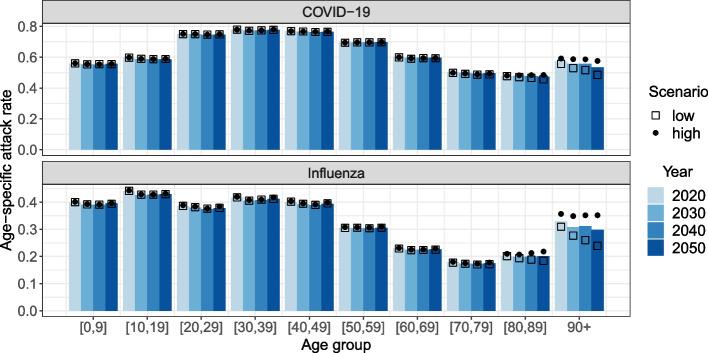
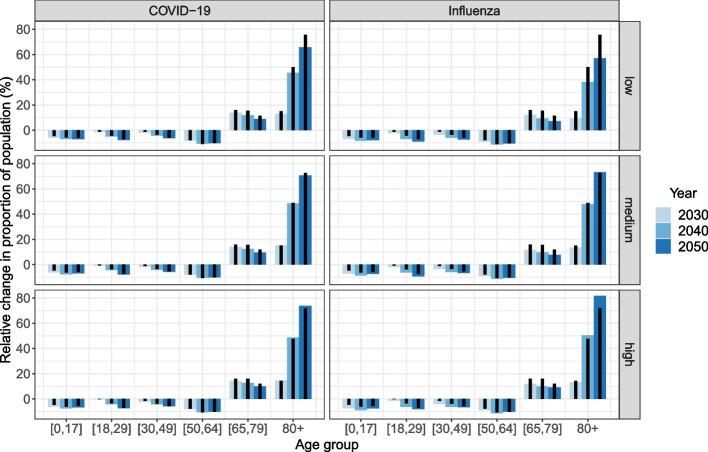
As the population is ageing, small households and LTCFs become more prevalent. Additionally, families with children become smaller (i.e. low fertility, single-parent families). The overall attack rate slightly decreases as the population is ageing, but to a larger degree for influenza than for SARS-CoV-2 due to differential age-specific attack rates. Nevertheless, the number of deaths and QALY losses per 1,000 people is increasing for both infections and at a speed influenced by the share living in LTCFs.
CONCLUSION
Population ageing is associated with smaller outbreaks of COVID-19 and influenza, but at the same time it is causing a substantially larger burden of mortality, even if the proportion of LTCF residents were to decrease. These relationships are influenced by age patterns in epidemiological parameters. Not only the shift in the age distribution, but also the induced changes in the household structures are important to consider when assessing the potential impact of population ageing on the transmission and burden of emerging respiratory infections.
背景
在大多数高收入国家,由于预期寿命的延长和持续低生育率,人口年龄结构已经趋于老龄化,人口老龄化预计在未来几十年还将继续甚至加速。尽管老年人平均很少有潜在的疾病传播途径,但他们因传染病,特别是呼吸道感染而患病和死亡的风险仍然很大。我们旨在探讨人口老龄化如何影响未来新兴呼吸道传染病的传播动态和死亡负担。
方法
我们使用来自人口登记处的纵向个人水平数据,对具有不断变化的年龄和家庭结构的比利时人口进行建模,并明确考虑长期护理机构(LTCF)。为未来居住在 LTCF 的老年人的比例提出了三种情景。对于每种人口情景,我们模拟了 2020 年、2030 年、2040 年和 2050 年 SARS-CoV-2 和新型甲型流感病毒的暴发,并区分了家庭和社区传播。我们按年龄和家庭规模/类型估计了攻击率,以及与疾病相关的死亡人数和相关的质量调整生命年(QALY)损失。
结果
随着人口老龄化,小家庭和 LTCF 变得更加普遍。此外,有孩子的家庭变得更小(即低生育率、单亲家庭)。由于年龄特异性攻击率的不同,人口老龄化使整体攻击率略有下降,但对于流感而言,下降幅度大于 SARS-CoV-2。尽管如此,两种感染的死亡人数和每 1000 人 QALY 损失都在增加,而且这种速度受到居住在 LTCF 中的人数的影响。
结论
人口老龄化与 COVID-19 和流感的小暴发有关,但同时也导致了更大的死亡负担,即使 LTCF 居民的比例下降也是如此。这些关系受流行病学参数年龄模式的影响。在评估人口老龄化对新兴呼吸道传染病传播和负担的潜在影响时,不仅要考虑年龄分布的变化,还要考虑家庭结构的变化。

 Zotero 插件