
胃泌素在胃癌中的核心作用。
The central role of gastrin in gastric cancer.
作者信息
Waldum Helge, Mjønes Patricia
机构信息
Department of Clinical and Molecular Medicine, Faculty of Medicine and Health Sciences, Norwegian University of Science and Technology, Trondheim, Norway.
Department of Pathology, St. Olav's Hospital - Trondheim University Hospital, Trondheim, Norway.
出版信息
Front Oncol. 2023 Oct 24;13:1176673. doi: 10.3389/fonc.2023.1176673. eCollection 2023.
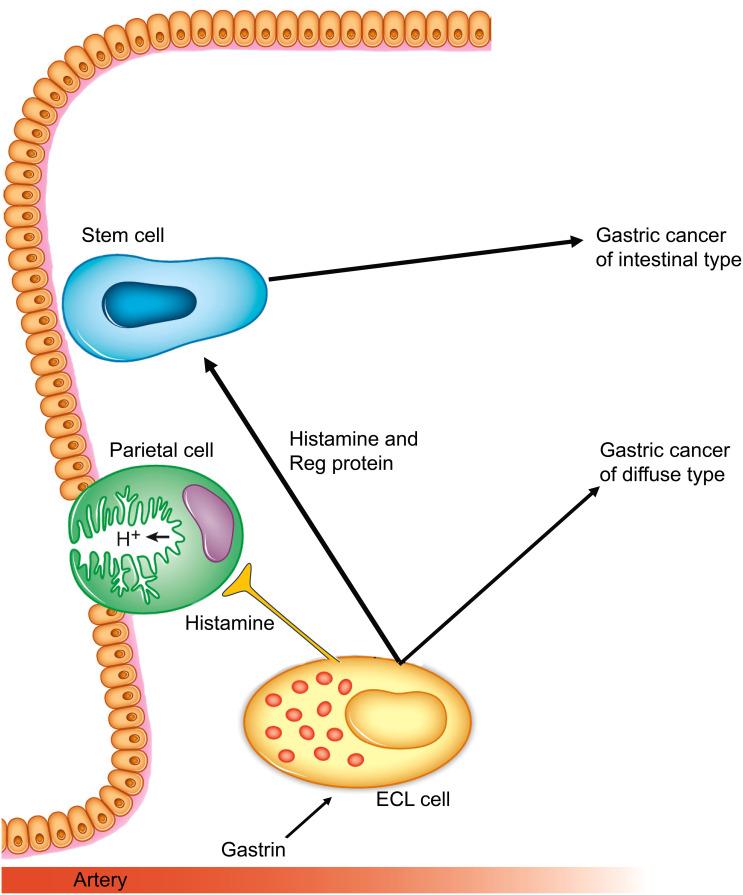
The prevalence of gastric cancer has markedly declined, but due to the high mortality rates associated with gastric cancer, it is still a serious disease. The preferred classification of gastric cancer is according to Lauren into either the intestinal type, which has a glandular growth pattern, or the diffuse type, which does not have glandular structures. Both types have been classified as adenocarcinomas, with the latter type based on periodic acid-Schiff (PAS) positivity presumed to reflect mucin. However, the presence of mucin in the diffuse type, in contrast to neuroendocrine/enterochromaffin-like (ECL) cell markers, has not been confirmed by immunohistochemistry and hybridization. The ECL cells are probably prone to becoming cancerous because they do not express E-cadherin. Gastric cancer is unique in that a bacterium, , is thought to be its main cause. predisposes infected individuals to cancer only after having caused oxyntic atrophy leading to gastric hypoacidity and hypergastrinemia. No single factor has been convincingly proved to be carcinogenic. It is probable that gastrin is the pathogenetic factor for gastric cancer due to , autoimmune gastritis, and long-term prolonged inhibition of gastric acid secretion. Hypergastrinemia induces ECL cell hyperplasia, which develops into neuroendocrine tumors (NETs) and then into neuroendocrine carcinomas in rodents, a sequence that has also been described in humans. During carcinogenesis, the tumor cells lose specific traits, requiring that sensitive methods be used to recognize their origin. Gastric cancer occurrence may hopefully be prevented by eradication at a young age, and by the reduced use of inhibitors of acid secretion and use of a gastrin antagonist in those with previous long-term infection and those with autoimmune gastritis.
胃癌的发病率已显著下降,但由于与胃癌相关的高死亡率,它仍然是一种严重的疾病。胃癌的首选分类是根据劳伦分类法,分为肠型,具有腺性生长模式,或弥漫型,不具有腺性结构。两种类型都被归类为腺癌,后一种类型基于过碘酸希夫(PAS)阳性,推测反映粘蛋白。然而,与神经内分泌/肠嗜铬样(ECL)细胞标记物相比,弥漫型中粘蛋白的存在尚未通过免疫组织化学和杂交得到证实。ECL细胞可能容易癌变,因为它们不表达E-钙粘蛋白。胃癌的独特之处在于,一种细菌被认为是其主要病因。只有在引起胃体萎缩导致胃酸过少和高胃泌素血症后,才会使受感染个体易患癌症。没有单一因素被令人信服地证明具有致癌性。由于幽门螺杆菌、自身免疫性胃炎和长期持续抑制胃酸分泌,胃泌素可能是胃癌的致病因素。高胃泌素血症诱导ECL细胞增生,在啮齿动物中发展为神经内分泌肿瘤(NETs),然后发展为神经内分泌癌,这一序列在人类中也有描述。在致癌过程中,肿瘤细胞失去特定特征,需要使用敏感方法来识别其起源。通过在年轻时根除幽门螺杆菌,以及在先前长期感染幽门螺杆菌的人和自身免疫性胃炎患者中减少使用酸分泌抑制剂和使用胃泌素拮抗剂,有望预防胃癌的发生。
 Zotero 插件