
结构变异和非编码变异增加了临床全基因组测序在罕见病诊断中的收益。
Structural and non-coding variants increase the diagnostic yield of clinical whole genome sequencing for rare diseases.
机构信息
Wellcome Centre for Human Genetics, University of Oxford, Old Road Campus, Roosevelt Drive, Oxford, OX3 7BN, UK.
NIHR Oxford Biomedical Research Centre, John Radcliffe Hospital, Oxford University Hospitals NHS Foundation Trust, Oxford, OX3 9DU, UK.
出版信息
Genome Med. 2023 Nov 9;15(1):94. doi: 10.1186/s13073-023-01240-0.
BACKGROUND
Whole genome sequencing is increasingly being used for the diagnosis of patients with rare diseases. However, the diagnostic yields of many studies, particularly those conducted in a healthcare setting, are often disappointingly low, at 25-30%. This is in part because although entire genomes are sequenced, analysis is often confined to in silico gene panels or coding regions of the genome.
METHODS
We undertook WGS on a cohort of 122 unrelated rare disease patients and their relatives (300 genomes) who had been pre-screened by gene panels or arrays. Patients were recruited from a broad spectrum of clinical specialties. We applied a bioinformatics pipeline that would allow comprehensive analysis of all variant types. We combined established bioinformatics tools for phenotypic and genomic analysis with our novel algorithms (SVRare, ALTSPLICE and GREEN-DB) to detect and annotate structural, splice site and non-coding variants.
RESULTS
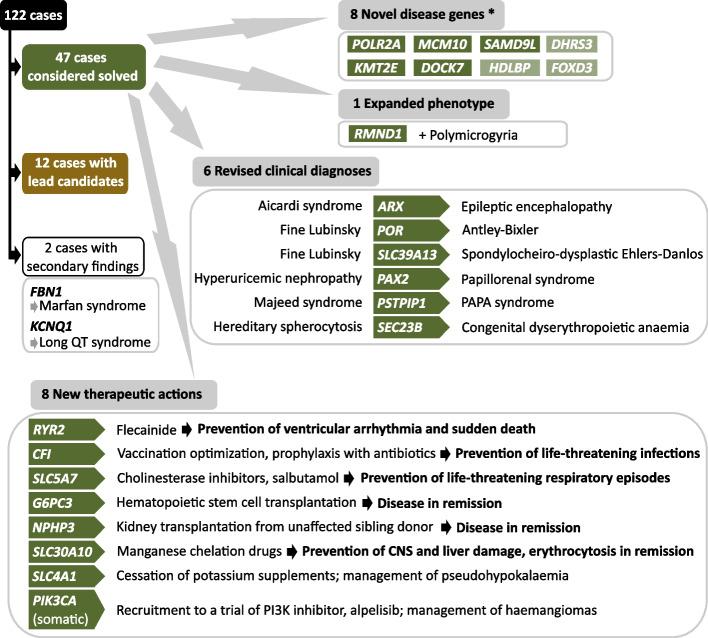
Our diagnostic yield was 43/122 cases (35%), although 47/122 cases (39%) were considered solved when considering novel candidate genes with supporting functional data into account. Structural, splice site and deep intronic variants contributed to 20/47 (43%) of our solved cases. Five genes that are novel, or were novel at the time of discovery, were identified, whilst a further three genes are putative novel disease genes with evidence of causality. We identified variants of uncertain significance in a further fourteen candidate genes. The phenotypic spectrum associated with RMND1 was expanded to include polymicrogyria. Two patients with secondary findings in FBN1 and KCNQ1 were confirmed to have previously unidentified Marfan and long QT syndromes, respectively, and were referred for further clinical interventions. Clinical diagnoses were changed in six patients and treatment adjustments made for eight individuals, which for five patients was considered life-saving.
CONCLUSIONS
Genome sequencing is increasingly being considered as a first-line genetic test in routine clinical settings and can make a substantial contribution to rapidly identifying a causal aetiology for many patients, shortening their diagnostic odyssey. We have demonstrated that structural, splice site and intronic variants make a significant contribution to diagnostic yield and that comprehensive analysis of the entire genome is essential to maximise the value of clinical genome sequencing.
背景
全基因组测序越来越多地用于诊断罕见病患者。然而,许多研究,特别是在医疗保健环境中进行的研究,其诊断率往往令人失望地低,只有 25-30%。这在一定程度上是因为尽管对整个基因组进行了测序,但分析通常仅限于计算机基因面板或基因组的编码区域。
方法
我们对 122 名患有罕见病的患者及其亲属(300 个基因组)进行了 WGS 检测,这些患者在基因面板或芯片预筛选后被招募。患者来自广泛的临床专科。我们应用了一种生物信息学管道,该管道允许对所有变体类型进行全面分析。我们将用于表型和基因组分析的成熟生物信息学工具与我们的新型算法(SVRare、ALTSPLICE 和 GREEN-DB)相结合,以检测和注释结构、剪接位点和非编码变异。
结果
我们的诊断率为 43/122 例(35%),但如果考虑到具有支持功能数据的新候选基因,47/122 例(39%)被认为得到了解决。结构、剪接位点和深内含子变异导致我们解决的 47 例病例中的 20 例(43%)。发现了五个新的或在发现时是新的基因,另外三个基因是具有因果关系证据的推定新疾病基因。我们在另外 14 个候选基因中发现了不确定意义的变异。与 RMND1 相关的表型谱扩展到包括多微小脑回。在 FBN1 和 KCNQ1 中发现二级结果的两名患者被证实分别患有以前未识别的马凡综合征和长 QT 综合征,并被转介进行进一步的临床干预。六名患者的临床诊断发生了变化,八名患者进行了治疗调整,其中五名患者的治疗调整被认为是挽救生命的。
结论
基因组测序越来越被认为是常规临床环境中的一线基因检测方法,它可以为许多患者快速确定因果病因做出重大贡献,缩短他们的诊断之旅。我们已经证明,结构、剪接位点和内含子变异对诊断率有显著贡献,全面分析整个基因组对于最大限度地发挥临床基因组测序的价值至关重要。


 Zotero 插件