
与犬多中心高级 B 细胞淋巴瘤首次缓解诱导期早期复发相关的基因表达谱。
Gene expression profiles associated with early relapse during first remission induction in canine multicentric high-grade B-cell lymphoma.
机构信息
Department of Veterinary Internal Medicine, Graduate School of Agricultural and Life Sciences, The University of Tokyo, Tokyo, Japan.
Veterinary Medical Center, Graduate School of Agricultural and Life Sciences, The University of Tokyo, Tokyo, Japan.
出版信息
J Vet Med Sci. 2024 Jan 10;86(1):18-27. doi: 10.1292/jvms.23-0269. Epub 2023 Nov 13.
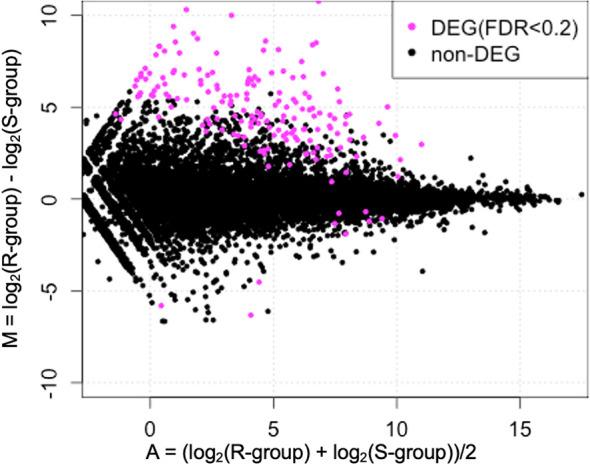
Although chemotherapy using CHOP-based protocol induces remission in most cases of canine multicentric high-grade B-cell lymphoma (mhBCL), some cases develop early relapse during the first induction protocol. In this study, we examined the gene expression profiles of canine mhBCL before chemotherapy and investigated their associations with early relapse during the first whole CHOP-based protocol. Twenty-five cases of mhBCL treated with CHOP-based protocol as first induction chemotherapy were included in this study. Sixteen cases completed the first whole CHOP-based protocol without relapse (S-group), and nine developed relapse during the chemotherapy (R-group). RNA-seq was performed on samples from neoplastic lymph nodes. Differentially expressed genes (DEGs) were extracted by the comparison of gene expression profiles between S- and R-groups, and the differences in the expression levels of these genes were validated by RT-qPCR. Extracted 179 DEGs included the genes related to chemokine CC motif ligand, T-cell receptor signaling pathway, and PD-L1 expression and PD-1 checkpoint pathway. We focused on chemokine CC motif ligand, and CCL4 was confirmed to be significantly downregulated in the R-group (P=0.039). We also focused on the genes related to T-cell signaling pathway, and CD3E (P=0.039), ITK (P=0.023), and LAT (P=0.023) genes were confirmed to be significantly upregulated in the R-group. The current results suggest that both changes in tumor cells and the interactions between tumor cells and immune cells are associated with the efficacy of the chemotherapy for first remission induction.
虽然基于 CHOP 方案的化疗在大多数犬多中心高级 B 细胞淋巴瘤(mhBCL)病例中诱导缓解,但有些病例在第一个诱导方案中早期复发。在这项研究中,我们检查了化疗前犬 mhBCL 的基因表达谱,并研究了它们与第一个基于全 CHOP 方案期间早期复发的相关性。本研究纳入了 25 例接受基于 CHOP 方案作为一线诱导化疗的 mhBCL 病例。16 例完成了第一个全 CHOP 方案且无复发(S 组),9 例在化疗期间复发(R 组)。对肿瘤性淋巴结样本进行 RNA-seq。通过 S 组和 R 组之间基因表达谱的比较提取差异表达基因(DEGs),并通过 RT-qPCR 验证这些基因表达水平的差异。提取的 179 个 DEGs 包括与趋化因子 CC 基序配体、T 细胞受体信号通路和 PD-L1 表达及 PD-1 检查点通路相关的基因。我们重点关注趋化因子 CC 基序配体,发现 CCL4 在 R 组中显著下调(P=0.039)。我们还重点关注与 T 细胞信号通路相关的基因,发现 CD3E(P=0.039)、ITK(P=0.023)和 LAT(P=0.023)基因在 R 组中显著上调。目前的结果表明,肿瘤细胞的变化以及肿瘤细胞与免疫细胞之间的相互作用均与首次缓解诱导化疗的疗效相关。


 Zotero 插件