
严重急性呼吸综合征冠状病毒2再次感染后新发长期新冠的风险:一项基于社区的队列研究。
Risk of New-Onset Long COVID Following Reinfection With Severe Acute Respiratory Syndrome Coronavirus 2: A Community-Based Cohort Study.
作者信息
Bosworth Matthew L, Shenhuy Boran, Walker A Sarah, Nafilyan Vahé, Alwan Nisreen A, O'Hara Margaret E, Ayoubkhani Daniel
机构信息
Data and Analysis for Social Care and Health Division, Office for National Statistics, Newport, United Kingdom.
Methodology and Quality Directorate, Office for National Statistics, Newport, United Kingdom.
出版信息
Open Forum Infect Dis. 2023 Oct 5;10(11):ofad493. doi: 10.1093/ofid/ofad493. eCollection 2023 Nov.
BACKGROUND
Little is known about the risk of long COVID following reinfection with severe acute respiratory syndrome coronavirus 2 (SARS-CoV-2). We estimated the likelihood of new-onset, self-reported long COVID after a second SARS-CoV-2 infection, compared to a first infection.
METHODS
We included UK COVID-19 Infection Survey participants who tested positive for SARS-CoV-2 between 1 November 2021 and 8 October 2022. The primary outcome was self-reported long COVID 12-20 weeks after each infection. Separate analyses were performed for those <16 years and ≥16 years. We estimated adjusted odds ratios (aORs) for new-onset long COVID using logistic regression, comparing second to first infections, controlling for sociodemographic characteristics and calendar date of infection, plus vaccination status in participants ≥16 years of age.
RESULTS
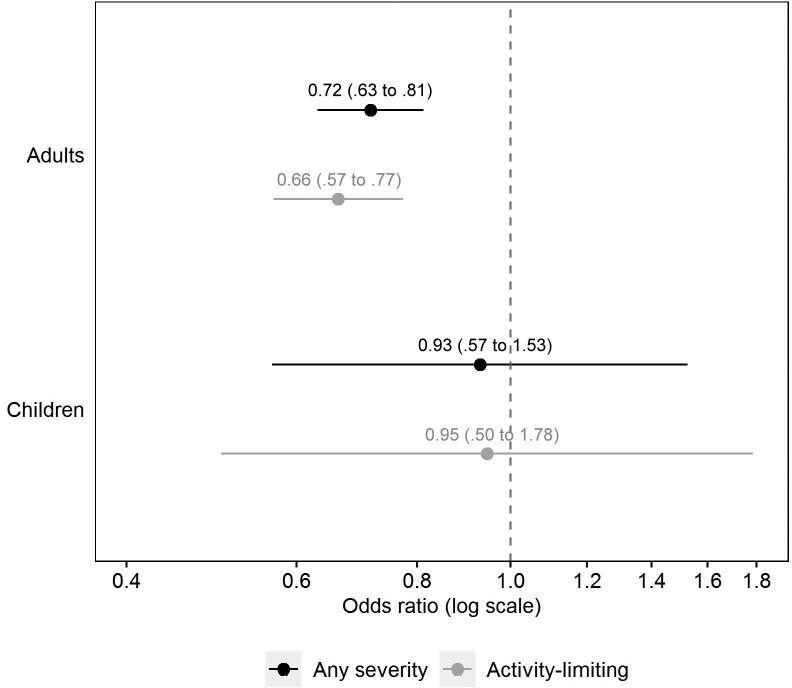
Overall, long COVID was reported by those ≥16 years after 4.0% and 2.4% of first and second infections, respectively; the corresponding estimates among those aged <16 years were 1.0% and 0.6%. The aOR for long COVID after second compared to first infections was 0.72 (95% confidence interval [CI], .63-.81) for those ≥16 years and 0.93 (95% CI, .57-1.53) for those <16 years.
CONCLUSIONS
The risk of new-onset long COVID after a second SARS-CoV-2 infection is lower than that after a first infection for persons aged ≥16 years, though there is no evidence of a difference in risk for those <16 years. However, there remains some risk of new-onset long COVID after a second infection, with around 1 in 40 of those aged ≥16 years and 1 in 165 of those <16 years reporting long COVID after a second infection.
背景
关于严重急性呼吸综合征冠状病毒2(SARS-CoV-2)再次感染后出现长期新冠症状的风险,我们所知甚少。我们估计了第二次SARS-CoV-2感染后新发自我报告的长期新冠症状的可能性,并与首次感染进行比较。
方法
我们纳入了在2021年11月1日至2022年10月8日期间SARS-CoV-2检测呈阳性的英国新冠病毒感染调查参与者。主要结局是每次感染后12 - 20周自我报告的长期新冠症状。对年龄<16岁和≥16岁的参与者分别进行分析。我们使用逻辑回归估计新发长期新冠症状的调整优势比(aOR),比较第二次感染与首次感染,同时控制社会人口学特征、感染的日历日期以及≥16岁参与者的疫苗接种状况。
结果
总体而言,≥16岁的参与者在首次和第二次感染后分别有4.0%和2.4%报告出现长期新冠症状;年龄<16岁的参与者相应比例分别为1.0%和0.6%。≥16岁参与者第二次感染后出现长期新冠症状的aOR为0.72(95%置信区间[CI],0.63 - 0.81),<16岁参与者为0.93(95%CI,0.57 - 1.53)。
结论
对于≥16岁的人群,第二次SARS-CoV-2感染后新发长期新冠症状的风险低于首次感染,尽管没有证据表明<16岁人群的风险存在差异。然而,第二次感染后仍有新发长期新冠症状的风险,≥16岁人群中约40分之一、<16岁人群中约165分之一在第二次感染后报告出现长期新冠症状。

 Zotero 插件