
利用临床和MRI衍生语义特征预测前列腺癌根治术后生化复发的风险生物标志物
Risk Biomarkers for Biochemical Recurrence after Radical Prostatectomy for Prostate Cancer Using Clinical and MRI-Derived Semantic Features.
作者信息
Guerra Adalgisa, Alves Filipe Caseiro, Maes Kris, Maio Rui, Villeirs Geert, Mouriño Helena
机构信息
Department of Radiology, Hospital da Luz Lisbon, 1500-650 Lisboa, Portugal.
Faculty of Medicine, Clinical Research CIBIT/ICNAS, University of Coimbra, 3004-504 Coimbra, Portugal.
出版信息
Cancers (Basel). 2023 Nov 5;15(21):5296. doi: 10.3390/cancers15215296.
OBJECTIVES
This study aimed to assess the impact of the covariates derived from a predictive model for detecting extracapsular extension on pathology (pECE+) on biochemical recurrence-free survival (BCRFS) within 4 years after robotic-assisted radical prostatectomy (RARP).
METHODS
Retrospective data analysis was conducted from a single center between 2015 and 2022. Variables under consideration included prostate-specific antigen (PSA) levels, patient age, prostate volume, MRI semantic features, and Grade Group (GG). We also assessed the influence of pECE+ and positive surgical margins on BCRFS. To attain these goals, we used the Kaplan-Meier survival function and the multivariable Cox regression model. Additionally, we analyzed the MRI features on BCR (biochemical recurrence) in low/intermediate risk patients.
RESULTS
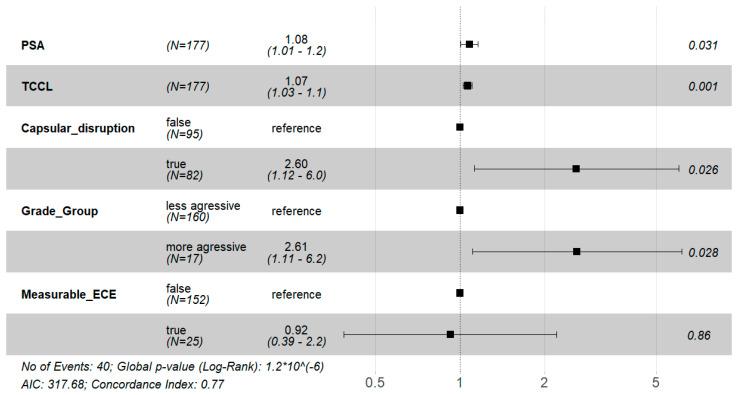
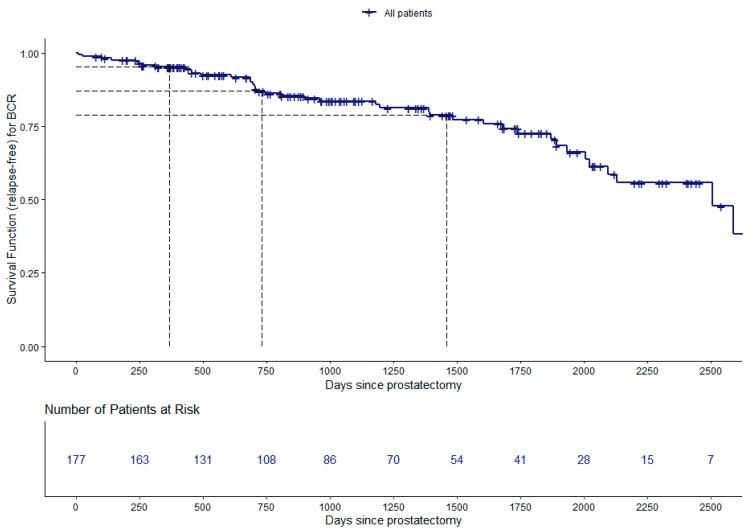
A total of 177 participants with a follow-up exceeding 6 months post-RARP were included. The 1-year, 2-year, and 4-year risks of BCR after radical prostatectomy were 5%, 13%, and 21%, respectively. The non-parametric approach for the survival analysis showed that adverse MRI features such as macroscopic ECE on MRI (mECE+), capsular disruption, high tumor capsular contact length (TCCL), GG ≥ 4, positive surgical margins (PSM), and pECE+ on pathology were risk factors for BCR. In low/intermediate-risk patients (pECE- and GG < 4), the presence of adverse MRI features has been shown to increase the risk of BCR.
CONCLUSIONS
The study highlights the importance of incorporating predictive MRI features for detecting extracapsular extension pre-surgery in influencing early outcomes and clinical decision making; mECE+, TCCL, capsular disruption, and GG ≥ 4 based on pre-surgical biopsy were independent prognostic factors for early BCR. The presence of adverse features on MRI can assist in identifying low/intermediate-risk patients who will benefit from closer monitoring.
目的
本研究旨在评估从检测病理包膜外侵犯(pECE+)的预测模型得出的协变量对机器人辅助根治性前列腺切除术(RARP)后4年内无生化复发生存(BCRFS)的影响。
方法
对2015年至2022年期间来自单一中心的回顾性数据分析。考虑的变量包括前列腺特异性抗原(PSA)水平、患者年龄、前列腺体积、MRI语义特征和分级组(GG)。我们还评估了pECE+和手术切缘阳性对BCRFS的影响。为实现这些目标,我们使用了Kaplan-Meier生存函数和多变量Cox回归模型。此外,我们分析了低/中危患者BCR(生化复发)的MRI特征。
结果
共纳入177例RARP术后随访超过6个月的参与者。根治性前列腺切除术后1年、2年和4年的BCR风险分别为5%、13%和21%。生存分析的非参数方法表明,MRI上的不良特征如MRI上的宏观包膜外侵犯(mECE+)、包膜破裂、高肿瘤包膜接触长度(TCCL)、GG≥4、手术切缘阳性(PSM)和病理pECE+是BCR的危险因素。在低/中危患者(pECE-且GG<4)中,不良MRI特征的存在已被证明会增加BCR的风险。
结论
该研究强调了在术前纳入预测MRI特征以检测包膜外侵犯对影响早期结局和临床决策的重要性;基于术前活检的mECE+、TCCL、包膜破裂和GG≥4是早期BCR的独立预后因素。MRI上不良特征的存在有助于识别将从密切监测中获益的低/中危患者。


 Zotero 插件