
饥荒暴露和初潮年龄对老年人代谢综合征的单独和联合影响:中国的一项横断面研究。
Separate and combined effects of famine exposure and menarche age on metabolic syndrome among the elderly: a cross-sectional study in China.
机构信息
Department of Internal Medicine Nursing, School of Nursing, Wannan Medical College, An Hui Province, Wuhu City, 241000, P.R, China.
Sports Institute, Chi Zhou College, Education Park, Chi Zhou City, An Hui Province, People's Republic of China.
出版信息
BMC Womens Health. 2023 Nov 14;23(1):600. doi: 10.1186/s12905-023-02737-x.
BACKGROUND
Epidemiological studies have revealed multiple risk factors for metabolic syndrome. However, there are no consistent findings on the association between famine exposure, age at menarche, and the prevalence of metabolic syndrome. This cross-sectional study aimed to reveal the individual and combined effects of famine exposure and age at menarche on the prevalence of metabolic syndrome among elderly women.
METHODS
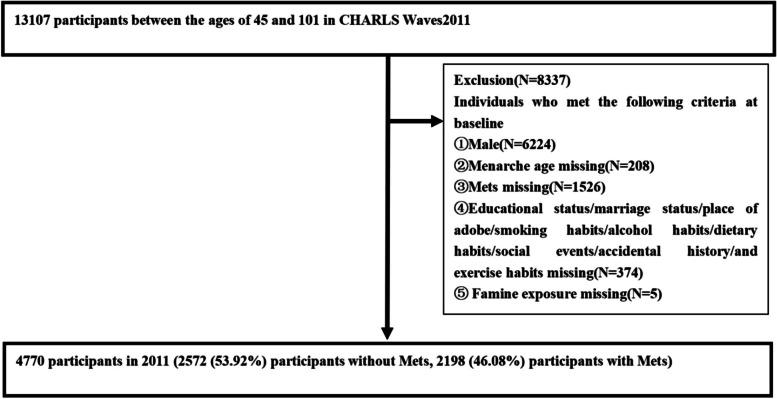
Four thousand seven hundred seventy participants between 60 and 93 years of age were selected from the China Health and Retirement Longitudinal Study. Statistical differences between the baseline characteristics of famine exposure, age at menarche, and metabolic syndrome were evaluated using the t-test, F-test, and Chi-square test. Three multivariable-adjusted logistic regression models were used to test the association between famine exposure, age of menarche, and the odds ratio of metabolic syndrome.
RESULTS
Two thousand one hundred ninety-eight (46.08%) participants had metabolic syndrome, while 2572 (53.92%) participants did not. Furthermore, 3068 (64.32%) women reported onset of menarche under 15 years of age, while 1702 (35.68%) women reported onset of menarche above 16 years of age. Regarding the separate association of famine exposure and age of menarche with metabolic syndrome, in model three, the adolescence/adulthood famine exposure group vs. no famine exposure group odds ratio was 2.45 (95% CI 2.02, 2.97), and the older than 16 years vs. younger than 15 years group odds ratio was 1.23 (95% CI 1.09, 1.39), which was the highest odds ratio among the three models. Regarding the combined association of famine exposure and age of menarche with metabolic syndrome, in model three, among the age of menarche ≤ 15 years group, the adolescence/adulthood famine exposure vs. no famine exposure group odds ratio was 2.45 (95% CI: 1.91, 3.14); among the menarche age ≥ 16 years group, the adolescence/adulthood famine exposure stages vs. exposed group odds ratio was 3.27 (95% CI: 2.44, 4.38), which was the highest odds ratio among the three models.
CONCLUSION
These findings suggested that famine exposure and age at menarche, either separately or in combination, were positively associated with the prevalence of metabolic syndrome among older women.
背景
流行病学研究揭示了多种代谢综合征的风险因素。然而,关于饥荒暴露、初潮年龄与代谢综合征患病率之间的关联,尚未得出一致的结论。本横断面研究旨在揭示饥荒暴露和初潮年龄对老年女性代谢综合征患病率的单独和联合影响。
方法
从中国健康与退休纵向研究中选择了 4770 名年龄在 60 至 93 岁之间的参与者。使用 t 检验、F 检验和卡方检验评估基线特征中饥荒暴露、初潮年龄和代谢综合征之间的统计学差异。使用三个多变量调整的逻辑回归模型来测试饥荒暴露、初潮年龄和代谢综合征的比值比之间的关联。
结果
2198 名(46.08%)参与者患有代谢综合征,而 2572 名(53.92%)参与者没有。此外,3068 名(64.32%)女性报告初潮年龄在 15 岁以下,而 1702 名(35.68%)女性报告初潮年龄在 16 岁以上。关于饥荒暴露和初潮年龄与代谢综合征的单独关联,在模型三,青春期/成年期饥荒暴露组与无饥荒暴露组的比值比为 2.45(95%CI:2.02,2.97),大于 16 岁组与小于 15 岁组的比值比为 1.23(95%CI:1.09,1.39),这是三个模型中最高的比值比。关于饥荒暴露和初潮年龄与代谢综合征的联合关联,在模型三,在初潮年龄≤15 岁组中,青春期/成年期饥荒暴露与无饥荒暴露组的比值比为 2.45(95%CI:1.91,3.14);在初潮年龄≥16 岁组中,青春期/成年期饥荒暴露阶段与暴露组的比值比为 3.27(95%CI:2.44,4.38),这是三个模型中最高的比值比。
结论
这些发现表明,饥荒暴露和初潮年龄,无论是单独还是联合,都与老年女性代谢综合征的患病率呈正相关。
 Zotero 插件