
学校卫生:解决儿童肥胖和 2 型糖尿病管理挑战的机会领域。
School-based health: an area of opportunity to address challenges in management of pediatric obesity and type 2 diabetes.
机构信息
Department of Pediatrics, Nationwide Children's Hospital.
The Ohio State University College of Medicine.
出版信息
Curr Opin Pediatr. 2024 Feb 1;36(1):33-41. doi: 10.1097/MOP.0000000000001307. Epub 2023 Nov 17.
PURPOSE OF REVIEW
Obesity and type 2 diabetes (T2D) are increasingly common, chronic, and complex and disproportionally affect systemically under-resourced communities negatively impacted by social determinants of health. The primary goals of management for both conditions are improvement of medical and psychosocial well being and prevention of secondary complications. The advent of pediatric specific multidisciplinary weight management programs, bariatric surgery, and recent FDA approved medications have provided clinicians with tools to improve patient outcomes. However, implementation remains a challenge.
RECENT FINDINGS
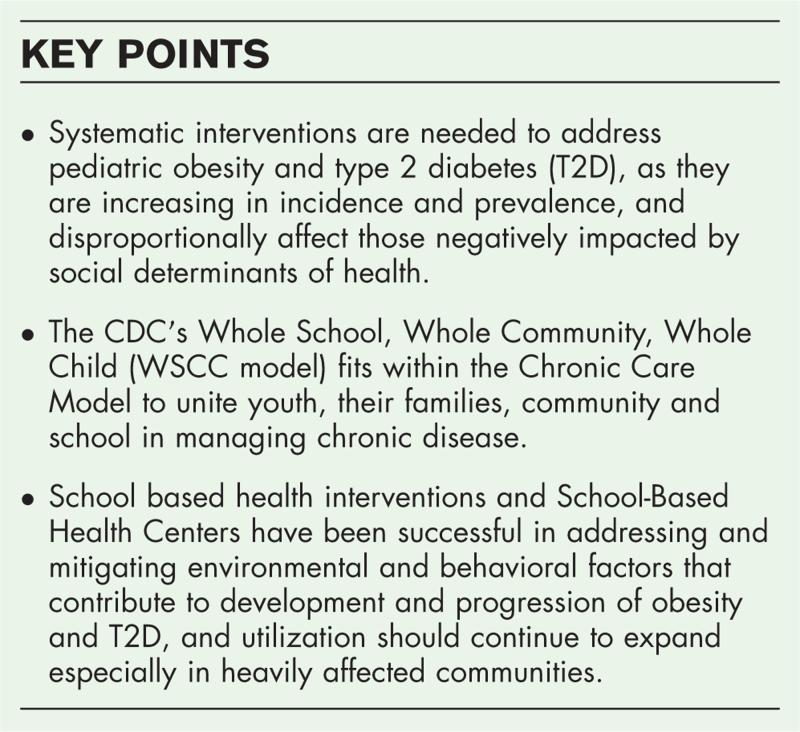
The Chronic Care Model proposes utilization of community-based interventions to support children and families in managing chronic disease The CDC's Whole School, Whole Community, Whole Child Model provides a framework for schools to engage in this role. School-Based Health Centers (SBHCs) utilize a child-focused, multidisciplinary approach to support the medical home and overcome barriers to routine primary care, medical screenings and successful care plans for management of chronic disease. SBHCs and school-based programs have proven sustainable and effective in addressing obesity and T2D in youth, however recent studies are limited and more research evaluating impact are needed.
SUMMARY
School-based health offers an evidence-based solution to ensuring equitable and comprehensive care for obesity and T2D, particularly among at-risk communities.
目的综述:肥胖症和 2 型糖尿病(T2D)日益普遍、慢性且复杂,严重影响着受健康社会决定因素负面影响的系统资源不足的社区。这两种疾病管理的主要目标是改善医疗和心理健康状况,并预防继发性并发症。儿科特定的多学科体重管理计划、减肥手术以及最近获得 FDA 批准的药物为临床医生提供了改善患者预后的工具。然而,实施仍然是一个挑战。
最新发现:慢性护理模式提出利用社区干预措施来支持儿童和家庭管理慢性疾病。疾病预防控制中心的“全学校、全社区、全儿童”模式为学校参与这一角色提供了一个框架。学校保健中心(SBHC)采用以儿童为中心的多学科方法,支持医疗之家,并克服常规初级保健、医疗筛查和成功的慢性病管理护理计划的障碍。SBHC 和基于学校的项目已被证明在解决青少年肥胖症和 T2D 方面是可持续和有效的,然而,最近的研究有限,需要更多的研究来评估其影响。
总结:学校保健为确保肥胖症和 T2D 的公平和全面护理提供了一个基于证据的解决方案,特别是在高风险社区。
 Zotero 插件