
产前乙醇暴露与胎儿神经内分泌代谢编程的变化。
Prenatal ethanol exposure and changes in fetal neuroendocrine metabolic programming.
机构信息
Department of Orthopedic Surgery, Joint Disease Research Center of Wuhan University, Zhongnan Hospital of Wuhan University, Wuhan, 430071, China.
Hubei Provincial Key Laboratory of Developmentally Originated Disease, Wuhan, 430071, China.
出版信息
Biol Res. 2023 Nov 17;56(1):61. doi: 10.1186/s40659-023-00473-y.
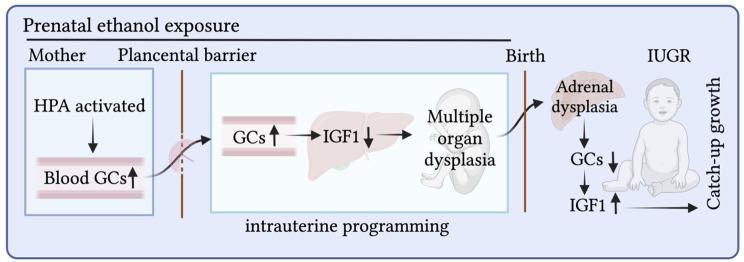
Prenatal ethanol exposure (PEE) (mainly through maternal alcohol consumption) has become widespread. However, studies suggest that it can cause intrauterine growth retardation (IUGR) and multi-organ developmental toxicity in offspring, and susceptibility to various chronic diseases (such as neuropsychiatric diseases, metabolic syndrome, and related diseases) in adults. Through ethanol's direct effects and its indirect effects mediated by maternal-derived glucocorticoids, PEE alters epigenetic modifications and organ developmental programming during fetal development, which damages the offspring health and increases susceptibility to various chronic diseases after birth. Ethanol directly leads to the developmental toxicity of multiple tissues and organs in many ways. Regarding maternal-derived glucocorticoid-mediated IUGR, developmental programming, and susceptibility to multiple conditions after birth, ethanol induces programmed changes in the neuroendocrine axes of offspring, such as the hypothalamus-pituitary-adrenal (HPA) and glucocorticoid-insulin-like growth factor 1 (GC-IGF1) axes. In addition, the differences in ethanol metabolic enzymes, placental glucocorticoid barrier function, and the sensitivity to glucocorticoids in various tissues and organs mediate the severity and sex differences in the developmental toxicity of ethanol exposure during pregnancy. Offspring exposed to ethanol during pregnancy have a "thrifty phenotype" in the fetal period, and show "catch-up growth" in the case of abundant nutrition after birth; when encountering adverse environments, these offspring are more likely to develop diseases. Here, we review the developmental toxicity, functional alterations in multiple organs, and neuroendocrine metabolic programming mechanisms induced by PEE based on our research and that of other investigators. This should provide new perspectives for the effective prevention and treatment of ethanol developmental toxicity and the early prevention of related fetal-originated diseases.
产前乙醇暴露(PEE)(主要通过母体饮酒)已变得普遍。然而,研究表明,它会导致胎儿宫内生长迟缓(IUGR)和多器官发育毒性,并使成年后患各种慢性疾病(如神经精神疾病、代谢综合征和相关疾病)的易感性增加。通过乙醇的直接作用及其通过母体来源的糖皮质激素介导的间接作用,PEE 在胎儿发育过程中改变表观遗传修饰和器官发育编程,从而损害后代健康并增加出生后患各种慢性疾病的易感性。乙醇通过多种方式直接导致多种组织和器官的发育毒性。关于母体来源的糖皮质激素介导的 IUGR、发育编程和出生后多种疾病的易感性,乙醇诱导后代神经内分泌轴的程序性变化,如下丘脑-垂体-肾上腺(HPA)和糖皮质激素-胰岛素样生长因子 1(GC-IGF1)轴。此外,乙醇代谢酶、胎盘糖皮质激素屏障功能以及各种组织和器官对糖皮质激素的敏感性的差异,介导了妊娠期间乙醇暴露的发育毒性的严重程度和性别差异。在胎儿期暴露于乙醇的后代在胎儿期具有“节俭表型”,并在出生后营养丰富的情况下表现出“追赶生长”;当遇到不利环境时,这些后代更容易患上疾病。在这里,我们根据我们自己的研究和其他研究人员的研究,综述了 PEE 引起的发育毒性、多个器官的功能改变和神经内分泌代谢编程机制。这应为有效预防和治疗乙醇发育毒性以及早期预防相关胎儿起源疾病提供新的视角。

 Zotero 插件