
生活方式干预与心血管事件风险的关联因糖化血红蛋白水平而异。
Association of Lifestyle Intervention With Risk for Cardiovascular Events Differs by Level of Glycated Hemoglobin.
作者信息
Bancks Michael P, Pilla Scott J, Balasubramanyam Ashok, Yeh Hsin-Chieh, Johnson Karen C, Rigdon Joseph, Wagenknecht Lynne E, Espeland Mark A
机构信息
Department of Epidemiology and Prevention, Wake Forest University School of Medicine, Winston-Salem, NC 27157, USA.
Department of Medicine, Johns Hopkins School of Medicine, Baltimore, MD 21205, USA.
出版信息
J Clin Endocrinol Metab. 2024 Feb 20;109(3):e1012-e1019. doi: 10.1210/clinem/dgad674.
PURPOSE
We reevaluated the Action for Health in Diabetes (Look AHEAD) intensive lifestyle intervention (ILI) to assess whether the effect of ILI on cardiovascular disease (CVD) prevention differed by baseline glycated hemoglobin (HbA1c).
METHODS
Look AHEAD randomized 5145 adults, aged 45 to 76 years with type 2 diabetes and overweight/obesity to ILI or a diabetes support and education (DSE) control group for a median of 9.6 years. ILI focused on achieving weight loss through decreased caloric intake and increased physical activity. We assessed the parent trial's primary composite CVD outcome. We evaluated additive and multiplicative heterogeneity of the intervention on CVD risk by baseline HbA1c.
RESULTS
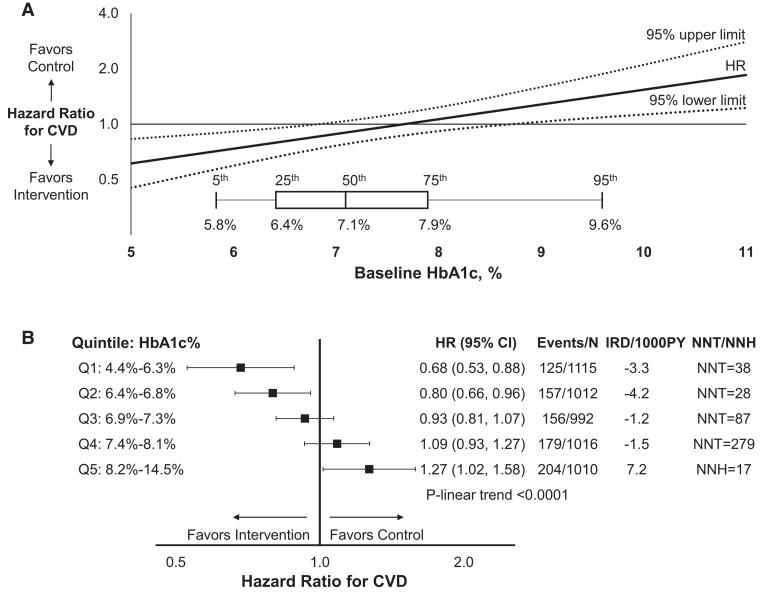
Mean baseline HbA1c was 7.3% (SD 1.2) and ranged from 4.4% (quintile 1) to 14.5% (quintile 5). We observed additive and multiplicative heterogeneity of the association between ILI and CVD (all P < .001) by baseline HbA1c. Randomization to ILI was associated with lower CVD risk for HbA1c quintiles 1 [hazard ratio (HR): 0.68, 95% confidence interval (CI): 0.53, 0.88] and 2 (HR: 0.80, 95% CI: 0.66, 0.96) and associated with higher CVD risk for HbA1c quintile 5 (HR: 1.27, 95% CI: 1.02, 1.58), compared to DSE.
CONCLUSION
Among adults with type 2 diabetes and overweight/obesity, randomization to a lifestyle intervention was differentially associated with CVD risk by baseline HbA1c such that it was associated with lower risk at lower HbA1c levels and higher risk at higher HbA1c levels. There is a critical need to develop and tailor lifestyle interventions to be successful for individuals with type 2 diabetes and high HbA1c.
目的
我们重新评估了糖尿病健康行动(Look AHEAD)强化生活方式干预(ILI),以评估ILI对心血管疾病(CVD)预防的效果是否因基线糖化血红蛋白(HbA1c)而异。
方法
Look AHEAD将5145名年龄在45至76岁、患有2型糖尿病且超重/肥胖的成年人随机分为ILI组或糖尿病支持与教育(DSE)对照组,为期中位数9.6年。ILI侧重于通过减少热量摄入和增加身体活动来实现体重减轻。我们评估了母试验的主要复合CVD结局。我们通过基线HbA1c评估了干预对CVD风险的相加和相乘异质性。
结果
平均基线HbA1c为7.3%(标准差1.2),范围从4.4%(五分位数1)到14.5%(五分位数5)。我们观察到,按基线HbA1c分层,ILI与CVD之间的关联存在相加和相乘异质性(所有P <.001)。与DSE相比,随机分配到ILI组使HbA1c五分位数1(风险比[HR]:0.68,95%置信区间[CI]:0.53,0.88)和2(HR:0.80,95%CI:0.66,0.96)的CVD风险降低,而使HbA1c五分位数5的CVD风险升高(HR:1.27,95%CI:1.02,1.58)。
结论
在患有2型糖尿病且超重/肥胖的成年人中,随机分配到生活方式干预组与CVD风险的关联因基线HbA1c而异,即HbA1c水平较低时风险降低,HbA1c水平较高时风险升高。迫切需要开发并量身定制生活方式干预措施,以使2型糖尿病和高HbA1c患者获得成功。
 Zotero 插件