
人工智能时代用于膀胱癌治疗的多参数磁共振成像
Multiparametric MRI in Era of Artificial Intelligence for Bladder Cancer Therapies.
作者信息
Akin Oguz, Lema-Dopico Alfonso, Paudyal Ramesh, Konar Amaresha Shridhar, Chenevert Thomas L, Malyarenko Dariya, Hadjiiski Lubomir, Al-Ahmadie Hikmat, Goh Alvin C, Bochner Bernard, Rosenberg Jonathan, Schwartz Lawrence H, Shukla-Dave Amita
机构信息
Department of Radiology, Memorial Sloan Kettering Cancer Center, New York, NY 10065, USA.
Department of Medical Physics, Memorial Sloan Kettering Cancer, New York, NY 10065, USA.
出版信息
Cancers (Basel). 2023 Nov 18;15(22):5468. doi: 10.3390/cancers15225468.
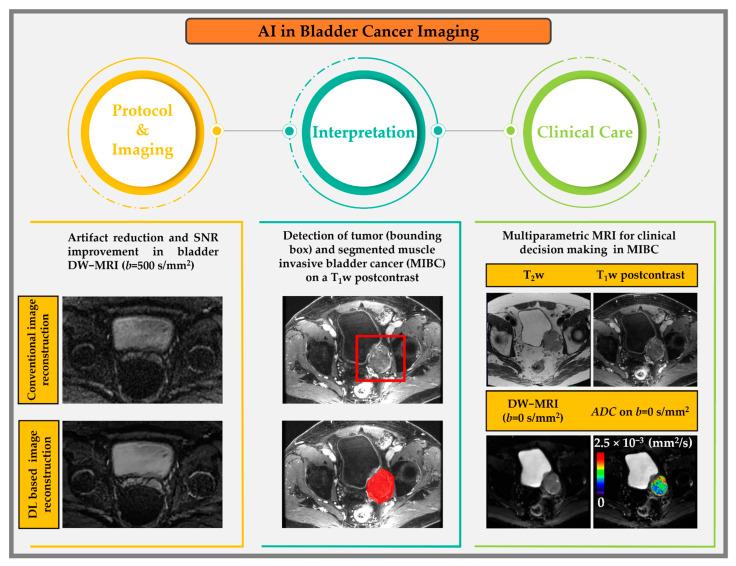
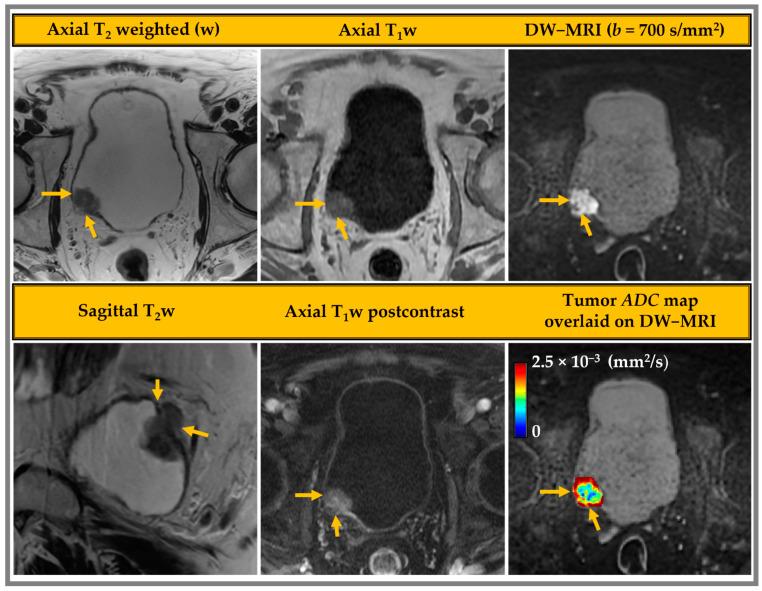
This review focuses on the principles, applications, and performance of mpMRI for bladder imaging. Quantitative imaging biomarkers (QIBs) derived from mpMRI are increasingly used in oncological applications, including tumor staging, prognosis, and assessment of treatment response. To standardize mpMRI acquisition and interpretation, an expert panel developed the Vesical Imaging-Reporting and Data System (VI-RADS). Many studies confirm the standardization and high degree of inter-reader agreement to discriminate muscle invasiveness in bladder cancer, supporting VI-RADS implementation in routine clinical practice. The standard MRI sequences for VI-RADS scoring are anatomical imaging, including Tw images, and physiological imaging with diffusion-weighted MRI (DW-MRI) and dynamic contrast-enhanced MRI (DCE-MRI). Physiological QIBs derived from analysis of DW- and DCE-MRI data and radiomic image features extracted from mpMRI images play an important role in bladder cancer. The current development of AI tools for analyzing mpMRI data and their potential impact on bladder imaging are surveyed. AI architectures are often implemented based on convolutional neural networks (CNNs), focusing on narrow/specific tasks. The application of AI can substantially impact bladder imaging clinical workflows; for example, manual tumor segmentation, which demands high time commitment and has inter-reader variability, can be replaced by an autosegmentation tool. The use of mpMRI and AI is projected to drive the field toward the personalized management of bladder cancer patients.
本综述重点关注多参数磁共振成像(mpMRI)用于膀胱成像的原理、应用和性能。源自mpMRI的定量成像生物标志物(QIBs)越来越多地用于肿瘤学应用,包括肿瘤分期、预后评估以及治疗反应评估。为了规范mpMRI的采集和解读,一个专家小组制定了膀胱影像报告和数据系统(VI-RADS)。许多研究证实了VI-RADS在鉴别膀胱癌肌肉浸润方面的标准化以及高度的阅片者间一致性,支持其在常规临床实践中的应用。用于VI-RADS评分的标准MRI序列包括解剖成像(如T2加权像)以及采用扩散加权磁共振成像(DW-MRI)和动态对比增强磁共振成像(DCE-MRI)的生理成像。从DW-MRI和DCE-MRI数据分析中得出的生理QIBs以及从mpMRI图像中提取的影像组学图像特征在膀胱癌中发挥着重要作用。本文还综述了当前用于分析mpMRI数据的人工智能(AI)工具的发展及其对膀胱成像的潜在影响。AI架构通常基于卷积神经网络(CNN)实现,专注于狭窄/特定的任务。AI的应用会对膀胱成像临床工作流程产生重大影响;例如,需要大量时间且存在阅片者间差异的手动肿瘤分割可以被自动分割工具所取代。预计mpMRI和AI的应用将推动膀胱癌患者的个性化管理。


 Zotero 插件