
利用哨兵-3号海洋陆地彩色成像仪图像和机器学习评估意大利沿海水域的生态质量。
Use of Sentinel-3 OLCI Images and Machine Learning to Assess the Ecological Quality of Italian Coastal Waters.
作者信息
Lapucci Chiara, Antonini Andrea, Böhm Emanuele, Organelli Emanuele, Massi Luca, Ortolani Alberto, Brandini Carlo, Maselli Fabio
机构信息
National Research Council (CNR), Institute of Marine Science (ISMAR), Via Madonna del Piano 10, 50019 Sesto Fiorentino, Florence, Italy.
LaMMA Consortium, Via Madonna del Piano 10, 50019 Sesto Fiorentino, Florence, Italy.
出版信息
Sensors (Basel). 2023 Nov 18;23(22):9258. doi: 10.3390/s23229258.
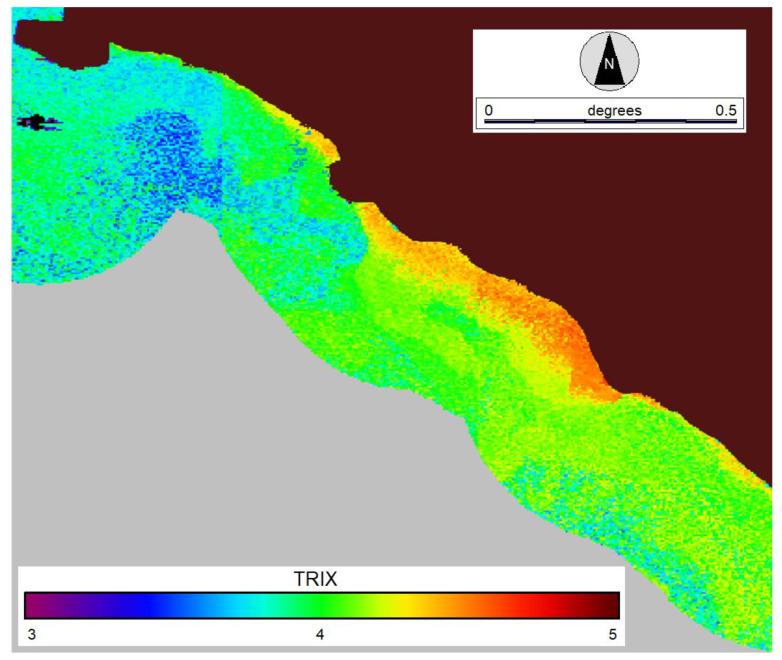
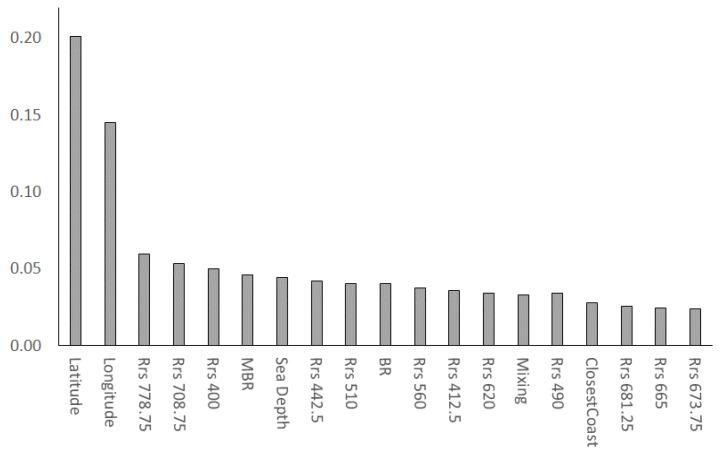
Understanding and monitoring the ecological quality of coastal waters is crucial for preserving marine ecosystems. Eutrophication is one of the major problems affecting the ecological state of coastal marine waters. For this reason, the control of the trophic conditions of aquatic ecosystems is needed for the evaluation of their ecological quality. This study leverages space-based Sentinel-3 Ocean and Land Color Instrument imagery (OLCI) to assess the ecological quality of Mediterranean coastal waters using the Trophic Index (TRIX) key indicator. In particular, we explore the feasibility of coupling remote sensing and machine learning techniques to estimate the TRIX levels in the Ligurian, Tyrrhenian, and Ionian coastal regions of Italy. Our research reveals distinct geographical patterns in TRIX values across the study area, with some regions exhibiting eutrophic conditions near estuaries and others showing oligotrophic characteristics. We employ the Random Forest Regression algorithm, optimizing calibration parameters to predict TRIX levels. Feature importance analysis highlights the significance of latitude, longitude, and specific spectral bands in TRIX prediction. A final statistical assessment validates our model's performance, demonstrating a moderate level of error (MAE of 0.51) and explanatory power (R of 0.37). These results highlight the potential of Sentinel-3 OLCI imagery in assessing ecological quality, contributing to our understanding of coastal water ecology. They also underscore the importance of merging remote sensing and machine learning in environmental monitoring and management. Future research should refine methodologies and expand datasets to enhance TRIX monitoring capabilities from space.
了解和监测沿海水域的生态质量对于保护海洋生态系统至关重要。富营养化是影响沿海海水生态状态的主要问题之一。因此,需要控制水生生态系统的营养状况以评估其生态质量。本研究利用基于太空的哨兵-3海洋和陆地颜色仪器图像(OLCI),使用营养指数(TRIX)关键指标评估地中海沿海水域的生态质量。特别是,我们探索了将遥感和机器学习技术相结合以估计意大利利古里亚海、第勒尼安海和爱奥尼亚海沿海地区TRIX水平的可行性。我们的研究揭示了整个研究区域TRIX值的明显地理模式,一些地区在河口附近呈现富营养化状况,而其他地区则表现出贫营养特征。我们采用随机森林回归算法,优化校准参数以预测TRIX水平。特征重要性分析突出了纬度、经度和特定光谱带在TRIX预测中的重要性。最终的统计评估验证了我们模型的性能,显示出中等程度的误差(平均绝对误差为0.51)和解释力(R为0.37)。这些结果突出了哨兵-3 OLCI图像在评估生态质量方面的潜力,有助于我们对沿海水生态的理解。它们还强调了在环境监测和管理中融合遥感和机器学习的重要性。未来的研究应改进方法并扩大数据集,以提高从太空监测TRIX的能力。



 Zotero 插件