
由Mfn2下调介导的线粒体DNA胞质逃逸通过cGas-Sting轴促进脊髓损伤中的小胶质细胞激活。
Cytoplasmic Escape of Mitochondrial DNA Mediated by Mfn2 Downregulation Promotes Microglial Activation via cGas-Sting Axis in Spinal Cord Injury.
作者信息
Wei Fei-Long, Wang Tian-Fu, Wang Chao-Li, Zhang Zhen-Peng, Zhao Jing-Wei, Heng Wei, Tang Zhen, Du Ming-Rui, Yan Xiao-Dong, Li Xiao-Xiang, Guo Zheng, Qian Ji-Xian, Zhou Cheng-Pei
机构信息
Department of Orthopaedics, Tangdu Hospital, Fourth Military Medical University, Xi'an, 710038, China.
Department of Pharmaceutical Analysis, School of Pharmacy, Fourth Military Medical University, Xi'an, 710032, China.
出版信息
Adv Sci (Weinh). 2024 Jan;11(4):e2305442. doi: 10.1002/advs.202305442. Epub 2023 Nov 27.
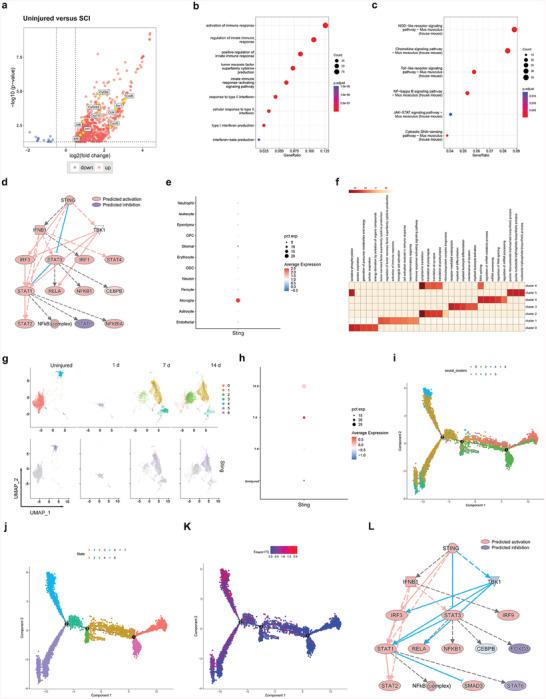
Neuroinflammation is associated with poor outcomes in patients with spinal cord injury (SCI). Recent studies have demonstrated that stimulator of interferon genes (Sting) plays a key role in inflammatory diseases. However, the role of Sting in SCI remains unclear. In the present study, it is found that increased Sting expression is mainly derived from activated microglia after SCI. Interestingly, knockout of Sting in microglia can improve the recovery of neurological function after SCI. Microglial Sting knockout restrains the polarization of microglia toward the M1 phenotype and alleviates neuronal death. Furthermore, it is found that the downregulation of mitofusin 2 (Mfn2) expression in microglial cells leads to an imbalance in mitochondrial fusion and division, inducing the release of mitochondrial DNA (mtDNA), which mediates the activation of the cGas-Sting signaling pathway and aggravates inflammatory response damage after SCI. A biomimetic microglial nanoparticle strategy to deliver MASM7 (named MSNs-MASM7@MI) is established. In vitro, MSNs-MASM7@MI showed no biological toxicity and effectively delivered MASM7. In vivo, MSNs-MASM7@MI improves nerve function after SCI. The study provides evidence that cGas-Sting signaling senses Mfn2-dependent mtDNA release and that its activation may play a key role in SCI. These findings provide new perspectives and potential therapeutic targets for SCI treatment.
神经炎症与脊髓损伤(SCI)患者的不良预后相关。最近的研究表明,干扰素基因刺激物(Sting)在炎症性疾病中起关键作用。然而,Sting在SCI中的作用仍不清楚。在本研究中,发现Sting表达增加主要源于SCI后活化的小胶质细胞。有趣的是,小胶质细胞中Sting基因敲除可改善SCI后神经功能的恢复。小胶质细胞Sting基因敲除可抑制小胶质细胞向M1表型极化并减轻神经元死亡。此外,发现小胶质细胞中丝裂原活化蛋白激酶2(Mfn2)表达下调导致线粒体融合与分裂失衡,诱导线粒体DNA(mtDNA)释放,介导cGas-Sting信号通路激活并加重SCI后的炎症反应损伤。建立了一种仿生小胶质纳米颗粒策略来递送MASM7(命名为MSNs-MASM7@MI)。在体外,MSNs-MASM7@MI无生物毒性并能有效递送MASM7。在体内,MSNs-MASM7@MI可改善SCI后的神经功能。该研究提供了证据表明cGas-Sting信号感知Mfn2依赖性mtDNA释放,其激活可能在SCI中起关键作用。这些发现为SCI治疗提供了新的视角和潜在的治疗靶点。

 Zotero 插件