
达克替尼治疗伴有脑转移的表皮生长因子受体突变型非小细胞肺癌:一项单臂、二期研究。
Dacomitinib in EGFR-mutant non-small-cell lung cancer with brain metastasis: a single-arm, phase II study.
机构信息
Division of Hematology-Oncology, Department of Medicine, Samsung Medical Center, Sungkyunkwan University School of Medicine, Seoul, Republic of Korea.
Division of Hematology-Oncology, Department of Medicine, Samsung Medical Center, Sungkyunkwan University School of Medicine, Seoul, Republic of Korea.
出版信息
ESMO Open. 2023 Dec;8(6):102068. doi: 10.1016/j.esmoop.2023.102068. Epub 2023 Nov 27.
INTRODUCTION
Dacomitinib showed superior progression-free survival (PFS) and overall survival compared to gefitinib in patients with advanced non-small-cell lung cancer (NSCLC) harboring epidermal growth factor receptor (EGFR) mutations in the ARCHER1050 study. However, because that study did not include patients with brain metastases, the efficacy of dacomitinib in patients with brain metastases has not been clarified.
PATIENTS AND METHODS
This single-arm phase II study enrolled 30 patients with treatment-naïve advanced NSCLC harboring activating EGFR mutations from January 2021 to June 2021 and started them on dacomitinib (45 mg/day). All patients had non-irradiated brain metastases with a diameter of ≥5 mm. The primary endpoint was confirmed intracranial objective response rate (iORR).
RESULTS
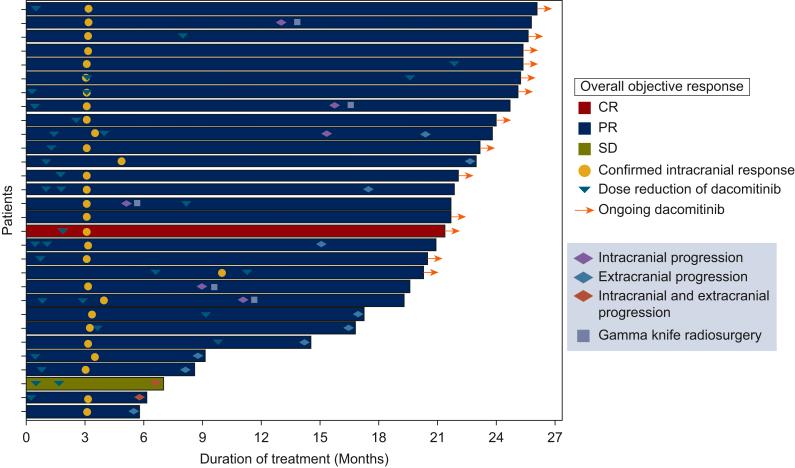
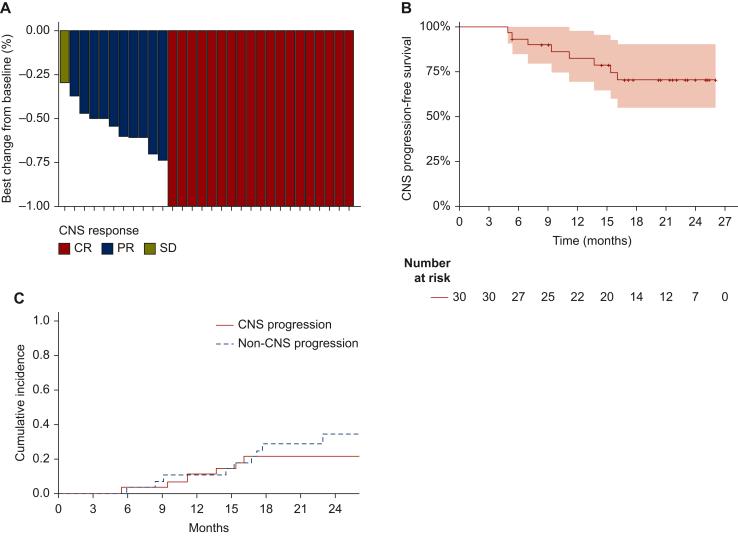
Patients had exon 19 deletions (46.7%) and L858R mutations in exon 21 (55.3%). The confirmed iORR was 96.7% (29/30), with an intracranial complete response of 63.3%. Median intracranial PFS (iPFS) was not reached, with 12- and 18-month iPFS rates of 78.6% [95% confidence interval (CI) 64.8% to 95.4%] and 70.4% (95% CI 54.9% to 90.1%), respectively. In the competing risk analysis, the 12-month cumulative incidence of intracranial progression was 16.7%. Regarding the overall efficacy for intracranial and extracranial lesions, the overall ORR was 96.7%, and the median PFS was 17.5 months (95% CI 15.2 months-not reached). Grade 3 or higher treatment-related adverse events were reported in 16.7% of patients, and 83.3% required a reduced dacomitinib dose to manage adverse events. However, none permanently discontinued dacomitinib treatment due to treatment-related adverse events.
CONCLUSIONS
Dacomitinib has outstanding intracranial efficacy in patients with EGFR-mutant NSCLC with brain metastases.
介绍
在 ARCHER1050 研究中,与吉非替尼相比,达可替尼在携带表皮生长因子受体(EGFR)突变的晚期非小细胞肺癌(NSCLC)患者中显示出更优的无进展生存期(PFS)和总生存期。然而,由于该研究未纳入脑转移患者,因此达可替尼在脑转移患者中的疗效尚未明确。
患者和方法
这项单臂 II 期研究纳入了 2021 年 1 月至 2021 年 6 月期间 30 例初治的携带激活型 EGFR 突变的晚期 NSCLC 且伴有未经放疗的脑转移瘤(直径≥5mm)的患者,并给予达可替尼(45mg/天)治疗。主要终点为确认的颅内客观缓解率(iORR)。
结果
患者 EGFR 外显子 19 缺失(46.7%)和外显子 21 L858R 突变(55.3%)。确认的 iORR 为 96.7%(29/30),颅内完全缓解率为 63.3%。中位颅内无进展生存期(iPFS)未达到,12 个月和 18 个月的 iPFS 率分别为 78.6%(95%CI,64.8%至 95.4%)和 70.4%(95%CI,54.9%至 90.1%)。在竞争风险分析中,颅内进展的 12 个月累积发生率为 16.7%。在颅内和颅外病变的总体疗效方面,总体 ORR 为 96.7%,中位 PFS 为 17.5 个月(95%CI,15.2 个月-未达到)。16.7%的患者发生 3 级或以上与治疗相关的不良事件,83.3%的患者需要减少达可替尼剂量以处理不良事件。然而,没有患者因治疗相关不良事件而永久停止达可替尼治疗。
结论
达可替尼在伴有脑转移的 EGFR 突变型 NSCLC 患者中具有显著的颅内疗效。
 Zotero 插件