
自然系统中的感觉集合。
Sensory collectives in natural systems.
机构信息
Department of Migration, Max Planck Institute of Animal Behavior, Konstanz, Germany.
Centre for the Advanced Study of Collective Behaviour, University of Konstanz, Konstanz, Germany.
出版信息
Elife. 2023 Nov 29;12:e88028. doi: 10.7554/eLife.88028.
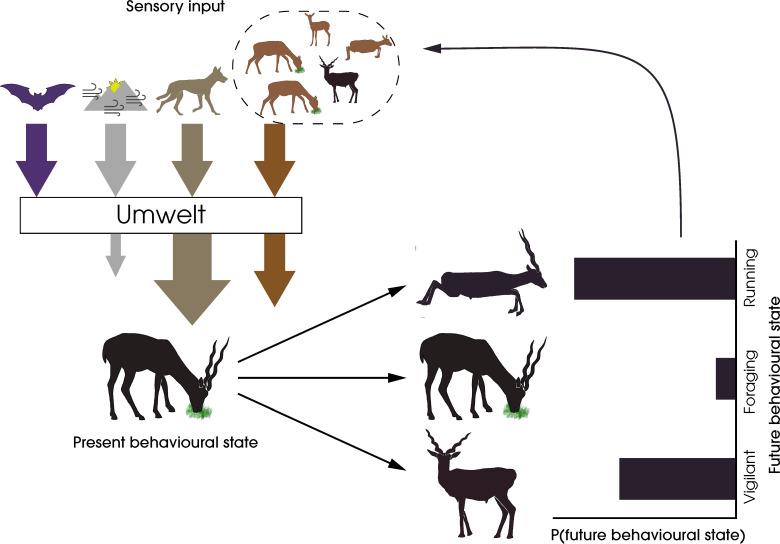
Groups of animals inhabit vastly different sensory worlds, or umwelten, which shape fundamental aspects of their behaviour. Yet the sensory ecology of species is rarely incorporated into the emerging field of collective behaviour, which studies the movements, population-level behaviours, and emergent properties of animal groups. Here, we review the contributions of sensory ecology and collective behaviour to understanding how animals move and interact within the context of their social and physical environments. Our goal is to advance and bridge these two areas of inquiry and highlight the potential for their creative integration. To achieve this goal, we organise our review around the following themes: (1) identifying the promise of integrating collective behaviour and sensory ecology; (2) defining and exploring the concept of a 'sensory collective'; (3) considering the potential for sensory collectives to shape the evolution of sensory systems; (4) exploring examples from diverse taxa to illustrate neural circuits involved in sensing and collective behaviour; and (5) suggesting the need for creative conceptual and methodological advances to quantify 'sensescapes'. In the final section, (6) applications to biological conservation, we argue that these topics are timely, given the ongoing anthropogenic changes to sensory stimuli (e.g. via light, sound, and chemical pollution) which are anticipated to impact animal collectives and group-level behaviour and, in turn, ecosystem composition and function. Our synthesis seeks to provide a forward-looking perspective on how sensory ecologists and collective behaviourists can both learn from and inspire one another to advance our understanding of animal behaviour, ecology, adaptation, and evolution.
动物群体栖息在截然不同的感觉世界(welt)中,这些感觉世界塑造了它们行为的基本方面。然而,物种的感觉生态学很少被纳入新兴的群体行为领域,后者研究动物群体的运动、种群水平行为和涌现特性。在这里,我们回顾了感觉生态学和群体行为学对理解动物如何在其社会和物理环境中运动和相互作用的贡献。我们的目标是推进和弥合这两个研究领域,并强调它们创造性整合的潜力。为了实现这一目标,我们围绕以下主题组织我们的综述:(1)确定整合群体行为和感觉生态学的前景;(2)定义和探索“感觉群体”的概念;(3)考虑感觉群体塑造感觉系统进化的潜力;(4)探索来自不同分类群的例子,说明参与感觉和群体行为的神经回路;(5)提出需要创造性的概念和方法进展来量化“感觉景观”。在最后一节(6)生物保护应用中,我们认为这些主题是及时的,因为对感觉刺激的人为改变(例如通过光、声音和化学污染)预计会影响动物群体和群体水平的行为,并进而影响生态系统的组成和功能。我们的综合分析旨在提供一个前瞻性的视角,说明感觉生态学家和群体行为学家如何相互学习和启发,以推进我们对动物行为、生态学、适应和进化的理解。

 Zotero 插件