
血浆中神经元来源的游离DNA的检测:神经退行性疾病的一种新诊断方法。
Detection of neuron-derived cfDNA in blood plasma: a new diagnostic approach for neurodegenerative conditions.
作者信息
Pollard Chad, Aston Kenneth, Emery Benjamin R, Hill Jonathon, Jenkins Timothy
机构信息
Department of Cell Biology and Physiology, Brigham Young University, Provo, UT, United States.
Department of Surgery, Division of Urology, University of Utah, Salt Lake City, UT, United States.
出版信息
Front Neurol. 2023 Oct 31;14:1272960. doi: 10.3389/fneur.2023.1272960. eCollection 2023.
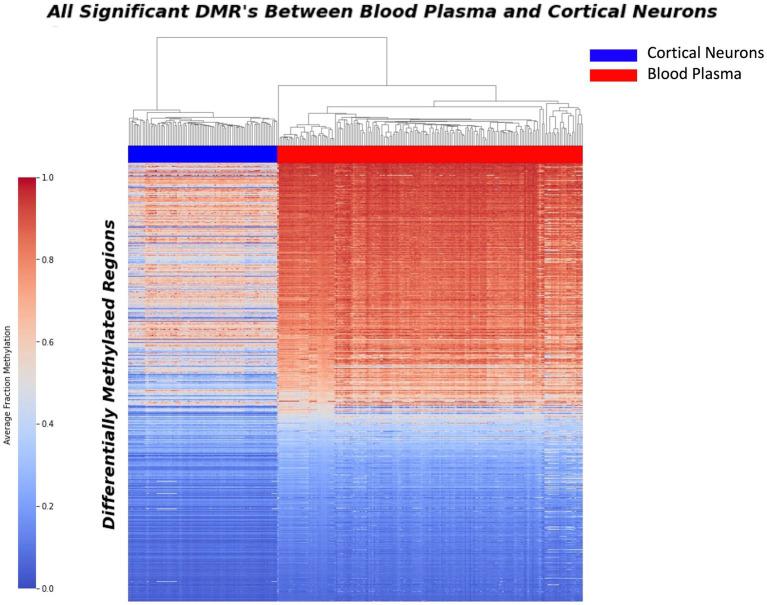
Neurodegenerative diseases, such as Alzheimer's disease (AD), pose significant challenges in early diagnosis, leading to irreversible brain damage and cognitive decline. In this study, we present a novel diagnostic approach that utilizes whole molecule analysis of neuron-derived cell-free DNA (cfDNA) as a biomarker for early detection of neurodegenerative diseases. By analyzing Differential Methylation Regions (DMRs) between purified cortical neurons and blood plasma samples, we identified robust biomarkers that accurately distinguish between neuronal and non-neuronal cfDNA. The use of cfDNA offers the advantage of convenient and minimally invasive sample collection compared to traditional cerebrospinal fluid or tissue biopsies, making this approach more accessible and patient friendly. Targeted sequencing at the identified DMR locus demonstrated that a conservative cutoff of 5% of neuron-derived cfDNA in blood plasma accurately identifies 100% of patients diagnosed with AD, showing promising potential for early disease detection. Additionally, this method effectively differentiated between patients with mild cognitive impairment (MCI) who later progressed to AD and those who did not, highlighting its prognostic capabilities. Importantly, the differentiation between patients with neurodegenerative diseases and healthy controls demonstrated the specificity of our approach. Furthermore, this cfDNA-based diagnostic strategy outperforms recently developed protein-based assays, which often lack accuracy and convenience. While our current approach focused on a limited set of loci, future research should explore the development of a more comprehensive model incorporating multiple loci to increase diagnostic accuracy further. Although certain limitations, such as technical variance associated with PCR amplification and bisulfite conversion, need to be addressed, this study emphasizes the potential of cfDNA analysis as a valuable tool for pre-symptomatic detection and monitoring of neurodegenerative diseases. With further development and validation, this innovative diagnostic strategy has the potential to significantly impact the field of neurodegenerative disease research and patient care, offering a promising avenue for early intervention and personalized therapeutic approaches.
神经退行性疾病,如阿尔茨海默病(AD),在早期诊断方面面临重大挑战,会导致不可逆的脑损伤和认知能力下降。在本研究中,我们提出了一种新颖的诊断方法,该方法利用对神经元衍生的游离DNA(cfDNA)进行全分子分析作为神经退行性疾病早期检测的生物标志物。通过分析纯化的皮质神经元与血浆样本之间的差异甲基化区域(DMR),我们确定了能够准确区分神经元cfDNA和非神经元cfDNA的可靠生物标志物。与传统的脑脊液或组织活检相比,使用cfDNA具有样本采集方便且微创的优势,使这种方法更易于实施且对患者更友好。在已确定的DMR位点进行靶向测序表明,血浆中神经元衍生的cfDNA保守阈值为5%时可准确识别100%已确诊的AD患者,显示出在疾病早期检测方面具有广阔的潜力。此外,该方法有效地区分了后来发展为AD的轻度认知障碍(MCI)患者和未发展为AD的患者,突出了其预后评估能力。重要的是,神经退行性疾病患者与健康对照之间的区分证明了我们方法的特异性。此外,这种基于cfDNA的诊断策略优于最近开发的基于蛋白质的检测方法,后者往往缺乏准确性和便利性。虽然我们目前的方法侧重于有限的一组位点,但未来的研究应探索开发一个包含多个位点的更全面模型,以进一步提高诊断准确性。尽管存在某些局限性,如与PCR扩增和亚硫酸氢盐转化相关的技术差异需要解决,但本研究强调了cfDNA分析作为神经退行性疾病症状前检测和监测的有价值工具的潜力。随着进一步的发展和验证,这种创新的诊断策略有可能对神经退行性疾病研究和患者护理领域产生重大影响,为早期干预和个性化治疗方法提供了一条充满希望的途径。



 Zotero 插件