
肠道微生物群和肠道代谢物对消化道癌症的遗传预测因果效应:一项两样本孟德尔随机化分析
Genetically Predicted Causal Effects of Gut Microbiota and Gut Metabolites on Digestive Tract Cancer: A Two-Sample Mendelian Randomization Analysis.
作者信息
Li Xu Jia, Gao Meng Ge, Chen Xu Xian, Rong Yu Ming, Huang Ling Li, Huang Jin Sheng
机构信息
VIP Department, Sun Yat-sen University Cancer Center, Guangzhou 510060, China.
State Key Laboratory of Oncology in South China, Sun Yat-sen University Cancer Center, Guangzhou 510060, China.
出版信息
World J Oncol. 2023 Dec;14(6):558-569. doi: 10.14740/wjon1737. Epub 2023 Nov 3.
BACKGROUND
Evidence from numerous observational studies and clinical trials has linked gut microbiota and metabolites to digestive tract cancer. However, the causal effect between these factors remains uncertain.
METHODS
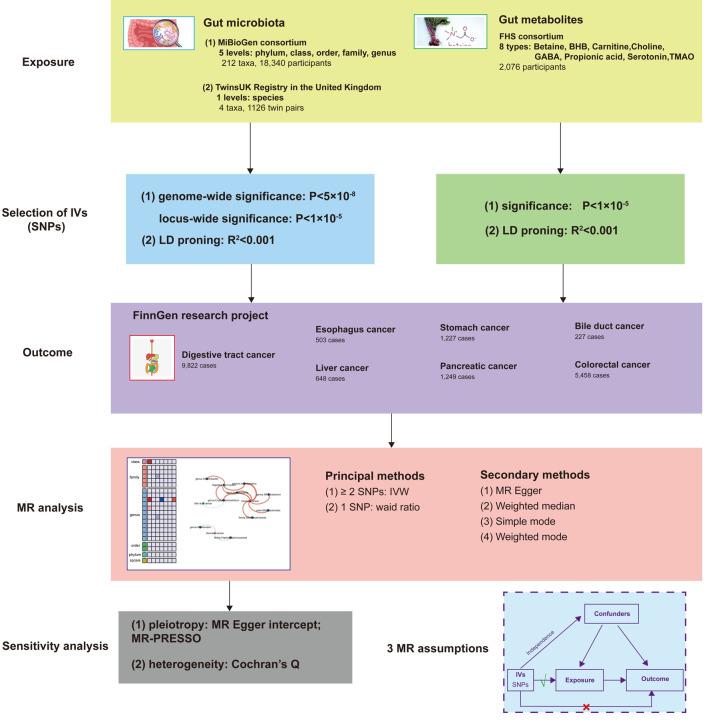
Data for this study were obtained from the MiBioGen, TwinsUK Registry, and FinnGen (version R8). Two-sample Mendelian randomization analysis with inverse variance weighting method was primarily used, and the results were validated by heterogeneity analysis, pleiotropy test, and sensitivity analysis.
RESULTS
At P < 5 × 10, our analysis identified four gut microbiotas as risk factors for digestive tract cancer and six as risk factors for colorectal cancer. Conversely, one gut microbiota exhibited protection against bile duct cancer, and two showed protective effects against stomach cancer. At P < 1 × 10, our investigation revealed five, six, three, eight, eight, and eight gut microbiotas as risk factors for esophageal, stomach, bile duct, liver, pancreatic, and colorectal cancers, respectively. In contrast, four, two, eight, two, two, and five gut microbiotas exhibited protective effects against these cancers. Additionally, , a metabolite of gut microbiota, displayed a significant protective effect against colorectal cancer.
CONCLUSION
In conclusion, specific gut microbiota and metabolites play roles as risk factors or protective factors for digestive tract cancer, and a causal relationship between them has been established, offering novel insights into gut microbiota-mediated cancer development.
背景
大量观察性研究和临床试验的证据已将肠道微生物群和代谢物与消化道癌症联系起来。然而,这些因素之间的因果关系仍不确定。
方法
本研究的数据来自MiBioGen、英国双胞胎注册库和芬兰基因库(R8版本)。主要采用逆方差加权法进行两样本孟德尔随机化分析,并通过异质性分析、多效性检验和敏感性分析对结果进行验证。
结果
在P < 5×10时,我们的分析确定了四种肠道微生物群为消化道癌症的危险因素,六种为结直肠癌的危险因素。相反,一种肠道微生物群对胆管癌有保护作用,两种对胃癌有保护作用。在P < 1×10时,我们的研究分别揭示了五种、六种、三种、八种、八种和八种肠道微生物群为食管癌、胃癌、胆管癌、肝癌、胰腺癌和结直肠癌的危险因素。相比之下,四种、两种、八种、两种、两种和五种肠道微生物群对这些癌症有保护作用。此外,肠道微生物群的一种代谢物对结直肠癌显示出显著的保护作用。
结论
总之,特定的肠道微生物群和代谢物作为消化道癌症的危险因素或保护因素发挥作用,并且它们之间的因果关系已经确立,为肠道微生物群介导的癌症发展提供了新的见解。


 Zotero 插件