
加拿大预防婴儿呼吸道合胞病毒疾病的尼塞韦单抗和母体呼吸道合胞病毒前融合蛋白疫苗策略的成本效益分析:一项模拟研究
Cost-effectiveness analysis of nirsevimab and maternal RSVpreF vaccine strategies for prevention of Respiratory Syncytial Virus disease among infants in Canada: a simulation study.
作者信息
Shoukat Affan, Abdollahi Elaheh, Galvani Alison P, Halperin Scott A, Langley Joanne M, Moghadas Seyed M
机构信息
Agent-Based Modelling Laboratory, York University, Toronto, Ontario, Canada.
Center for Infectious Disease Modeling and Analysis (CIDMA), Yale School of Public Health, New Haven, CT, USA.
出版信息
Lancet Reg Health Am. 2023 Nov 9;28:100629. doi: 10.1016/j.lana.2023.100629. eCollection 2023 Dec.
BACKGROUND
The cost-effectiveness of immunisation strategies with a long-acting monoclonal antibody (nirsevimab) and/or a protein-based maternal vaccine (RSVpreF) for protecting infants from Respiratory Syncytial Virus (RSV)-associated illness has not been previously determined for Canada. We estimated the health benefits and cost-effectiveness of nirsevimab for immunising the entire birth cohort, regardless of gestational age or other risk factors. Additionally, we evaluated the health benefits and cost-effectiveness of a combined strategy of year-round vaccination of pregnant women with RSVpreF and immunisation of infants at high risk, including those born preterm or with chronic conditions, with nirsevimab during the RSV season.
METHODS
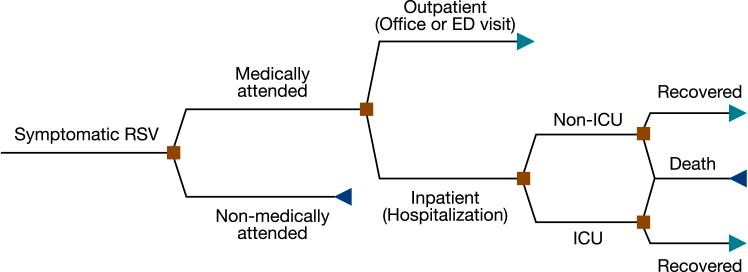
We developed a discrete-event simulation model, parameterized with the data on medically-attended RSV infections among infants under one year of age from 2010 to 2019, including outpatient care, hospitalisations, and deaths. Intervention scenarios targeting twelve monthly birth cohorts and pregnant women, reflecting the 2021 census data for Ontario, Canada were evaluated over a follow-up time horizon of one year from birth. Taking into account the costs (in 2023 Canadian dollars) associated with RSV-related outcomes, we calculated the net monetary benefit using the quality-adjusted life-year (QALY) gained. Further, we determined the range of price-per-dose (PPD) for nirsevimab and RSVpreF within which the program was cost-effective. Cost-effectiveness analyses were conducted from both healthcare and societal perspectives.
FINDINGS
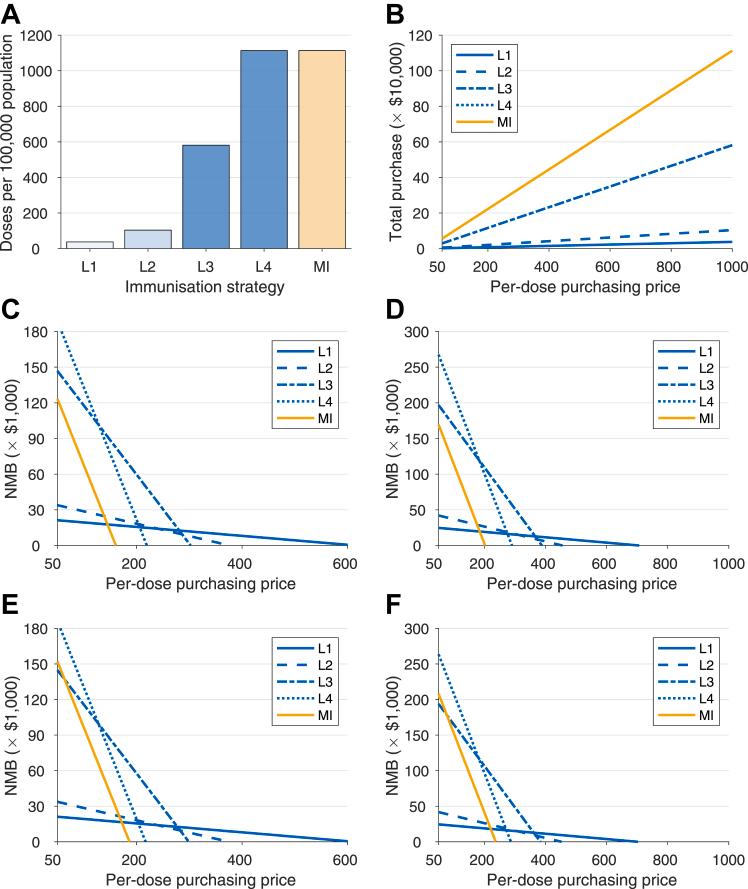
Using a willingness-to-pay of CAD$50,000 per QALY gained, we found that immunising the entire birth cohort with nirsevimab would be cost-effective from a societal perspective for a PPD of up to $290, with an annual budget impact of $83,978 for 1113 infants per 100,000 population. An alternative, combined strategy of vaccinating pregnant women and immunising only infants at high risk of severe disease would lead to a lower budget impact of $49,473 per 100,000 population with a PPD of $290 and $195 for nirsevimab and RSVpreF vaccine, respectively. This combined strategy would reduce infant mortality by 76%-85%, comparable to a 78% reduction achieved through a nirsevimab-only program of the entire birth cohort. The PPD for cost-effective programs with nirsevimab was sensitive to the target population among infants.
INTERPRETATION
Passive immunisation of infants under 6 months of age with nirsevimab and vaccination of pregnant women with RSVpreF could be a cost-effective strategy for protecting infants during their first RSV season.
FUNDING
This study was supported by the Canadian Immunisation Research Network (CIRN) and the Canadian Institutes of Health Research (CIHR). Seyed M. Moghadas acknowledges support from the Natural Sciences and Engineering Research Council of Canada (MfPH and Discovery grants). Alison P. Galvani acknowledges support from the The Notsew Orm Sands Foundation.
背景
长效单克隆抗体(尼塞韦单抗)和/或基于蛋白质的母体疫苗(RSVpreF)用于保护婴儿免受呼吸道合胞病毒(RSV)相关疾病影响的免疫策略在加拿大的成本效益此前尚未确定。我们估计了尼塞韦单抗对整个出生队列进行免疫接种的健康益处和成本效益,无论其胎龄或其他风险因素如何。此外,我们评估了一种联合策略的健康益处和成本效益,该策略包括在RSV季节对孕妇进行全年RSVpreF疫苗接种,并对高危婴儿(包括早产或患有慢性病的婴儿)使用尼塞韦单抗进行免疫接种。
方法
我们开发了一个离散事件模拟模型,使用2010年至2019年一岁以下婴儿因RSV感染就医的数据(包括门诊护理、住院和死亡)进行参数化。针对12个月度出生队列和孕妇的干预方案,反映了加拿大安大略省2021年人口普查数据,在出生后一年的随访时间范围内进行评估。考虑到与RSV相关结果相关的成本(以2023年加拿大元计),我们使用获得的质量调整生命年(QALY)计算净货币效益。此外,我们确定了尼塞韦单抗和RSVpreF每剂价格(PPD)的范围,在此范围内该项目具有成本效益。从医疗保健和社会角度进行了成本效益分析。
结果
使用每获得一个QALY支付意愿为50000加元,我们发现从社会角度来看,对整个出生队列使用尼塞韦单抗进行免疫接种,每剂价格高达290加元时具有成本效益,每100000人口中1113名婴儿的年度预算影响为83978加元。另一种联合策略是对孕妇进行疫苗接种,仅对重症高危婴儿进行免疫接种,每100000人口的预算影响较低,为49473加元,尼塞韦单抗和RSVpreF疫苗的每剂价格分别为290加元和195加元。这种联合策略将使婴儿死亡率降低76%-85%,与仅对整个出生队列使用尼塞韦单抗的方案所实现的78%的降低率相当。含尼塞韦单抗的成本效益方案的每剂价格对婴儿中的目标人群敏感。
解读
对6个月以下婴儿进行尼塞韦单抗被动免疫以及对孕妇进行RSVpreF疫苗接种可能是在婴儿首个RSV季节保护他们的一种具有成本效益的策略。
资金
本研究由加拿大免疫研究网络(CIRN)和加拿大卫生研究院(CIHR)资助。赛义德·M·莫加达斯感谢加拿大自然科学与工程研究理事会(MfPH和发现基金)的支持。艾莉森·P·加尔瓦尼感谢诺特索·奥姆·桑兹基金会的支持。


 Zotero 插件