
犬类衰老项目组中25种最常见犬种的主人报告的医疗状况的终生患病率。
Lifetime prevalence of owner-reported medical conditions in the 25 most common dog breeds in the Dog Aging Project pack.
作者信息
Forsyth Kiersten K, McCoy Brianah M, Schmid Sarah M, Promislow Daniel E L, Snyder-Mackler Noah, Creevy Kate E
机构信息
Department of Veterinary Clinical Sciences, College of Veterinary Medicine, Purdue University, West Lafayette, IN, United States.
School of Life Sciences, Arizona State University, Tempe, AZ, United States.
出版信息
Front Vet Sci. 2023 Nov 3;10:1140417. doi: 10.3389/fvets.2023.1140417. eCollection 2023.
INTRODUCTION
Large scale data on the prevalence of diverse medical conditions among dog breeds in the United States are sparse. This cross-sectional study sought to estimate the lifetime prevalence of medical conditions among US dogs and to determine whether purebred dogs have higher lifetime prevalence of specific medical conditions compared to mixed-breed dogs.
METHODS
Using owner-reported survey data collected through the Dog Aging Project (DAP) Health and Life Experience Survey for 27,541 companion dogs, we identified the 10 most commonly reported medical conditions in each of the 25 most common dog breeds within the DAP cohort. Lifetime prevalence estimates of these medical conditions were compared between mixed-breed and purebred populations. The frequency of dogs for whom no medical conditions were reported was also assessed within each breed and the overall mixed-breed and purebred populations.
RESULTS
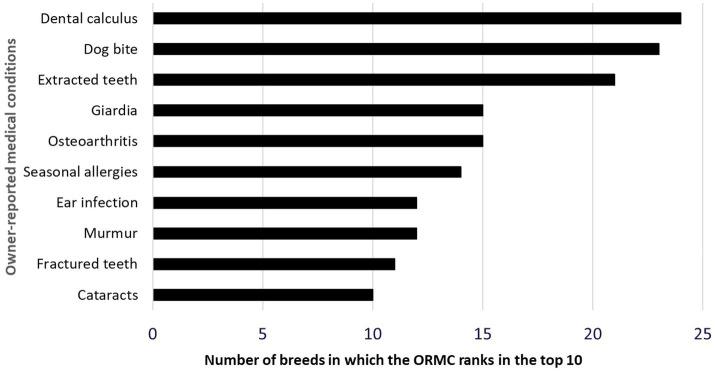
A total of 53 medical conditions comprised the top 10 conditions for the 25 most popular breeds. The number of dogs for whom no medical conditions were reported was significantly different (p = 0.002) between purebred (22.3%) and mixed-breed dogs (20.7%). The medical conditions most frequently reported within the top 10 conditions across breeds were dental calculus (in 24 out of 25 breeds), dog bite (23/25), extracted teeth (21/25), osteoarthritis (15/25), and Giardia (15/25).
DISCUSSION
Purebred dogs in the DAP did not show higher lifetime prevalence of medical conditions compared to mixed-breed dogs, and a higher proportion of purebred dogs than mixed-breed dogs had no owner-reported medical conditions. Individual breeds may still show higher lifetime prevalence for specific conditions.
引言
关于美国犬种中各种疾病患病率的大规模数据稀少。这项横断面研究旨在估计美国犬类疾病的终生患病率,并确定纯种犬与混种犬相比,特定疾病的终生患病率是否更高。
方法
利用通过犬类衰老项目(DAP)健康与生活经历调查收集的27541只伴侣犬的主人报告的调查数据,我们确定了DAP队列中25种最常见犬种中每种犬最常报告的10种疾病。比较了混种犬和纯种犬群体中这些疾病的终生患病率估计值。还评估了每个犬种以及整个混种犬和纯种犬群体中未报告任何疾病的犬只频率。
结果
共有53种疾病构成了25种最受欢迎犬种的前10种疾病。纯种犬(22.3%)和混种犬(20.7%)中未报告任何疾病的犬只数量存在显著差异(p = 0.002)。各犬种前10种疾病中最常报告的疾病是牙结石(25种犬种中有24种)、犬咬伤(23/25)、拔牙(21/25)、骨关节炎(15/25)和贾第虫病(15/25)。
讨论
与混种犬相比,DAP中的纯种犬并未表现出更高的疾病终生患病率,且纯种犬中未被主人报告有疾病的比例高于混种犬。个别犬种可能仍表现出特定疾病的更高终生患病率。

 Zotero 插件