
同一枚硬币的两面:常染色体显性遗传性肾小管间质性肾病的复杂表现:文献综述与病例报告
Two sides of the same coin: a complex presentation of autosomal dominant tubulointerstitial kidney diseases: a literature review and case reports.
作者信息
Fistrek Prlic Margareta, Huljev Frkovic Sanda, Beck Bodo, Tonkovic Durisevic Ivana, Bulimbasic Stela, Coric Marijana, Lamot Lovro, Ivandic Ema, Vukovic Brinar Ivana
机构信息
Department of Nephrology, Arterial Hypertension, Dialysis and Transplantation, University Hospital Center Zagreb, Zagreb, Croatia.
Department of Pediatrics, Division of Genetics and Metabolism, University Hospital Center Zagreb, Zagreb, Croatia.
出版信息
Front Pediatr. 2023 Nov 10;11:1283325. doi: 10.3389/fped.2023.1283325. eCollection 2023.
INTRODUCTION
Genetic kidney diseases are underdiagnosed; namely, from 7% to 40% of patients suffering from chronic kidney disease (CKD) can carry a pathogenic variant, depending on population characteristics. Hereditary tubulointerstitial kidney diseases, including autosomal dominant tubulointerstitial kidney diseases (ADTKD), are even more challenging to diagnose. ADTKD is a rare form of genetic kidney disease resulting from pathogenic variants in the and genes. There is no typical clinical or histopathological sign of ADTKD, it is characterized by progressive CKD, an autosomal dominant inheritance pattern, and tubular atrophy with interstitial fibrosis on kidney biopsy. There is no significant proteinuria, and the urinary sediment is bland. The patients usually do not have severe arterial hypertension. There can be a history of early gout, especially when compared to the UMOD gene variants. Children can have enuresis due to a loss of renal concentration. On ultrasound, the kidneys can appear normal or small in size. Renal cysts are not pathognomonic for any of the named diseases. End-stage renal disease (ESRD) develops at the average age of 45, but this can be very variable. Family history that suggests autosomal dominant inheritance and CKD fulfilling the aforementioned characteristics of tubulointerstitial kidney disease should raise suspicion of ADTKD. In the setting of a negative family history for CKD, clinical suspicion should be raised based on clinical characteristics, including early onset of hyperuricemia or gout and compatible histology on the kidney biopsy. Contrary to the aforementioned characteristics of ADTKD, in the case of HNF1B-related disease, there is a more complex clinical presentation with extrarenal manifestations of the disease (diabetes mellitus, hypomagnesemia, neurologic and psychiatric disturbances, etc.). The diagnosis of ADTKD is based on a positive family history and a detection of the pathogenic variant in one of the genes in an affected individual.
AIM
The aim of our study is to present two case reports of ADTKD with different characteristics (slowly progressive CKD vs. complex clinical presentation with an extrarenal manifestation of the disease) with a literature review.
METHODS
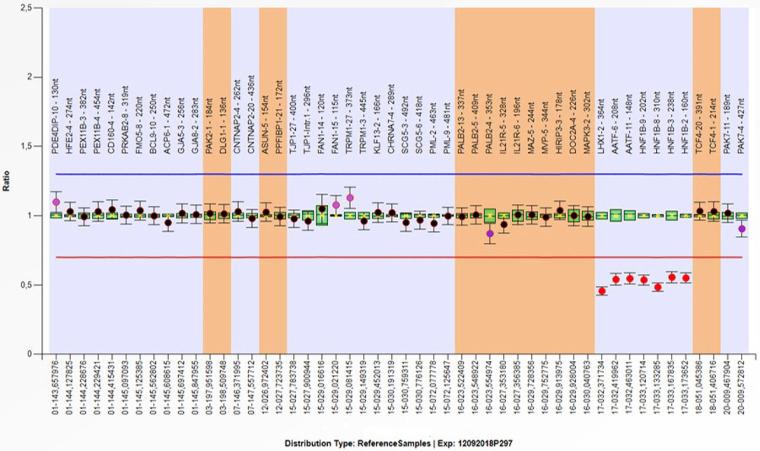
A 34-year-old patient with CKD and a positive family history of CKD in whom kidney biopsy showed nonspecific chronic changes, with only genetic analysis confirming the diagnosis of MUC1-related ADTKD. Our second case is of a 17-year-old patient with an unremarkable family history who was initially referred to genetic counseling due to cognitive and motor impairment with long-lasting epilepsy. Extensive workup revealed increased serum creatinine levels with no proteinuria and bland urinary sediment, along with hypomagnesemia. His genetic analysis revealed 17q12 deletion syndrome, causing the loss of one copy of the gene, the and the gene.
CONCLUSION
Autosomal dominant tubulointerstitial kidney diseases are challenging to diagnose due to a lack of typical clinical or histopathological signs as well as an uncharacteristic and versatile clinical presentation. Increased clinical awareness is crucial for the detection of these diseases.
引言
遗传性肾脏疾病的诊断率较低;也就是说,根据人群特征,7%至40%的慢性肾脏病(CKD)患者可能携带致病变异。遗传性肾小管间质性肾病,包括常染色体显性遗传性肾小管间质性肾病(ADTKD),诊断起来更具挑战性。ADTKD是一种罕见的遗传性肾脏疾病,由 和 基因的致病变异引起。ADTKD没有典型的临床或组织病理学特征,其特点是CKD呈进行性发展、常染色体显性遗传模式,肾活检显示肾小管萎缩伴间质纤维化。蛋白尿不明显,尿沉渣正常。患者通常没有严重的动脉高血压。可能有早期痛风病史,尤其是与UMOD基因变异相比。儿童可能因肾浓缩功能丧失而出现遗尿。超声检查时,肾脏可能大小正常或偏小。肾囊肿对上述任何一种疾病都没有诊断特异性。终末期肾病(ESRD)的平均发病年龄为45岁,但这可能有很大差异。提示常染色体显性遗传且CKD符合上述肾小管间质性肾病特征的家族史应引起对ADTKD的怀疑。在CKD家族史阴性的情况下,应根据临床特征,包括高尿酸血症或痛风的早发以及肾活检中相符的组织学表现,提高临床怀疑。与ADTKD的上述特征相反,在HNF1B相关疾病的情况下,临床表现更为复杂,伴有肾外表现(糖尿病、低镁血症、神经和精神障碍等)。ADTKD的诊断基于阳性家族史以及在受影响个体中检测到其中一个基因的致病变异。
目的
我们研究的目的是通过文献综述呈现两例具有不同特征(缓慢进展性CKD与伴有疾病肾外表现的复杂临床表现)的ADTKD病例报告。
方法
一名34岁的CKD患者,有CKD阳性家族史,肾活检显示非特异性慢性改变,仅通过基因分析确诊为MUC1相关的ADTKD。我们的第二例是一名17岁患者,家族史无异常,最初因认知和运动障碍以及长期癫痫被转诊至遗传咨询门诊。全面检查发现血清肌酐水平升高,无蛋白尿且尿沉渣正常,同时伴有低镁血症。他的基因分析显示17q12缺失综合征,导致 基因、 和 基因的一个拷贝丢失。
结论
由于缺乏典型的临床或组织病理学特征以及不典型且多样的临床表现,常染色体显性遗传性肾小管间质性肾病的诊断具有挑战性。提高临床认识对这些疾病的检测至关重要。


 Zotero 插件